
In the 2008 fantasy/romance drama film, “The Curious Case of Benjamin Button,” Brad Pitt’s character ages in reverse.
And while that is, of course, biologically impossible, Jessica Pegula seems to be doing it in real time in the real world of professional tennis.
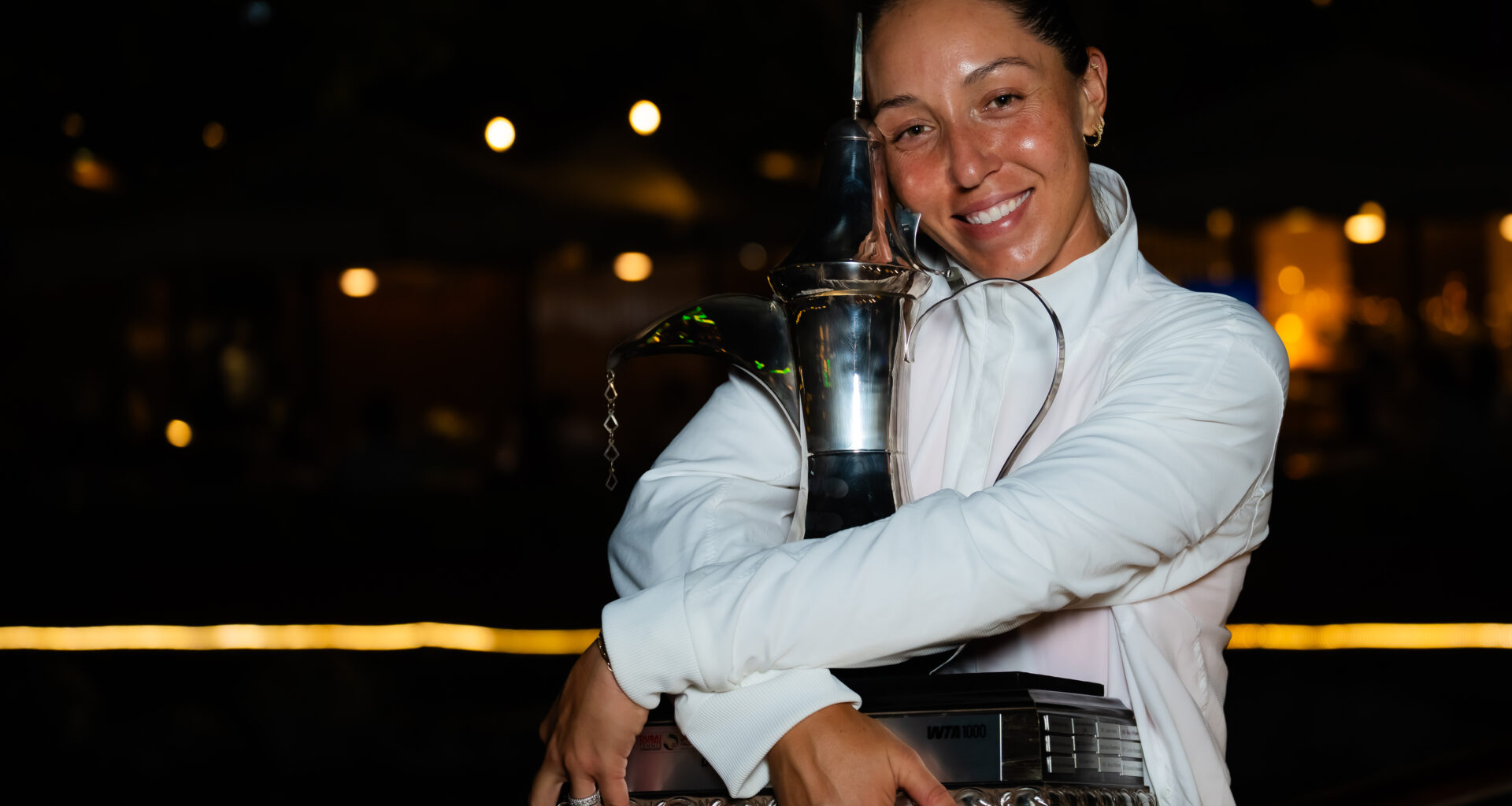
On Saturday, on the cusp of 32, Pegula was the winner of the Dubai Duty Free Tennis Championships after a surgically precise 6-2, 6-4 victory over Elina Svitolina.
Pegula didn’t finish in the WTA Tour Driven by Mercedes-Benz year-end Top 10 until 2022, at the age of 28. Now she’s done it four years in a row and is seriously contemplating the possibility of a fifth.
“Honestly, every year I surprise myself,” Pegula told Cole Bambini of wtatennis.com. “Because tennis is really hard. It’s so week-to-week. And you have to be able to go through each week as a new week and not have a lot of highs and a lot of lows.
“i think I’m really, really good at that. My personality, I’ve been able to find a really good niche of how to carry myself throughout the weeks, not to take losses too deeply. And when I do well, I’m able to get right back to work and move on to the next thing. It’s something I’ve been able to figure out over the last couple of years.”
Pegula finished it with an ace in a tidy 73 minutes.
After she executed a happy hop, skip and a jump on the court, Pegula walked to her team’s box, where coach Mark Knowles sat, head down, texting madly. With all eyes in the stadium on her (with Knowles the lone exception), Pegula shrugged comically and waited. After a few moments, Knowles sheepishly looked up and moved to embrace her.
Everything — everything — she’s been working on seemed to work. Tennis Channel analyst Andrea Petkovic was impressed.
“That forehand down the line,” Petkovic said jokingly toward the end, “I hope she takes it out to dinner tonight. Maybe some wine and candles.”
Coming into the tournament, Pegula had a feeling she might go deep. Because of the awkward travel logistics of playing in Australia, wanting to go home to Florida afterward, and playing the Middle East events, Pegula opted to skip Doha after reaching the semifinals in Melbourne.
“I’m glad I gave myself some extra time to regroup, to reset after a really great Grand Slam,” Pegula said. “I had a semifinal result the year before, so I knew it was possible. Just really happy with the way I was able to flip the script this week. To be able to come here for just one tournament — that’s something I don’t usually do — it shows the confidence I have in my game.
“I kind of know what I need to do to win matches right now.”
This was Pegula’s fourth WTA 1000 title, following Guadalajara (2022), Montreal (2023) and Toronto (2024). In defeating Svitolina, Amanda Anisimova, Clara Tauson and Iva Jovic, Pegula beat four Top 20 players in a single event for only the second time.
Credit to Svitolina, who also happens to be 31 years old. Understandably, she looked tired after Friday’s three-hour semifinal win over Coco Gauff that ended past 11 p.m. Svitolina was playing her first WTA 1000 final in nearly eight years (Rome 2018), the longest such gap since the format was introduced in 2009.
In 1971, Clairol ran a memorable television commercial for a women’s hair-coloring product called “Loving Care.” The catch phrase: You’re not getting older, you’re getting better.
It was a clever piece of marketing, but it would be surprising if any of the consumers believed it.
Pegula is actually proving that adage to be true.
“I’m obsessed with becoming a better player,” Pegula said. “That’s something that’s kept me at the top of the game — that I always want to improve. I love to compete and I love to win tournaments, but at the end of the day what really motivates me is becoming a better player — every single day.
“I think with the depth we have in women’s tennis that is something that is key to be able to stay at the top. And I think I’ve really embraced that.”
Here’s more of Pegula’s interview:
All four of your WTA 1000 titles have come on hard courts. For the benefit of the casual tennis fan, why is your game so well-suited to hard courts?
I take the ball very early. Hard court, I like the footing on hard. I like that there’s no bad bounces, things that can go wrong. There’s a very true bounce so I can get into a good rhythm pretty easily. I hit pretty hard, deep and flat, so I think my ball kind of skids through the court. When I can find my rhythm on a hard court, that’s when I start playing my best tennis. I think tonight, even last night [against Anisimova] I found it at the end and was able to carry it into today. I was taking the ball early, hitting my forehand really well, taking away time and changing direction.
People always focus on “weapons” — the big serve, the big forehand. To your point, Andrea Petkovic said on the Tennis Channel broadcast that nobody disguises and changes the direction of the shot from both sides better than you … How has that skill evolved in recent years?
I think that’s something I’ve always been able to do really well. It’s funny, sometimes people ask me, ‘I don’t know how you hit the ball so hard but it looks like you’re just sitting there, chilling. All of a sudden it just springs off your racket.’ I think one of my traits that makes me a good player is I have good timing and really good hand-eye coordination.
Over the past six months, that’s something we’ve kind of embraced. It’s been like, `OK, this is how you play tennis. How do we make this even more efficient? How do we get your footwork to evolve into how good your hands are?’ So I’ve really worked on footwork, worked on spacing, worked on flowing through my shots a little bit.
It’s not the way everybody plays but I think it’s showcased what’s made me really efficient. So I give a lot of credit to my coaches. We kind of went back to the drawing board with that and really evolved it, kind of believed that this is how I have to play. Do that in practice and execute it into a match.
That’s one of my strengths is that I’m able to pick up things really, really fast. I’m not the fastest or the strongest or the tallest, but I think as an athlete my ability to adapt, to pick up on things very quickly, execute them in matches — I’m all for that. It’s about embracing the things that I do well as a tennis player.
What were some of the specific things you worked on in the offseason?
Actually, my preseason was terrible [laughing]. I got a couple of injuries and barely played. I didn’t even think I was going to be able to play Brisbane. But I was able to play Brisbane and make the semis, and obviously, went to AO and played great tennis. I think at the end of the year, after US Open and Asia, I kind of knew what I needed to do. Very beginning of offseason, we really emphasized it.
It was kind of interesting … we weren’t that concerned about the injuries and movement and stuff because we knew how I needed to play, what we were really going to hone in on and focus on. I think that relaxed me, even though I didn’t have a great preseason. I knew how I needed to play tennis and, luckily, I was able to find that in Australia. After the swing of the year, after [WTA] Finals, I was excited because I knew how I needed to play and I knew what I could still get better at. That was working at the end of the year, and I was able to build off that.
On the cusp of 32, is it possible that you’re playing the best tennis of your life?
[Laughing] I’m old, you can say it. I don’t feel that old because I had so many injuries in my early 20s that I don’t think I’ve built up the wear and tear on tour yearly. I was hurt a lot. I was able to mature and find my game and believe in what I needed to do through the ups and downs.
I hope I can inspire girls to show that you don’t have to be 20 years old. You can still play really good tennis if you take care of your body and keep improving. So, yeah, I’m really proud of myself that I can do that as a player at 32 now. I don’t think that’s necessarily the norm, but we saw that on the men’s tour and women, too. It’s a different age now. You don’t have to be 18 to do well. Playing someone like Elina, she’s doing the same thing. There’s a different crop of us that have done well at later stages, but you can always get better.
In your mind, what has to happen for you to take the final step and win a Grand Slam singles title?
I think matches like this week really help. Building confidence on how I need to play and things I still want to get better and improve. Just keep chipping away and building that. Maybe a little luck [laughing]. I think again, keeping that mindset every day in practice and the gym and at these tournaments, I’m hoping it’s going to get me there in the end.