
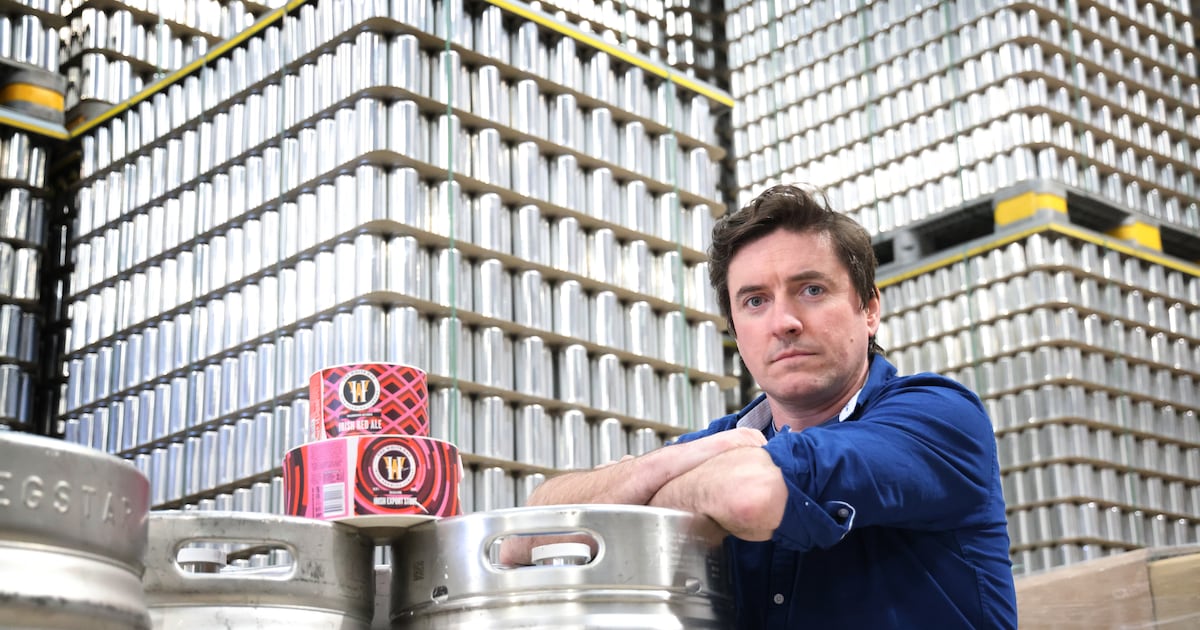
“They are sitting on a cash pile of unclaimed deposits and we are left out of pocket,” says Bob Coggins, who runs the White Hag Brewing Company in Ballymote, Co Sligo.
Two years into the Re-Turn Deposit Return Scheme (DRS), Coggins feels there are ongoing issues that need to be addressed.
“A bunch of smaller producers have gone to Re-Turn raising concerns about the sustainability of the workload – and the sustainability of foisting one-off costs on us. It is not fair or equitable for us to have to carry this,” he says.
For the past two years, Irish households have had to get used to the idea of retaining their empty receptacles – or face the prospect of losing money.
The DRS has upended the way we recycle. Each item purchased up to the capacity of 500ml comes with an additional charge of 15 cents – which is not returned until the bottle or can is inserted into one of more than 2,500 Re-Turn machines dotted around the country. Cans and bottles with a volume of more than 500ml come with a fee of 25 cents.
The impetus for the scheme was the Single Use Plastics directive.
EU-mandated targets mean that Ireland has to achieve a recycling figure of 90 per cent by the year 2029 – and the scheme has become the main element in attempting to do that. When it was launched, Ireland’s recycling rate for ‘on-the-go’ bottles was a meagre 23 per cent. With an estimated five million single-use bottles and cans consumed here every day, it is a big job.
The DRS has undoubtedly irked a lot of people, not least those who feel inconvenienced by the frequent trips to the bottle and can machine. People have also wondered what happens to all those deposits that aren’t claimed.
Advocates point to a significant increase in recycling as a result of the scheme’s introduction. They say it is helping to change attitudes to how we handle our waste.
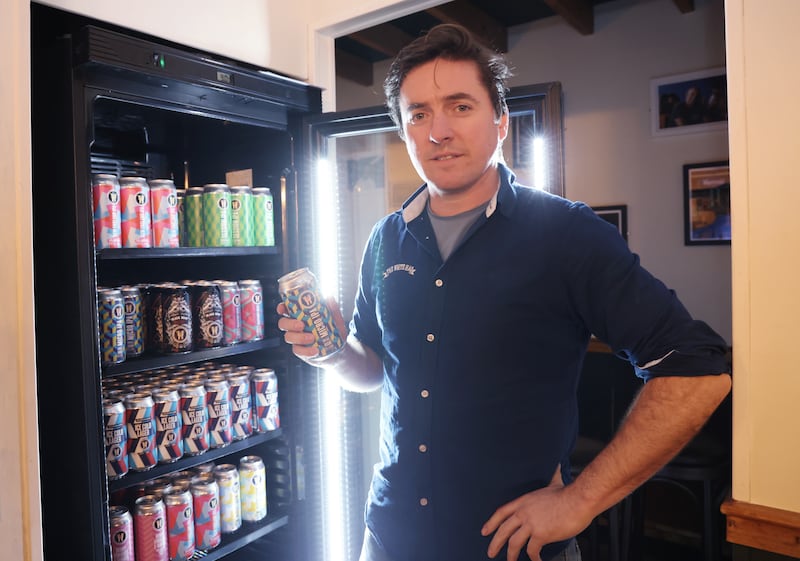 Bob Coggins of White Hag Brewery in Ballymote, Co Sligo. Photograph: Bryan O’Brien
Two years in, retailers, producers and consumers are now well acquainted with its workings, but that doesn’t mean it is operating smoothly from everyone’s point of view.
Coggins says many smaller Irish producers are still unhappy with some elements, citing ongoing administration costs. He says while retailers receive an allowance, producers like White Hag do not.
He says the early days proved particularly challenging: “We felt that the implementation was a bit rushed. There wasn’t due consideration given to all sides. The construct of the board heavily reflected large producers – and not small producers, of which there are far more, naturally.
“Even the idea of doing it in January to March – it should have happened over the summer, away from the peaks and troughs of Christmas and the new year.
“It caused us a massive challenge. We were left with stock that retailers didn’t want because it didn’t have the scheme logo.”
As a small drinks producer, White Hag faces different issues to those confronted by retailers. In the early days, many complained of machines not operating properly and of the time and cost involved in processing refunds.
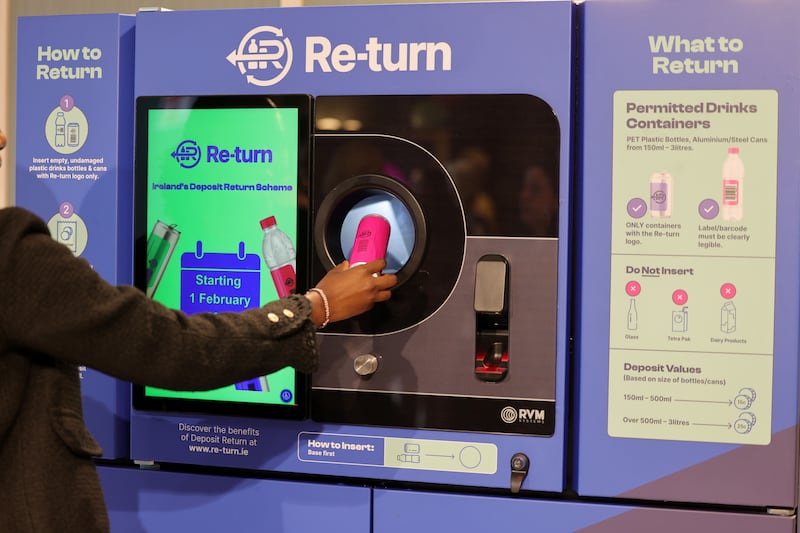 A shopper recycles a can at a Re-turn reverse vending machine. Photograph: Alan Betson
According to Chris Furey, who runs eight Eurospar supermarkets as part of the Furey Smyth Group, the scheme’s “teething issues” have been largely resolved.
“The technology is there for us – and the DRS machines are in direct communication with the checkouts. There is a barcode printed and it is all effortless. That was all geared up for the retailers,” Furey says.
Furey is effusive in praise for the scheme. He says his group is delighted to be playing its role in furthering awareness of the need to recycle, and growing the ‘circular economy’.
Jean McCabe of the representative body Retail Excellence says her feedback from retailers is broadly similar and that after the initial set-up problems it had been a “relatively positive” experience for most.
She noted that, while helping the environment, the scheme had also proven to be a good “footfall driver” for businesses.
Furey notes that schools, like one near the Eurospar in Hartstown, Co Dublin, have used the scheme to teach children how to recycle and also generate charitable revenue for the school itself. He says the DRS machine there is “one of the busiest in the world”.
But there are obvious downsides, too. There is a burgeoning scavenging operation, particularly in cities where consumers are less likely to carry their empty cans or bottles home.
A bin’s worth can prove relatively lucrative. Dublin City Council (DCC) chief executive Richard Shakespeare has said vulnerable people are emptying bins to cherry-pick these items and claim the deposits. The result is an additional clean-up cost for the council.
This became an issue in Dublin not long after the DRS was rolled out in 2024.
To deter people from rummaging in bins to retrieve bottles and cans, a semicircular “give, take, return” bottle and can holder was trialled across Dublin city centre. The holders were installed on 100 cast iron bins, allowing people to leave their empty bottles and cans in these receptacles, to be taken by others who want to retrieve cash vouchers at deposit return machines. The semicircular surrounds can hold up to 12 items.
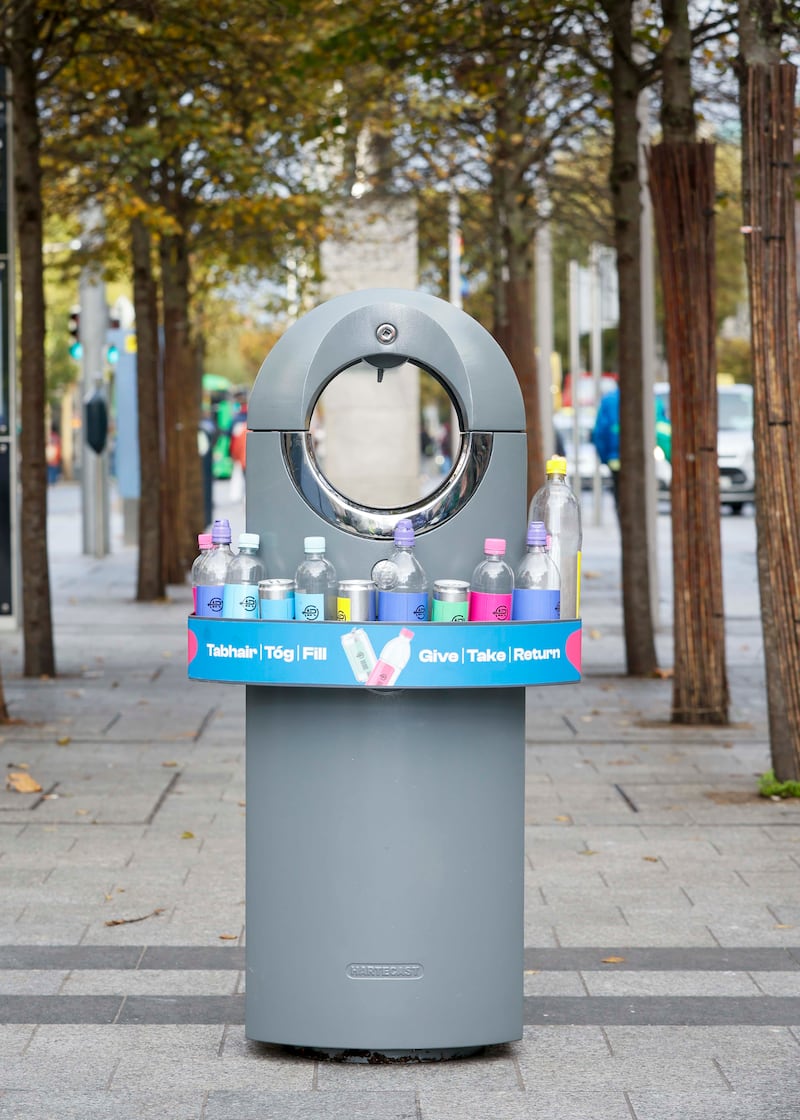 A bin with the ‘Give Take Return’ bottle and can bin surround. Photograph: Fennell Photography
A similar solution was identified for a number of the city centre ‘Big Belly’ solar compacting bins.
Additionally, the council banned the practice of city centre businesses leaving plastic bags on streets in late 2024 – something that was already an issue due to seagulls and foxes ripping them open and pulling out the contents.
A spokesperson for DCC said it engages “regularly” with Re-Turn with regard to the operation of the scheme and, while they have no plans to expand the number of deposit return holders, the matter will be kept under review.
But for city centre businesses, littering remains an issue. “There’s not enough of the bins,” says Alan Campbell, who runs The Bankers Bar on Trinity Street.
“It’s a sad and horrible look for the city. A lot of business owners face a huge mess outside their premises before they ever turn the key to open their doors for the day.”
Campbell says there is also a small minority of people who are taking bags out of wheelie bins and emptying them across the streets.
A Re-Turn spokesman said the company had not been “previously informed” of clean-up figures cited by the DCC chief executive in media interviews (in which he said it would cost between €500,000 and €1 million), but said it “would welcome the opportunity to better understand and discuss them”.
He said Re-Turn’s own research indicated that bottles and cans left on the new bin surrounds were being collected, on average, every 16 minutes – and that the scheme had contributed to independent figures showing a 60 per cent reduction in bottle and can litter across the State.
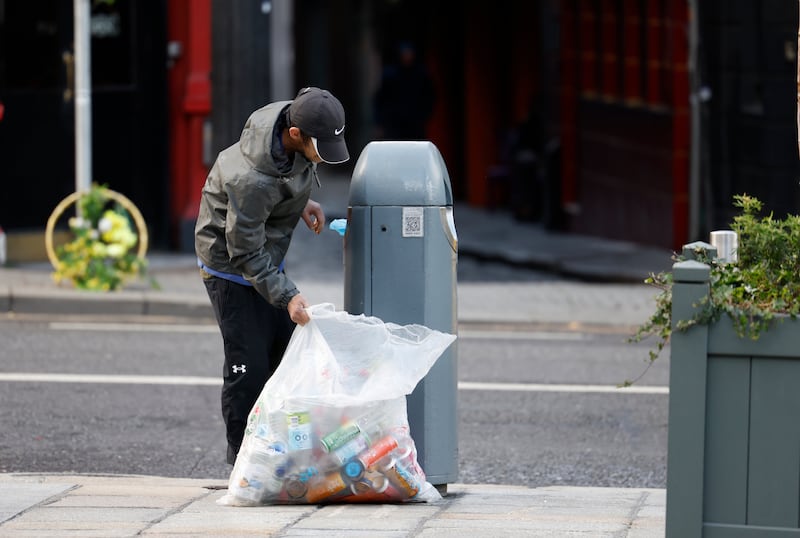 A man collecting bottles and cans from a bin in Dame Street, Dublin. Photograph: Nick Bradshaw
The company maintains that the recycling rate for these items has increased from 49 per cent to more than 90 per cent since the scheme began.
The issue of retained deposits – and the cash pile – is continually referenced by critics of the scheme. According to its most recent figures, Re-Turn held €66.7 million in unredeemed deposits in 2024.
The Department of Climate, Energy and the Environment holds quarterly meetings with Re-Turn where it discusses the latest finances and future strategy.
Last month the Minister of State at the Department of Enterprise, Alan Dillon, said the company had informed the department in December of a further accrual of €55.1 million in unredeemed deposits. On the face of it, this would bring the running amount to well over €120 million in its first two years of operation.
The Minister noted, however, that the updated figure was for the first nine months of 2025 and still subject to final audit. It also excludes VAT at 23 per cent.
The value of unredeemed deposits is usually mentioned in conjunction with the fact that directors’ fees at the company totalled €600,000 in 2024. Re-Turn has not broken out the salary for chief executive Ciarán Foley.
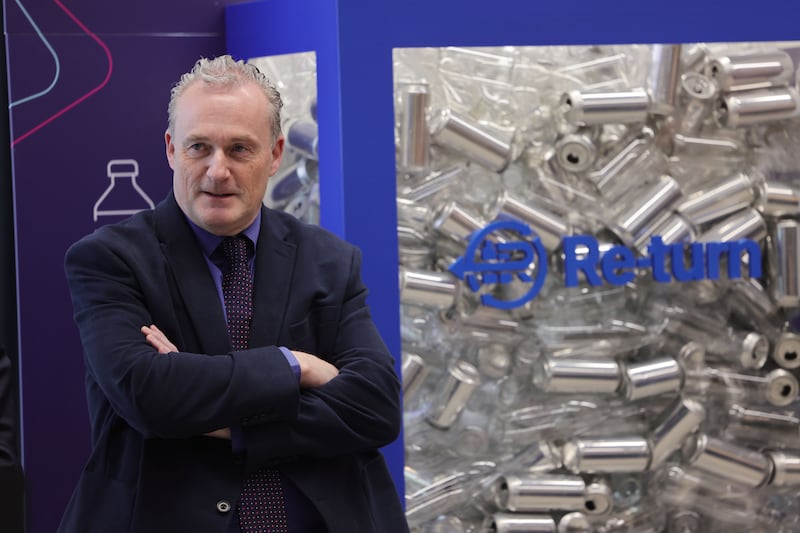 Ciaran Foley, Re-Turn CEO, at the unveiling of Ireland’s Deposit Return Scheme run by Re-Turn. Photograph: Alan Betson/The Irish Times
It says that, as a not-for-profit company, all money is reinvested in the running of the scheme and in ‘circular economy’ projects. As more people use the scheme, the spokesman said, the number of retained deposits will fall.
On director pay, the company told The Irish Times: “Re-Turn’s board, including an independent chair, plays a vital role in the oversight, governance, and strategic direction of the organisation. These fees reflect the responsibilities and time commitment involved, and are reviewed by the board’s governance and remuneration committee. All appointments and remuneration policies are guided by best practice in corporate governance and are subject to oversight under the terms of Re-Turn’s licence.”
[ Pollution and littering putting pressure on shorelinesOpens in new window ]
Re-Turn says it is open to engagement with all stakeholders, in the interest of making the scheme work to its full potential.
According to Dillon, department officials monitor the performance of the scheme closely and meet Re-Turn every month to review progress.
Chris Furey believes Ireland’s experience with the scheme will be used as a guide by other countries that are preparing to roll out their own.
To hit its recycling target, Spain is set to introduce a deposit return system in November this year. It will come with a €0.10 charge on each item.
In the UK, a scheme is scheduled to come online in October 2027. An impact assessment for England and Northern Ireland estimates that annual running costs of £1 billion will be offset by annual benefits of £1.6 billion.
“From a retail point of view, Ireland is held up as the best in the world,” says Furey. “I think as a country we should be very proud.”
On the other side of the debate, Coggins says the fact that Ireland moved ahead with the scheme when much of Europe lagged behind created an additional headache for small Irish exporters.
“We see beers being imported from the UK into Ireland and it is not equitable,” he says. “You are competing with cans that can’t be recycled in the DRS. At the same time, we are also sending beer into France where there is a different system.”
Coggins says he has detected a change in attitude over the past couple of months and Re-Turn “have been more willing to engage and listen to us”.
“We are members of Bord Bia and are completely committed to sustainability,” says Coggins.
“We don’t produce glass any more – only recyclable aluminium – and we use only returnable steel kegs. This isn’t new to us – it is not something we are trying to avoid.
“It is an inevitability that we all have to recycle as much as possible. But it has to be done sustainably – not just for the environment – but to be able to run a profitable business.”