
The Yakima Valley hasn’t experienced four consecutive years of drought since record-keeping began in the late 19th century. That could change this year, as the window closes for snowpack to build across the Cascades.
Snow cover and snow depth have been at their lowest levels in decades across the Western U.S., raising concerns about water shortages and wildfires this summer. While some officials remain hopeful for snow in the late winter and early spring, others are sounding the alarm about the drought already.
Based on historical records, the snowpack is unlikely to be made up in the coming months, Deputy Washington State Climatologist Karin Bumbaco told reporters during a news conference on the snowpack drought on Feb. 12.
“If the Upper Yakima was to receive normal snow every day, it would only receive 50% snowpack by April,” Bumbaco said.
Snowpack is the third-lowest on record in Washington, after the drought years of 2005 and 2015, Bumbaco said. December precipitation was high, coming as a heavy rain that flooded many parts of the state.
The situation puts more attention on the Yakima Basin Integrated Plan, a long-term framework for water management in Kittitas, Yakima and Benton counties. It involves collaborative work by federal, state and local officials, along with the Yakama Nation, irrigation districts and conservation groups.
A number of multimillion-dollar projects are underway to prepare for a new future with less water.
The drought
This winter’s forecasted La Niña conditions, which often translate to snow, have been weak. The first four months of the water year, which begins in October, were the warmest on record, Bumbaco said.
The signs also point to a longer fire season, she said.
“Once it dries out, we have a bigger window of opportunity for fires to start,” she said. “It’s not great news for fires later in the summer.”

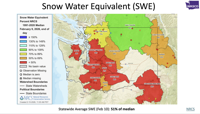
The Upper Yakima subbasin was only at 36% of median snowpack on Feb. 9, according to a graph by the Office of the State Climatologist.
Office of the State Climatologist
The five reservoirs that make up the Bureau of Reclamation’s Yakima Project quickly filled with the high December rainfall. But the amount of snowpack and the timing of snow melt are key factors to a drought. The reservoirs hold around 1 million acre-feet, but there are 2.4 million acre-feet in allotted water rights.
“It’s getting real. There’s no way around it, it’s not good,” said Scott Revell, Roza Irrigation District manager. He is communicating with growers about the prospects of another drought year, which may mean more and longer system shutoffs.
It’s a problem that will only become more common moving forward. Climate models predict that by 2050, snowpack drought will occur in Washington 40% of the time.
Chad Stuart, Yakima Field Office manager of the Bureau of Reclamation, speaks at a Yakima Basin Integrated Plan meeting Wednesday, Dec. 10, 2025, in Yakima, Wash.
Evan Abell / Yakima Herald-Republic
A decades-long partnership in the basin has yielded projects that are expanding water storage capacities, conservation measures, habitat restoration and fish passage, all in anticipation of a water-scarce future. It’s all tied together in
“The benefit that theto the 30-year integrated water management plan.
plan has for farms and fish is tremendous and it is recognized as such. The model for partnering together is also recognized,” said Chad Stuart, Yakima Field Office manager of the Bureau of Reclamation.
Where are we?
Progress takes time.
“Much like building a cathedral, this is a decadal project,” said Larry Mattson, Office of the Columbia River director.
Talks of an integrated plan began in 2008, when members of the Roza Irrigation District and the Yakama Nation came together to come up with an alternative to a large-scale proposed reservoir project, and set aside decades of legal conflict.
Projects in the Yakima Basin are organized around seven elements: fish passage, structural and operational changes, surface water storage, groundwater storage, watershed protection, water conservation and water market reallocation. The effort is the third phase of the Yakima River Basin Watershed Enhancement Program, which Congress created in 1979.
Many projects affiliated with the integrated plan have already been completed.
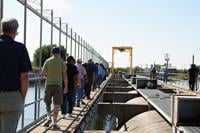
Members of the Yakima Basin Joint Board tour walk along the fish screen at Wapato Diversion Dam on June 26, 2025.
Questen Inghram / Yakima Herald-Republic
That includes miles of canals being lined or converted into pipe to conserve water and hundreds of acres of habitat and floodplain being restored. Growers have taken water conservation measures upon themselves, such as expanding drip irrigation and building their own storage ponds.
Basin-wide conservation efforts have achieved over 70% of the required 85,000 acre-feet in conserved water, according to a 2025 water report from Ecology.
“The past few years, we’ve seen some tremendous effort in conservation work, which is providing tens of thousands of acre-feet for fish flows in the Yakima basin, which has been critical in times of drought,” Stuart said.
What’s next
There’s more to come. Major projects underway include:
•Cle Elum pool raise (near completion): The Cle Elum project will raise Lake Cle Elum by 3 feet, translating to 14,600 acre-feet of additional water storage for irrigators, municipalities and fish.
“We’re down to the final five yards, to use a football metaphor,” Mattson said.
Shoreline work is scheduled to be completed this summer, Stuart said. It could be ready for 2027, if flowage easements are secured with some final property owners.
•Cle Elum fish passage (near completion): The juvenile fish passage helix has been through pilot tests and Yakama Nation’s adult salmon trapping facility is nearing completion. It will help to open up miles of fish habitat that was previously made inaccessible with the construction of the Cle Elum Dam in 1933.
It will be operational this spring, Stuart said.
•Bateman Island Causeway removal (near completion): A project to remove a land bridge to an island at the confluence of the Yakima and Columbia rivers near Richland is nearly complete. The causeway stagnated water, caused smolt die-off and partly blocked fish migration for 85 years. The Army Corps of Engineers is leading the project, in collaboration with the Yakama Nation and the Mid-Columbia Fisheries Enhancement Group.
“It is huge,” said Danielle Squeochs, hydrogeologist for Yakama Nation Fisheries. “We’re referring to it as the reconnection of the Yakima River.”
•Kachess Drought Relief Pumping Plant (proposed): If completed, it could fulfill the rest of the 200,000 acre-feet of storage that has been required by the Legislature. A floating pump station would make more water in Lake Kachess accessible for use. The proposal has faced opposition from property owners near the lake.
Revell said there haven’t been any recent developments on this proposed project, but the irrigation district is pushing for it.
“Our ability to work on it during drought is limited,” Revell said.
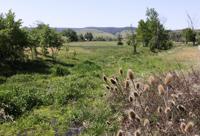
Springwood Ranch Friday, May 2, 2025, in Thorp, Wash.
Evan Abell / Yakima Herald-Republic
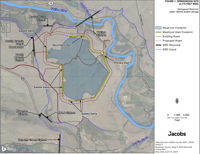
One plan for a new reservoir at Springwood Ranch is depicted near Thorp, Wash.
•Prosser Diversion Dam upgrades (early development): Reclamation and the Yakama Nation are looking at ways to upgrade fish passage at the Prosser Diversion Dam to reduce fish mortality.
•Roza Dam fish screen replacement (nearly complete): Reclamation is almost finished installing fish screens that would more effectively save fish at the intake of the Roza irrigation system.
•Springwood Reservoir (early development): A proposal to create a new reservoir near Thorp is being studied.
The Kittitas Reclamation District, Yakama Nation and the state Department of Fish and Wildlife created a unique partnership to acquire the Springwood Ranch.
Reclamation is leading the feasibility study and modeling efforts, which are expected to finish in 2027, Stuart said.
The study is looking at an off-channel reservoir that could store between 20,000 and 100,000 acre-feet of water. It also is looking at adding a hydroelectrical component to the reservoir, capable of generating 10 megawatts of power.
• Wapato Dam replacement (early development): The Bureau of Indian Affairs’ Wapato Dam, which supplies water to the Wapato Irrigation Project, may soon be replaced. The dam is aging and has a high fish mortality rate. Two design options are currently being studied as replacements.
• Nelson Project (phase two underway): One of the first major projects of the water plan was the removal of the Nelson dam near Naches in 2023, which was replaced with a less invasive diversion to improve flooding protection and fish passage.
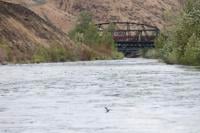
The Naches River flows toward the Yakima River Wednesday, May 22, 2024, in Yakima, Wash.
Evan Abell / Yakima Herald-Republic
The first half of the second phase of the project is nearly complete, said Jeff Bond, City of Yakima Water Treatment Plant manager. That involves installing new irrigation pipelines.
• Aquifer projects: Two types of groundwater-related projects, known as managed aquifer recharge and aquifer storage and recovery, have also been implemented or proposed basin-wide.
An aquifer storage and recovery project within the Roza Irrigation District holds particular promise, with a pilot test well going through the permitting process right now.
“I’m optimistic for it. If that test well pans out, then you’ve got the canal infrastructure running through there. We could augment and expand and scale up that system with minimal capital investment, if it proves feasible,” Mattson said.
This year is a “very big year” for fish passage projects, Squeochs said. Between the removal of the Bateman Island Causeway and juvenile fish passage at Cle Elum, fish should have an easier time migrating this year.
“We’re really excited to see the fish get out and hopefully come back home,” she said.
The path ahead
Integrated water plan projects continue to receive federal and state support, despite widespread belt-tightening in government budgets.
Recent allocations include $2.5 million for the Cle Elum Fish Passage project and $330,000 for the Kachess project for 2026, Reclamation spokesperson Erika Lopez said in an email.
The economic consequences of drought are high in the Yakima basin.
The total estimated cost for the 30-year plan as a whole is around $4 billion, Mattson said. It’s received just over $1 billion so far. That’s compared to the $4.5 billion annual value of the agricultural production in the Valley.
The stakes for drought are high.
A drought that results in 70% of normal water supply could impact up to 6,000 jobs and result in up to $424 million in direct losses, according to a state Department of Agriculture study. In a year with 50% water supply, direct losses could reach $668 million with 10,309 jobs lost. The total economic impact could be $1.1 billion.
This past year, non-senior water rights holders in the Yakima basin received 40% of their estimated allotment.
Revell, of the Roza district, is communicating with growers about the drought. He’s also talking to lawmakers about the effect and why solutions are needed.
“I often tell legislators, ‘If you have beer or wine in your fridge, they’re probably made with Roza hops or Roza grapes,'” Revell said.
***
This is the fifth part of a series, “Water pressure: How irrigators and communities are preparing for drought in the Yakima Basin.”
Read part 1: Yakima Basin water leaders emphasize cooperation amid unprecedented shutoff
Read part 2: Yakima Basin restoration projects helped reduce flood damage this month
Read part 3: Water banks allow development to occur in water-short Yakima basin
Read part 4: Groundwater is declining rapidly in the Yakima Basin. Some projects aim to help
Have a question or story about drought and water in the Yakima River Basin? Contact Questen Inghram at qinghram@yakimaherald.com or 509-577-7674.