
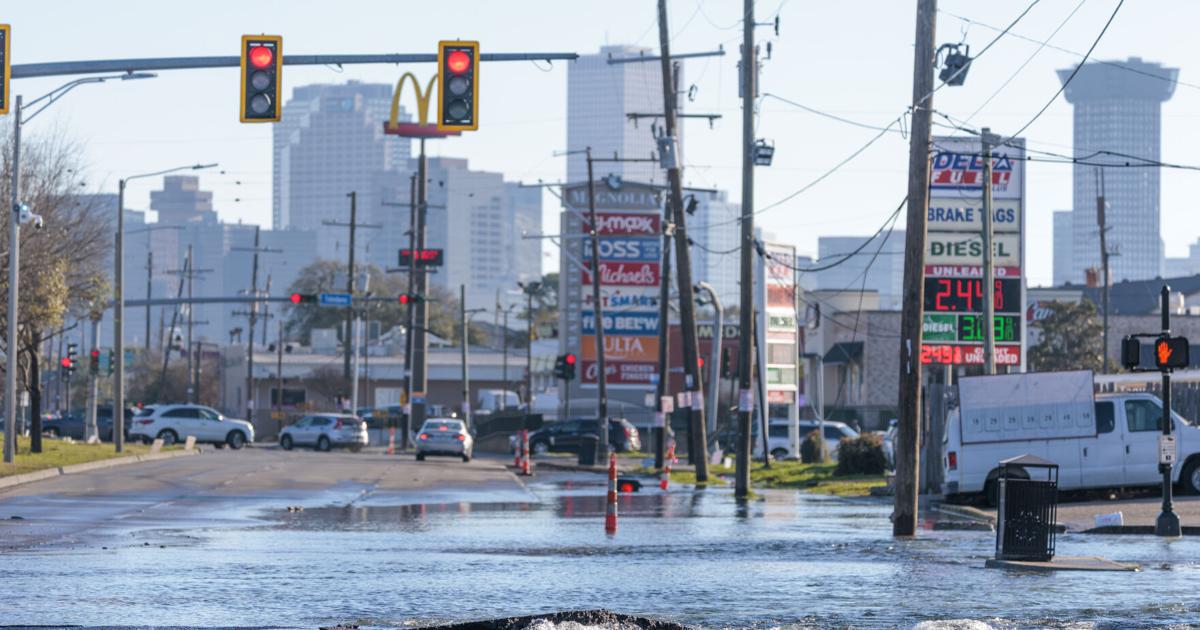
An extensive break in an underground pipe early Monday along South Claiborne Avenue flooded streets, knocked out water service and forced schools and businesses to close as officials advised thousands of residents from the French Quarter to Mid-City to boil their water.
It wasn’t clear as of Monday afternoon what caused the 88-year-old water main near the intersection of Claiborne Avenue and Amelia Street to burst and break apart the roadway, surging water for several blocks along the busy commercial thoroughfare. It was the second major water main break to cause street flooding and a boil-water advisory in less than a month.
Crews managed to stop the flow of water from the main by 8:20 a.m. As the water cleared, significant cracks and sections of lifted asphalt were visible. Muddy residue covered sidewalks and driveways for several blocks.
Sewerage and Water Board Executive Director Randy Hayman said some roadwork was underway on Sunday night, but he did not know if that contributed to the rupture. He said the S&WB was not involved with the roadwork.
Hayman said he didn’t know exactly how long it would take to repair the pipe and the roadway, but it could be a relatively quick fix if contractors don’t run into unforeseen problems.
“It’s conjecture until they have a chance to see it and evaluate it. But I’m hoping that we’re able to do all this in a week – hoping,” Hayman said.
The break appeared to be just upriver of a $26 million water main replacement project along the 2600 through 3300 blocks of South Claiborne Avenue, which snarled traffic for years before the S&WB completed it last spring.
Several schools and daycares in the area were delaying classes or closing campuses because of the break. Most businesses between Louisiana Avenue and Napoleon Avenue were closed on Monday morning, including fast food restaurants, retail stores and a car wash.
Low water pressure forced the S&WB to issue a boil water advisory for the Central Business District, the French Quarter, and most Uptown neighborhoods stretching from Leonidas, Gert Town and B.W. Cooper to the Irish Channel, West and East Riverside and the Audubon area.
Water samples were being tested for bacteria, with results expected on Tuesday. The S&WB will lift the advisory once the water is deemed safe for use.
Officials said residents in the affected areas should use bottled or boiled tap water for drinking, cooking, cleaning food or brushing their teeth until the advisory is lifted. Residents with compromised immune systems should also use safe water to wash hands, shower or bathe.
At least some businesses and homes lacked running water altogether. Employees at several businesses, including those that closed, said they showed up to work on Monday morning to find water out of service.
Terrell Huntington, who was walking along South Claiborne Avenue, said the friend’s house he was staying at nearby also had no water that morning.
“I’m hitting the faucet and nothing’s coming up,” Huntington said.
It was not clear how many customers lacked running water.
Many schools across Uptown also closed for the day, forcing school buses full of students to turn around before dropping the students off. The McGehee School notified parents its bathrooms lacked sufficient water pressure to operate, forcing the Prytania Street school to close because of risks to hygiene and fire suppression posing hygiene and fire suppression risks.
“I share in your frustration about today’s closure and the underlying infrastructure challenges, and thank you for your understanding as we work to assess and open school as soon as safely possible,” Interim Head of School Hannah Dietsch said in a note to McGehee parents.
Albert Mims and Antoinette Harris Mims, who own a home in nearby Central City, said water has been springing up onto Claiborne Avenue near the intersection with Amelia Street for months. The couple said they reported it to the S&WB by calling the phone number on their bill about a month ago, but nothing was done and the problem only seemed to get worse.
“It started off as a wet area, and then it got it just got worse,” Albert Mims said. “The streets started getting slippery, and nobody cared.”
Hayman said many of the city’s water pipes are near or past 100 years old, which is generally considered the end of their life span.
“We have an old system, and we’re not unique. That’s across the country, that there’s an old system. But there is a need for us to make sure that we have the capacity to make repairs,” Hayman said.
There are about 1,500 miles of water mains in New Orleans, and about one-third of that system is 100 years old or older, the former S&WB executive director, Ghassan Korban, said in a November 2024 interview.