
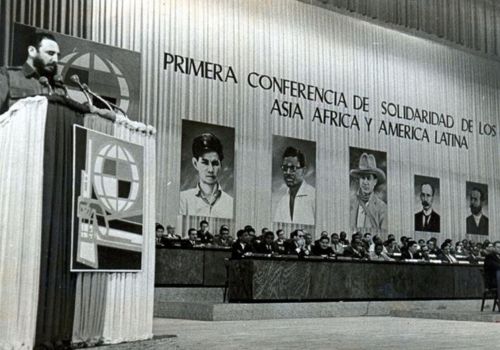
In January 1966, as the world marked the seventh anniversary of the Cuban Revolution, Havana became the epicentre of a seismic shift in the global struggle against imperialism. The First Solidarity Conference of the Peoples for Africa, Asia, and Latin America, known to history as the Tricontinental Conference, was not merely another meeting; it was a declaration of war against the remaining colonial order.
Mehdi Ben Barka, the Moroccan revolutionary and President of the Conference’s International Preparatory Committee, just weeks before his assassination and the start of the gathering, keenly observed its historic meaning, explicitly highlighting that the meeting would bring together ‘two great contemporary currents of the World Revolution’: the current of the socialist revolution that started in the 1917 October Revolution of the Soviet Union and the ‘parallel current of the revolution for national liberation’. For the peoples of Africa – still living under the terrors of Portuguese colonialism, apartheid, and the machinations of neocolonialism – Havana represented a new dawn of coordinated struggle, bringing together this historic composition.
In the latest publication out of 1804 Books, we bring you never-before-seen records of the proceedings and participants of the event in Tricontinental: Havana 1966: Speeches and Documents of the First Solidarity Conference of the Peoples for Africa, Asia, and Latin America (February 2026). These records allow us to move beyond commemoration and into analysis of how African liberation movements forged strategic thinking on sovereignty, class struggle, and internationalism that continues to resonate today.
Colonialism and Neocolonialism: A Critical Juncture
To understand the significance of this gathering, one must first grasp the historical juncture. The Bandung Conference of 1955 had planted the seeds of political independence on the continent, but by 1966, the situation had radically evolved. The Congo crisis had demonstrated the brutal reality of imperialist intervention following the assassination of Patrice Lumumba. In Southern and West Africa, the fascist triumvirate – of Salazar in Guinea-Bissau, Cabo Verde, Angola, Mozambique, Smith in Rhodesia, and Verwoerd in South Africa – were consolidating a racist, military-economic bloc to stem the tide of African liberation. Simultaneously, the US imperialist aggression in Vietnam served as a stark reminder that the enemy was global and interconnected. It was in this context that the Tricontinental Conference expanded the anti-imperialist front, bringing the revolutionary struggles of Latin America into a formal alliance with those of Africa and Asia.
Collectively, they took stock of the contemporary character of imperialism and its specific manifestations, first elaborated in speeches from movement leaders and then followed by resolutions from the Economic, Organisation, Political, and Social and Cultural Commissions and various Sub-Commissions (e.g. on Vietnam). Moving from the abstract to the concrete, these were then elaborated in specific resolutions dealing with the particular character of international organisations (such as rejection of the Organisation of American States), national questions, burning issues, and sectoral issues, etc.
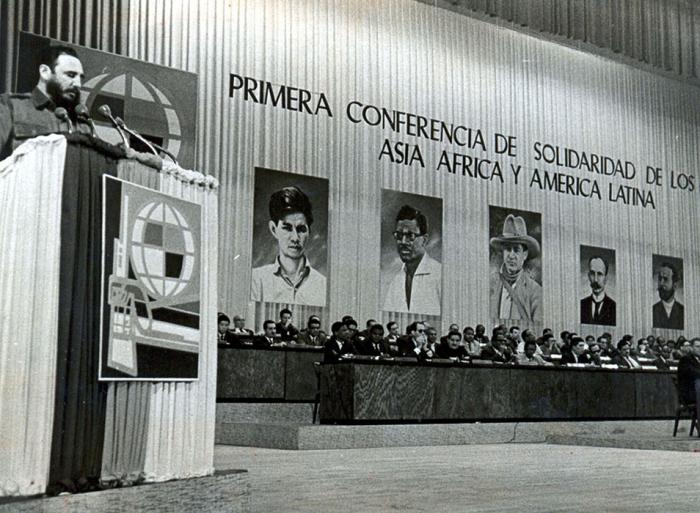
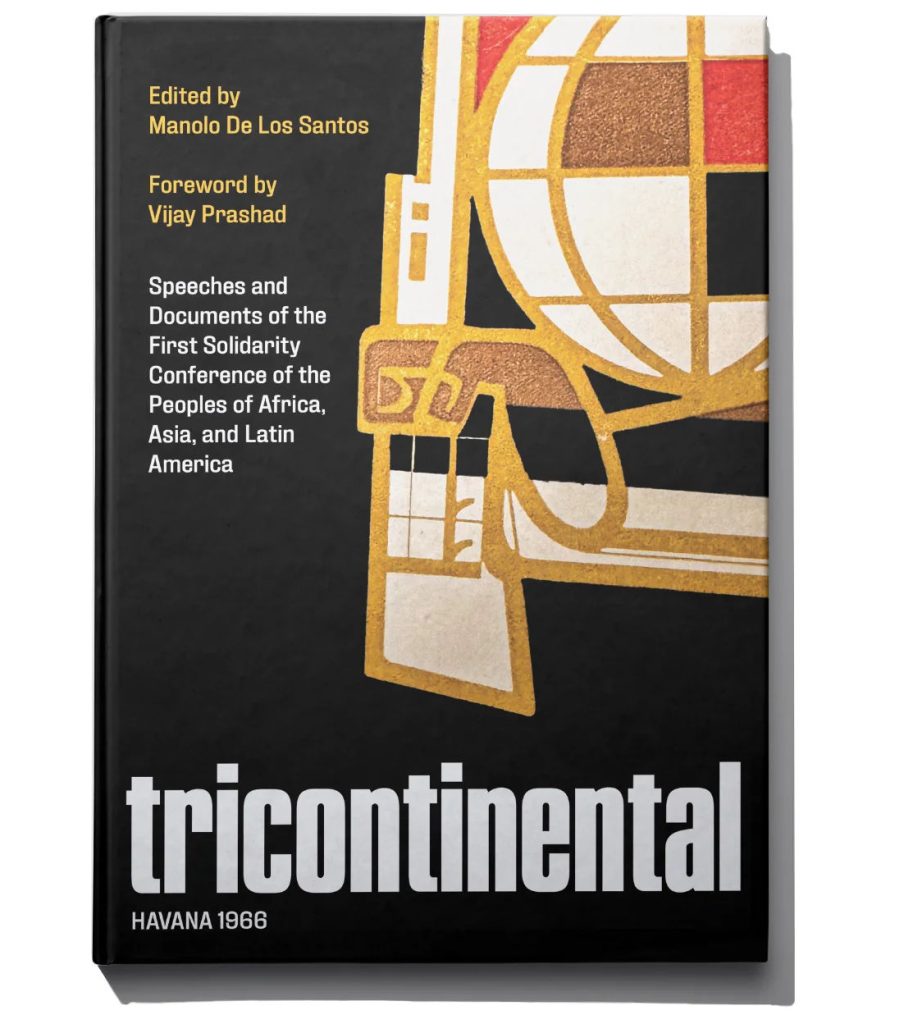
Fidel Castro addresses delegates attending the Havana Conference, January 1966. Source: Granma International.
In the ‘General Resolution of the Political Commission on Colonialism and Neocolonialism’ – included in our new book – the conference resolved that:
Our time is characterised by great revolutionary progresses. The process of creation of a new world, more perfect, more harmonious, and more just is taking place in front of us. We are living in the times of the collapse of the colonial system of imperialism, in the times of the awakening and of the renaissance of the countries of Asia, Africa, and Latin America. Imperialism, at the breakdown of its colonial system, resorts to new methods in order to maintain, under its control, countries close to independence and to reduce to a mere formal political independence those nations that have already obtained independence by breaking their colonial chains. Thus, neocolonialism has been added to the old colonialist policy, already in agony.
After exploring the general features of that stage of imperialism, the resolution – like many of the other elucidations that followed – soberly elaborated on the new US-led dominant forces and the mechanisms deployed to maintain neocolonial structures in recent decades. For example, on the question of the post-war international financial order, the same resolution delved into the role of international financial institutions and their interests:
…the International Monetary Fund, the International Bank for Reconstruction and Development, the Inter-American Development Bank, and others [are] at the service of the expansion policy of imperialism, and in particular North American imperialism, because the United States controls these institutions. As a matter of fact, the United States alone has 25 percent of the votes in the IMF, 34 percent in the IBRD, and 41 percent in the IDB. Having this control, the United States uses these institutions for its imperialist ends, with this double advantage: it has at its disposal, in addition to its own funds, those of the underdeveloped countries who are members of those institutions, and it does not appear as directly imposing burdensome political and economic conditions on these nations.
An example of this utilisation are the loans granted by the World Bank since its foundation in 1946 to 1959 to eleven African countries, for a total of 627,500,000 dollars. How was this apparently impressive total allocated?
One third of the loans went to the Union of South Africa for the construction and modernising of communications, so as to facilitate the export to the United States of uranium and other strategic materials; for payment of the electric power installations, turbogenerators and other equipment for the uranium mines and other mines in that country. And it so happens that North American monopolies have special ‘interest’ in South African mines, not to mention that these loans were a means of strengthening the fascist and bestially racist government which has been imposed on the Black people, which form an overwhelming majority of the population.
… Numerous similar examples can be cited throughout Africa. In contrast, not a single loan has been granted for a project signifying a basic construction for the industrial development of the African countries, such as that of the Aswan Dam, or, if granted, have been subject to burdensome terms.
Following the identification of the ‘criminal practices of economic and military blockades directed against the movement of national liberation’, this resolution put forward the Conference’s programmatic ‘support of all measures directed against the neocolonialist policy’ that continued to subordinate the political sovereignty of the former colonies and resistance movements.
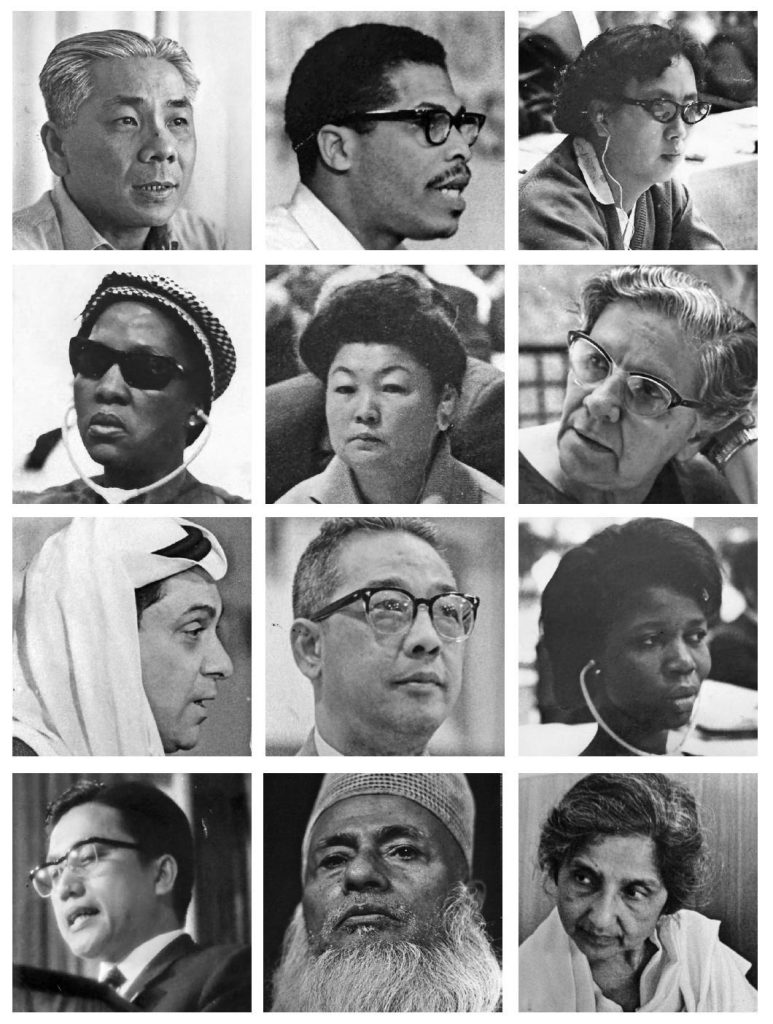
Left to Right: Nguyen Van Thien (South Vietnam), Paul Lantimo (Haiti), Chieh Shuu Chang (China), Florence Mophosho (South Africa), Bijamal Ramazanova (USSR), Luisa Gonzalez (Costa Rica), Amad Jamaluddin Abdulla (Arab Peninsula), Lee Siew Shoh (Malaysia), Pauline Miranda Clerk (Ghana), Kim Riong Gu (DPRK), Abdul Hamid Khan Bashani (Pakistan), Aruna Asaf Ali (India). Source: Archives of Granma and Bohemian.
The Theoretical Arsenal of Liberation
Cuba, having smashed the dogma of geographic fatalism by making a socialist revolution just ninety miles from the US, was the logical host. Yet, for the African delegations present, the conference was a critical space for profound strategic reflection for the next phase of the liberation struggle.
Among the most powerful voices was that of Amílcar Cabral, Secretary General of the African Party for the Independence of Guinea and Cape Verde (PAIGC). Cabral’s speech stands as a masterclass in revolutionary theory. He moved beyond simple condemnations of imperialism to dissect the internal contradictions of the liberation movements themselves. He famously argued that ‘the ideological deficiency, not to say the total lack of ideology, within the national liberation movements constitutes one of the greatest weaknesses of our struggle against imperialism.’ In a direct challenge to the delegates, he articulated the harsh class reality facing the petty-bourgeois leadership of many movements, stating that to truly serve the revolution, they must be ‘capable of committing suicide as a class in order to be reborn as revolutionary workers, completely identified with the deepest aspirations of the people to which they belong.’
This was not abstract philosophy; it was a practical guide for the armed struggles unfolding in the forests of Guinea, the highlands of Angola, and the scrublands of Mozambique. Cabral’s intervention ensured that the conference understood that national liberation was not just about raising a flag, but about freeing the process of development of the national productive forces, which necessarily implied a socialist path. ‘In our present historical situation,’ he asserted, ‘there are only two possible paths for an independent nation: to return to imperialist domination (neocolonialism, capitalism, state capitalism), or to take the way of socialism.’
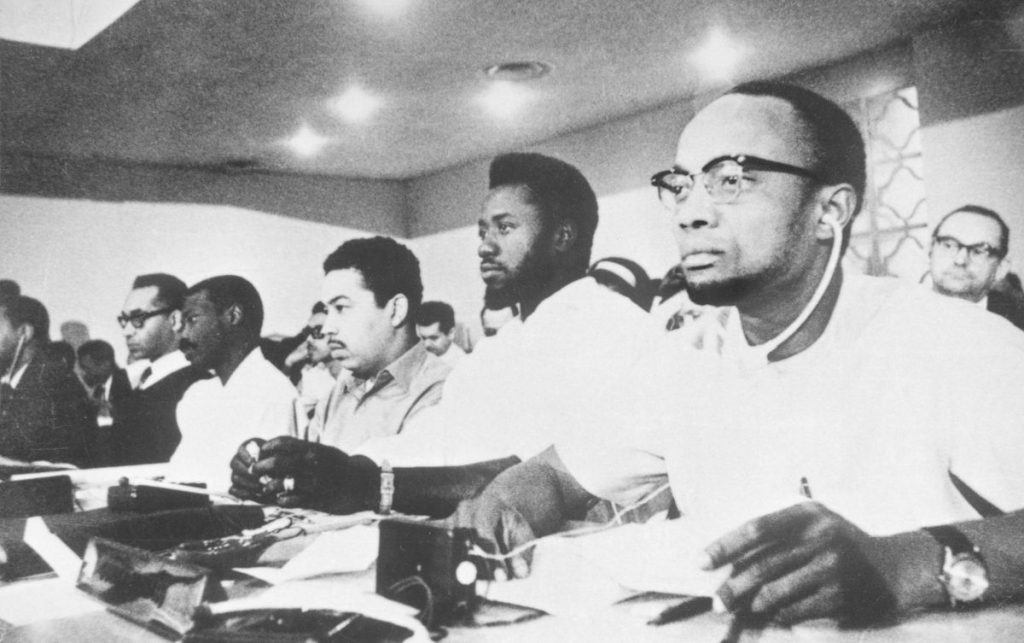
Amílcar Cabral and the PAIGC delegation at the Tricontinental Conference, January 1966. Source: Granma International.
Voices of the Battlefield
The conference floor resonated with the voices of those in the trenches, representing a politically dense spectrum of forces rather than a purely diplomatic presence. These included armed liberation movements such as the PAIGC led by Cabral, Mozambique Liberation Front (FRELIMO) — represented by figures such as Marcelino dos Santos and Josina Muthemba Machel — alongside the Popular Movement for the Liberation of Angola (MPLA), the African National Congress (ANC) — including leaders such as Yusuf Dadoo — the South West Africa National Union (SWANU), and the Zimbabwe African People’s Union (ZAPU); banned or suppressed nationalist currents such as Sawaba from Niger represented by Abdoulaye Mamani; labour internationalism through figures like John Kofi Barku Tettegah of the All-African Trade Union Federation; and international mass organisations such as the Women’s International Democratic Federation, represented by South Africa’s Florence Mophosho. Several delegates would later shape postcolonial state trajectories — Pedro Pires became President of Cabo Verde — while others, including Cabral and Muthemba Machel, were martyred in the course of the liberation struggle.
M. Gabriel Yumbu of the National Liberation Council of the Congo laid bare the economic roots of imperialist interest, detailing the ‘geological scandal’ of the Congo’s wealth, from uranium to cobalt, and how it was plundered by US and Belgian monopolies. He exposed the farce of neocolonial independence, where the words ‘parliament,’ ‘government,’ and ‘army’ had lost all meaning under the puppet regime in Léopoldville.
Robert Resha of the African National Congress (ANC) brought the horrors of apartheid to the podium. He painted a statistical picture of the brutality: 87% of the land reserved for the white minority; a per capita income ratio of 425 pounds for whites versus 39 for Africans; the systematic imprisonment of a people. Resha declared that with the Sharpeville massacre and the subsequent crackdown, a new phase had begun – the phase of Umkhonto we Sizwe (‘Spear of the Nation’). He assured the gathered revolutionaries that despite the imprisonment of leaders like Nelson Mandela, the people were prepared for the ‘bloody and difficult days that lie ahead.’
John K. Tettegah of Ghana, speaking on behalf of Kwame Nkrumah, linked the fate of Africa to the unity of the three continents. He condemned the imperialist manipulation of the UN and the cowardice of the British Labour government in Rhodesia, calling for material and moral support to the freedom fighters until final victory.
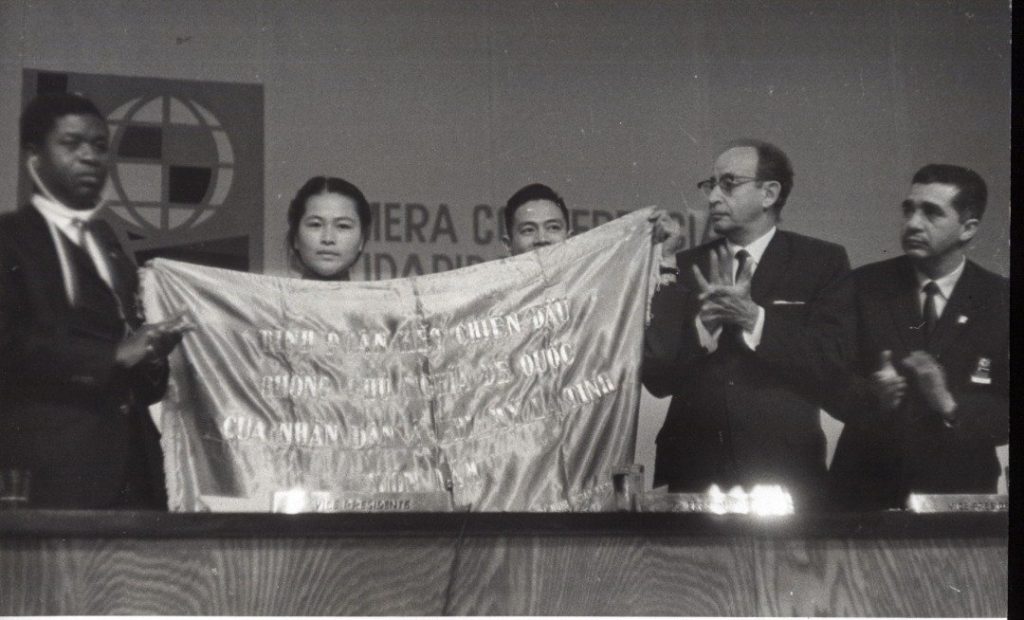
Vietnamese delegation being honoured during the Tricontinental Conference, January 1966. Source: OSPAAAL Archive.
The Cuban Internationalists
What transformed the conference from a forum of solidarity into an engine of liberation was the concrete commitment of revolutionary Cuba. In his closing address, Fidel Castro did not mince words. He directly addressed the fear of US retaliation, a fear used to paralyze movements. Using the slanderous campaigns against Che Guevara as a backdrop, Fidel redefined the battlefield. ‘Our country is a small country,’ he admitted, ‘our territory may even be partially occupied by the enemy, but that would never mean the cessation of our resistance… for Cuban revolutionaries, the battlefield against imperialism encompasses the entire world!’
This was not rhetoric. It was the state policy of a young but fearless revolution. Fidel declared that the world revolutionary movement could count on Cuban combatants ‘in any corner of the Earth.’ This commitment shattered the isolation of the African liberation movements. The conference led directly to the creation of the Organisation of Solidarity with the Peoples of Africa, Asia, and Latin America (OSPAAAL), with its headquarters in Havana. This institution became the logistical and political hub for supporting the final offensive to get rid of colonialism on the continent.
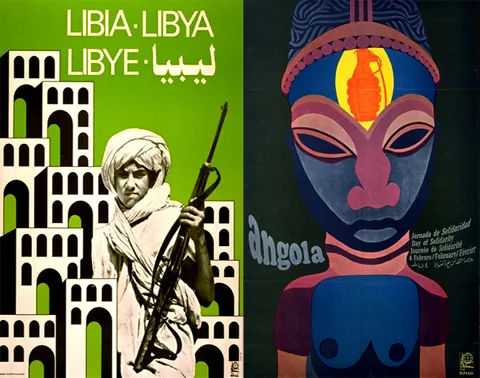
OSPAAAL solidarity posters used to mobilise global support for the liberation struggles in Libya and Angola. Source: OSPAAAL Archive.
The impact was immediate and historic as material aid expanded massively. The training provided by the Cuban Revolution to the cadres of the MPLA, FRELIMO, PAIGC, and ANC was not merely military; Cuban teachers, doctors, artists and engineers would crisscross the continent sharing with fighters and people alike. The ultimate vindication of this solidarity came years later, most decisively at the Battle of Cuito Cuanavale in 1987–88, where the combined forces of Cuba, Angola, and SWAPO shattered the myth of the invincible South African apartheid army, leading directly to the independence of Namibia and the definitive weakening of the apartheid regime.
The Tricontinental Conference of 1966 provided the strategic clarity and organisational framework for the final assault on colonialism in Africa. As Fidel stated in his closing remarks, the murder of Mehdi Ben Barka, like the assassination of Lumumba, would not stop the victorious march of the people toward freedom. Havana proved that a small island could serve as a powerful rear guard for the liberation of a continent. The history of African liberation cannot be written without acknowledging the pivotal role of that January in Havana.
Warmly,
Manolo De Los Santos

Manolo is the Executive Director of The People’s Forum and researcher at Tricontinental: Institute for Social Research. He co-edited, most recently, Viviremos: Venezuela vs Hybrid War (LeftWord, 2020) and is the editor of Tricontinental: Havana 1966– Documents of the First Solidarity Conference of the Peoples of Africa, Asia, and Latin America (1804 Books, 2026).