
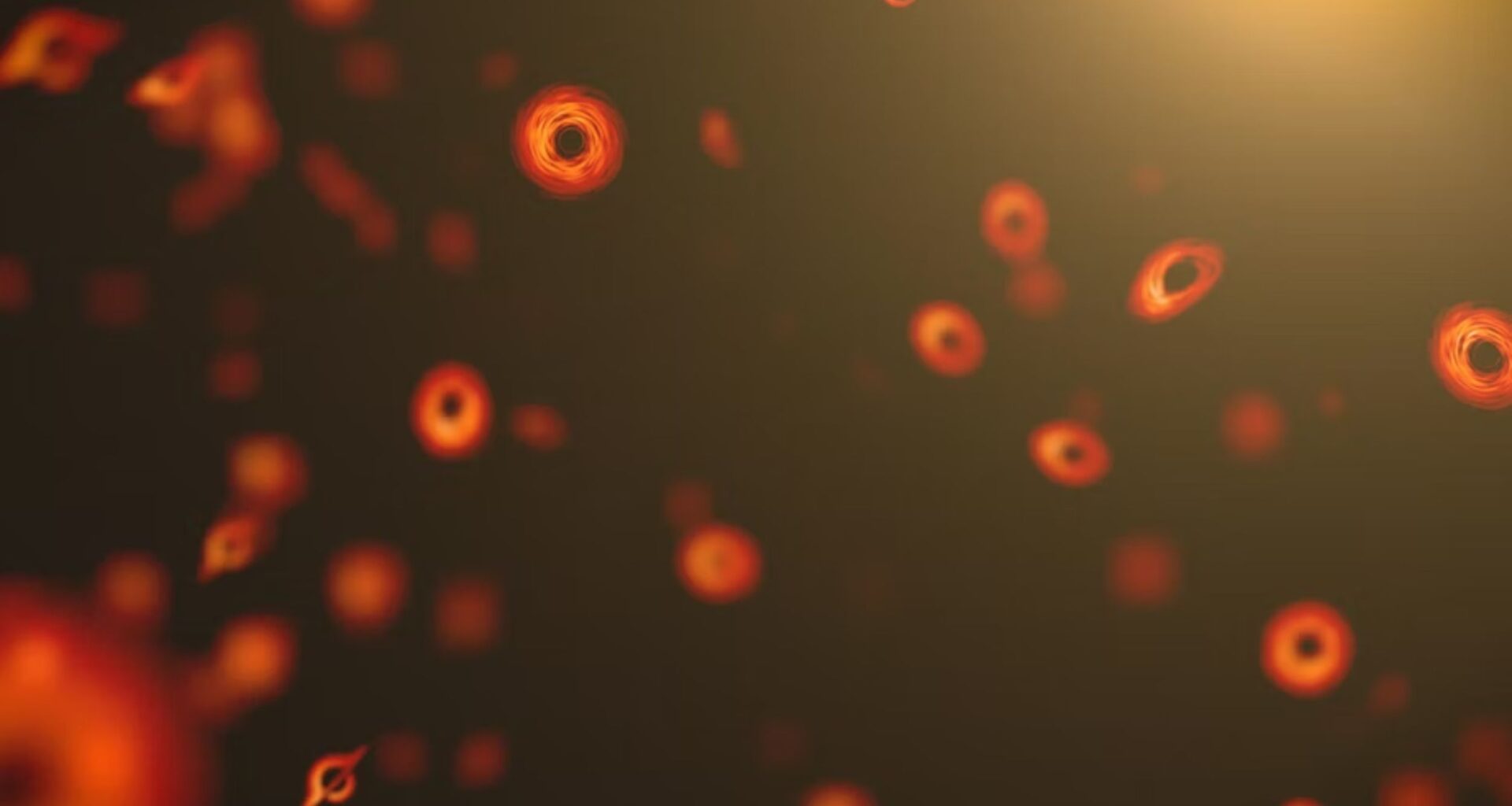
Physicists think they may have figured out where an extremely powerful, nearly undetectable particle that hit Earth came from, linking it to the final explosion of a very small black hole.
If they are right, that single event could offer new insight into what the universe created in its earliest moments after the Big Bang.
The signal itself

In 2023, the KM3NeT observatory logged a particle near 220 PeV, a unit equal to a quadrillion electron volts, beneath the Mediterranean.
To explain that spike, physicist Dr. Michael J. Baker linked the record particle to a vanishing black hole from the universe’s first moments.
At the University of Massachusetts Amherst (UMass Amherst) the new idea points to black holes that can stay quiet, then explode fast.
If that picture holds, the same idea must also fit other ghost particles that arrived with far less energy.
Why energy matters
The burst came from a neutrino, a nearly massless particle that almost never interacts with matter, and it carried more energy than any neutrino ever detected before.
Such extreme energy demands an accelerator far beyond any lab, because only huge gravity or violent shocks can push particles that hard.
Inside the Large Hadron Collider, the FASER experiment measured neutrinos in the trillion electron volt range, almost 100,000 times below this.
Few known cosmic objects can toss out neutrinos at that level, leaving room for explanations that start in the universe’s first seconds.
Catching ghost particles
Deep water gave KM3NeT a dark backdrop, so its sensors could spot the brief light made by a passing neutrino.
When a neutrino hit a water molecule, it kicked loose a charged particle that made Cherenkov radiation, blue light in clear water.
Along its path, that charged particle left a faint blue glow, letting scientists reconstruct the neutrino’s direction and energy.
Because neutrinos slip through almost everything, each detection depends on luck, and one event cannot map a whole population.
Small black holes
Some physicists have considered primordial black holes, black holes formed soon after the Big Bang, as leftover objects from the universe’s first seconds.
Unlike black holes born from dying stars, these could start tiny, and some masses would let them evaporate in today’s universe.
Placed in our galaxy, an exploding primordial black hole could spray out particles, including neutrinos energetic enough to reach detectors.
Yet no one has confirmed that such early black holes exist, so any single candidate must clear many cross-checks.
Hawking’s disappearing act
Back in the 1970s, physicists named Hawking radiation, particles emitted from a black hole’s edge, as one way black holes fade.
Calculations show that smaller black holes heat up as they lose mass, which speeds up that leak.
Near the end, the process runs away, and the final moments can look like an explosion that releases high-energy neutrinos.
A link between a neutrino burst and evaporation would give evidence for that effect outside math.
A charged twist
One move in their paper was giving those black holes a hidden charge that does not act like electricity.
With enough charge, a black hole became quasiextremal, almost fully charged and much cooler, so Hawking radiation slowed down.
Instead of normal electricity, the hidden charge stayed trapped for eons, because the black hole could not easily shed it.
Eventually the built-up field could trigger the Schwinger effect, pair creation in intense fields, dumping the charge and ending in a blast.
Reconciling two detectors
Years before KM3NeT’s detection, IceCube had already seen extremely high-energy neutrinos in the Antarctic ice, each carrying more than one quadrillion electron volts of energy, an amount far beyond what human-made particle accelerators can produce.
Because quasiextremal black holes stayed cool for most of their lives, they emitted fewer midrange neutrinos before their final burst.
That suppression let the UMass Amherst team fit both detectors at once, without demanding an impossible number of explosions.
Even so, the idea predicts bursts should be rare and close, which means future detections must line up in time and direction.
Gamma rays expected
High-energy explosions should also throw off gamma rays, the highest-energy form of light, alongside the neutrinos.
From China, the Large High Altitude Air Shower Observatory (LHAASO) scanned the sky hours before the event and detected no unusual flashes.
Under this charged black hole idea, the final release of energy would happen very quickly, so any burst of light would appear only minutes before the particle arrived.
If a future event produces a matching flash during that narrow window, it would support the theory, while another silent sky would make it harder to defend.
Dark matter stakes
Beyond the neutrino puzzle, the model aims at dark matter, unseen mass that holds galaxies together, by hiding it in black holes.
Spread through the Milky Way, that population would sit close enough for occasional bursts, while still hiding from most telescopes.
“Furthermore, these black holes could constitute all of the observed dark matter in the universe,” wrote Dr. Baker.
Plenty of measurements already limit how many primordial black holes can exist, so the allowed window is narrow.
What comes next
More detections from KM3NeT and IceCube could test whether rare, nearby bursts keep showing the same energy pattern.
Better timing between neutrino tracks and gamma-ray searches, in LHAASO data, will decide how far this black hole idea can go.
The study is published in Physical Review Letters.
Photo: NASA’s Goddard Space Flight Center
—–
Like what you read? Subscribe to our newsletter for engaging articles, exclusive content, and the latest updates.
Check us out on EarthSnap, a free app brought to you by Eric Ralls and Earth.com.
—–