
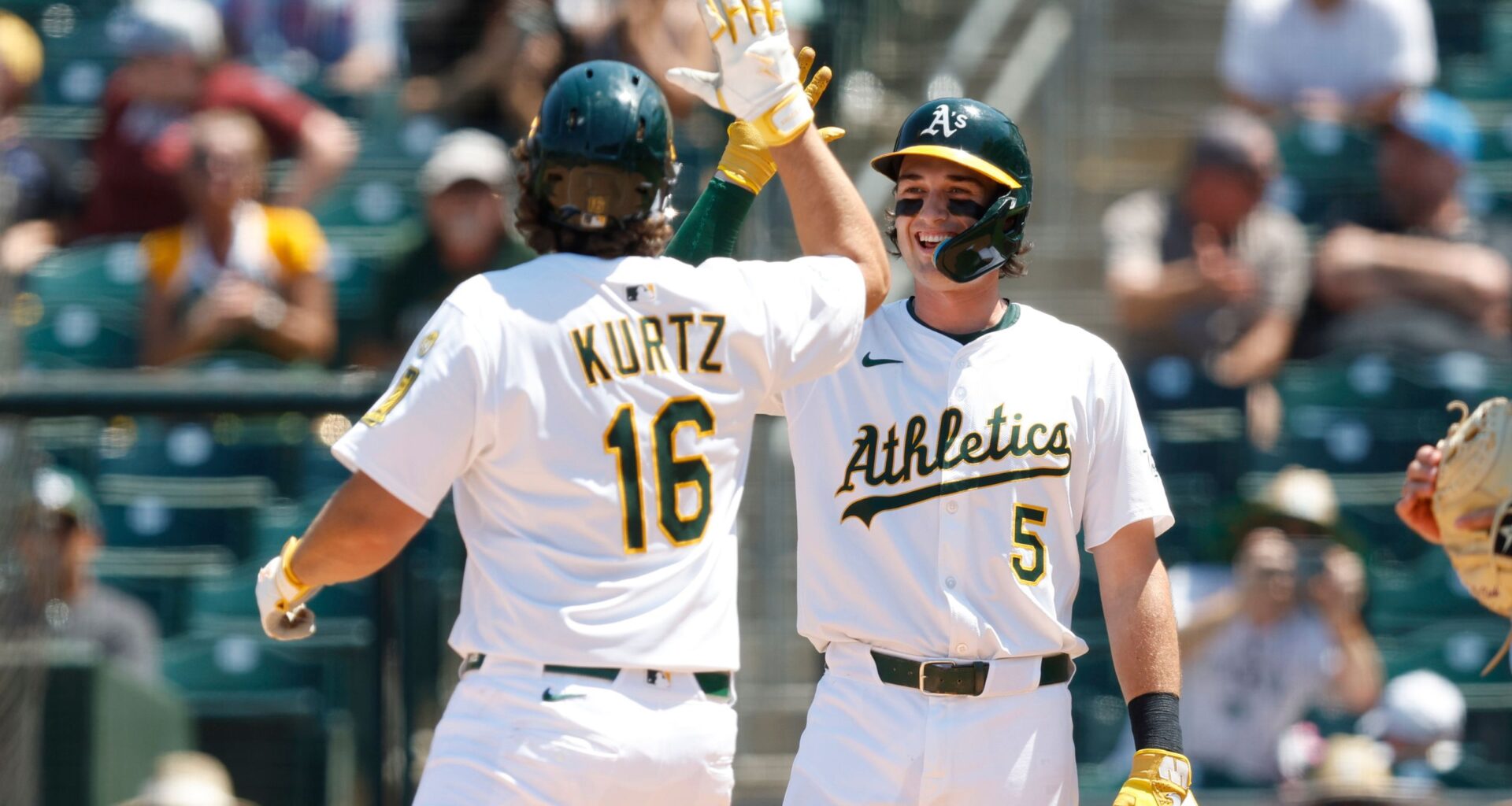
Image credit:
Nick Kurtz (left) and Jacob Wilson (Photo by Lachlan Cunningham/Getty Images)
Baseball players generally throw harder, hit the ball harder and run faster than they did a decade ago.
They are also moving a lot more quickly through the minor leagues.
We’re not just talking about anecdotal examples. Yes, Athletics first baseman Nick Kurtz barely touched the minors on his way to winning 2025 American League Rookie of the Year. Paul Skenes’ instant success with the Pirates led to questions about whether he even needed 34 minor league innings as a prelude.
This phenomenon is not limited to a player here or there. Across all MLB teams, players are spending less time in the minors. The entire MiLB development process has changed. Now, we’re seeing players go from draft or signing day to a big league roster at record rates.
In the late 2010s, the typical progression for a college first-round hitter was to get a brief stint in Rookie or short-season Class A ball in his signing year to acclimate to the pro game before being sent to Low-A. In his first full season the following spring, he would open at High-A to determine whether he was worthy of an in-season promotion to Double-A.
In most cases, even elite college hitters in the 2010s, such as Kris Bryant or Anthony Rendon, would spend their entire second pro season in the minor leagues.
Today, time in Rookie ball is often nonexistent for first-round college hitters. Low-A is either a quick stop or skipped entirely. Whereas High-A used to be a 3-4 month stint, it is now a two-month layover.
Reaching MLB in that second pro season is not at all out of the question. Kurtz did it. So did Zach Neto, Jacob Wilson and Cam Smith.
Overall, college first-round hitters in the 2020s are getting an average of 300 fewer plate appearances at Class A and below than they did from 2016 to 2020, dropping from 600 PAs to just under 300.
The trend continues in Double-A. The average college first-rounder is getting 140 fewer PAs in Double-A before being promoted (from 466 to 326). Only at Triple-A is the experience similar to what it was a decade ago. Now those players average 238 PAs, compared to 252 in the 2016-2020 timeframe.
Shifting gears from college hitters to high school first-rounders, the numbers change, but the trend remains the same. High school first-rounders who reach the majors are getting 400 fewer plate appearances in Class A and the Rookie levels than they did from 2016-2020. What was once 1,067 PAs is now 770 on average.
While Rookie-level PAs took the biggest dip, hitters are also getting 80 fewer PAs at each Class A level before moving up. Double-A has seen a 100-PA drop (525 to 424), with only Triple-A remaining roughly in line with the experience level hitters were getting from 2016-2020.
This trend remains true when looking at all hitters, even if the time spent at each level goes up. College hitters are getting nearly 250 fewer PAs on average in Class A and below and 125 fewer PAs in Double-A and Triple-A. High school hitters have seen a 300-PA drop in Class A and below experience, as well as an 85-PA dip at Double-A/Triple-A. International hitters are averaging 300 fewer PAs in Class A and below and 200 fewer PAs in Double-A/Triple-A.

The trends are very similar for pitchers. From 2021-2025, college pitchers had 87 fewer innings when they debuted compared to the same demographic from 2016-2020. High school and international pitchers have 110-120 fewer innings on average. The reductions are seen across Rookie ball, both Class A levels and Double-A, while Triple-A experience has remained effectively the same.
It used to be that a hitter with fewer than 1,250 minor league plate appearances when he was called up was considered an extremely fast mover. Just 15.5% of MLB position players from 2012 to 2019 fit in that category. Now, it’s relatively normal.


This decade, 39.7% of position players have debuted with fewer than 1,250 MiLB PAs on their resume.
So what’s happening?
There are a multitude of theories. This is likely a trend with a variety of contributing factors. Here are some of the theories most mentioned in discussions with MLB front office officials, scouts and coaches.
Minor League Reorganization
MLB eliminated or reclassified the short-season Class A leagues (New York-Penn, Northwest) and Rookie-advanced levels (Appalachian, Pioneer) in the reorganization of the minors in 2021. That, combined with the reduction in the number of players each team was allowed to roster, led to a follow-up decision to move the Rookie-level Arizona and Florida Complex Leagues to earlier start dates.
Instead of being where new draftees head after they have signed, those leagues are now filled with players moving up from the Dominican Summer League. So, rather than playing official games, many draftees participate in bridge league workouts and unofficial games in their draft year.
While those players are getting into game-type situations, those games do not count for official statistics. Some of the reduction, in essence, has been a trade of real minor league games for simulated scenarios and training sessions.
There has been a shift in the perceived level of different classifications, as well. The average Low-A hitter in 2015 was roughly 21.5 years old, while the average pitcher was 21.9 years old. In 2025, the average Low-A hitter is a bit under 21 years old, while the average Low-A pitcher is roughly 21.7 years old.
With those levels filled with younger and less experienced players, the dynamic has pushed organizations to move more skilled players out of that level more quickly or have them skip it entirely.
The Canceled COVID Season
The reduction in minor league playing time has continued even as 2021, 2022 and 2023 signees have reached the majors, but the cancellation of the 2020 MiLB season because of the coronavirus pandemic clearly played a role in the dip in MiLB experience among MLB arrivals as the 2020s began, and it still is having an impact to some extent. There continue to be players who were in organizations in 2020 who are making their MLB debuts.
High school-drafted shortstops Bobby Witt Jr. and CJ Abrams are prime examples of how the lost season affected players’ minor league experience. Witt reached the majors with just 160 games in the minors and 744 plate appearances. Abrams’ 116 games and 541 plate appearances are among the fewest seen for prep draftees.
In both cases, the 2019 draftees were set to play at Class A in 2020. Instead, Witt and Abrams spent that summer at their teams’ alternate training sites. While those games didn’t count statistically, they did play a role in both of them reaching the majors in 2022.
The Game Is Getting Younger
Major league rosters are younger—and by extension cheaper—than they were a decade or two ago.
In the 2000s, 51.8% of all MLB plate appearances came from players who were at least 29 years old. In the 2010s, that percentage dipped to 45.0%. In the 2020s, it’s 42.2%. Last year, it was 39.7%.
Nowadays, fewer hitters are able to hold onto jobs in their 30s. In the 2000s, 27.9% of plate appearances went to hitters 32 or older. This decade, it’s 17.5%.
Many of those plate appearances have gone from the oldest hitters to the youngest. This decade, 26.1% of plate appearances go to hitters 25 years old or younger. In 2025, it was 29.1%, the highest mark of the past 45 years. In the 2000s, players that young accounted for just 21.1% of plate appearances.

Training Has Improved
It wasn’t all that many years ago that the offseason was, at best, a time for minor league players to build strength. In reality, for many it was a time to earn enough money in offseason jobs to be able to afford playing for another year.
Now, hitters and pitchers use the offseason to fix weaknesses with offseason training plans designed specifically for each individual player. A pitcher who needs a better breaking ball spends the winter toying with new grips. Another makes sure to never skip leg day to add 2-3 mph to his fastball.
Hitters will arrive at spring training with retooled swings that have been honed over months in the cage. A hitter can practice handling elevated fastballs day after day, while another uses weighted-bat training to add needed bat speed.
That improved training is also true before players become professionals. Players often reach pro ball more physically developed and more experienced against top-tier competition than they were in the past.
Teams Are Measuring Skills More Quickly
The ability to measure every in-game moment more precisely has also allowed teams to feel more confident about promoting players quickly. In 2023, Roman Anthony was hitting .228/.376/.316 at Low-A Salem when the Red Sox promoted him to High-A Greenville.
Anthony’s hard-hit rate, chase rate, average exit velocity and other measurables that wouldn’t have been available a decade earlier made it clear that his on-field statistical results in 42 games didn’t match his actual performance and skill.
Anthony hit .294/.412/.569 at Greenville after his promotion. He hit everywhere he went afterward and eventually became the best prospect in baseball.
The Risk Of Moving Fast
Most likely, it’s a combination of factors that have led to decreased minor league experience and earlier MLB debuts. This is a cycle that somewhat feeds itself. Every Paul Skenes, Zach Neto, Nick Kurtz or Jacob Wilson who flies to the majors and has success helps encourage other teams to push their players faster.
There is a potential downside, however. The reduction in minor league levels and tighter roster limits also forces teams to make quicker decisions. That may mean that some players will end up being left out.
For example, it’s hard to imagine a team allowing the next Denard Span to develop. A 2002 first-round pick of the Twins out of high school, Span didn’t reach full-season ball until 2004. He needed 901 Double-A plate appearances and another 732 at Triple-A before he was MLB-ready in 2008.
Span went on to produce 28 bWAR and rack up 1,498 hits while holding down center field into his early 30s.
In Span’s case, slow and steady development led to a big reward. But in the modern game, very few players are likely to be able to follow that same path.