
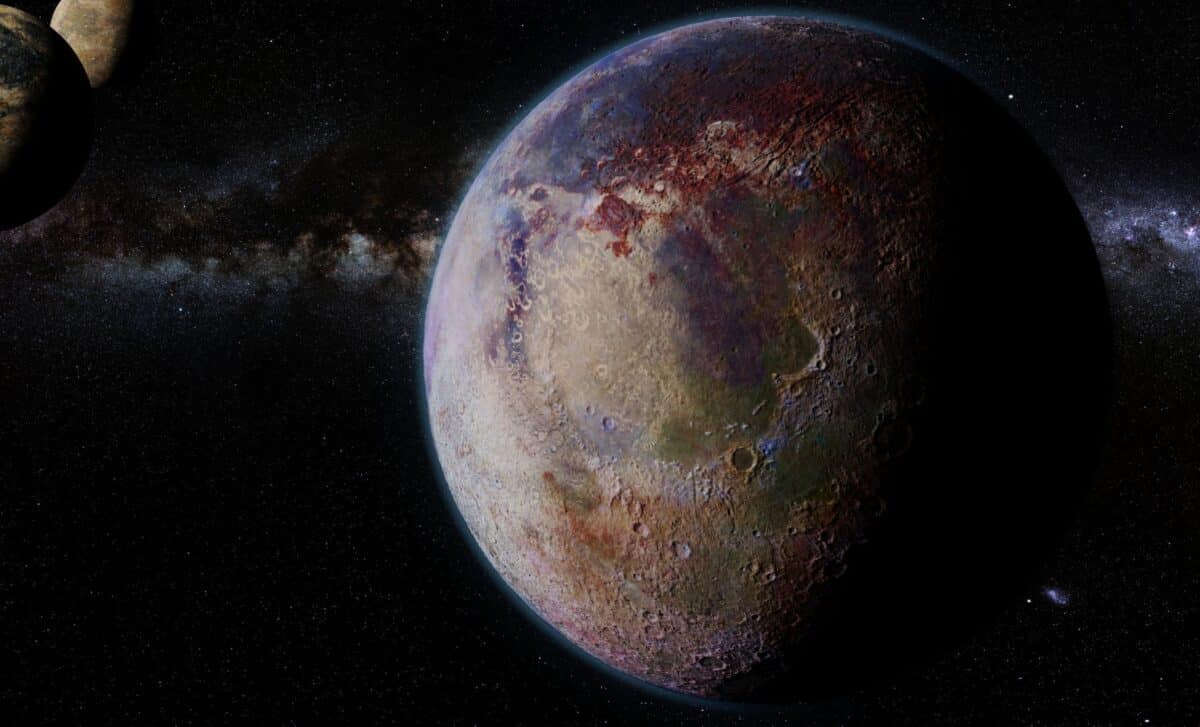
A team of U.S. and U.K. researchers has outlined a new way to detect alien moons by tracking subtle flashes of reflected light during lunar eclipses in distant planetary systems. The method, designed for NASA’s planned Habitable Worlds Observatory (HWO), could allow astronomers to identify Earth-like exomoons orbiting gas giants up to 39 light-years away.
The search has long lagged behind the discovery of exoplanets. While more than 6,000 exoplanets have been confirmed, not a single exomoon has been definitively verified. Yet our own solar system hosts nearly 900 known moons, many orbiting giant planets, suggesting such bodies could be common elsewhere.
A Detection Method Based on Reflected Light
According to a study accepted for publication in arXiv, the research team developed computer models showing how HWO could detect Earth-like exomoons through reflected starlight.
“HWO’s primary mission is to search for signatures of life on planets orbiting other stars. To achieve this, HWO will need to observe many nearby star systems, sometimes for several days at a time,” explained Mary Anne Limbach of the University of Michigan.
During such events, starlight reflects off the star-facing side of the exoplanet. The researchers propose that if an Earth-sized moon passes behind the planet, effectively undergoing a lunar eclipse, some of that reflected light could bounce off the moon’s atmosphere and travel toward Earth.
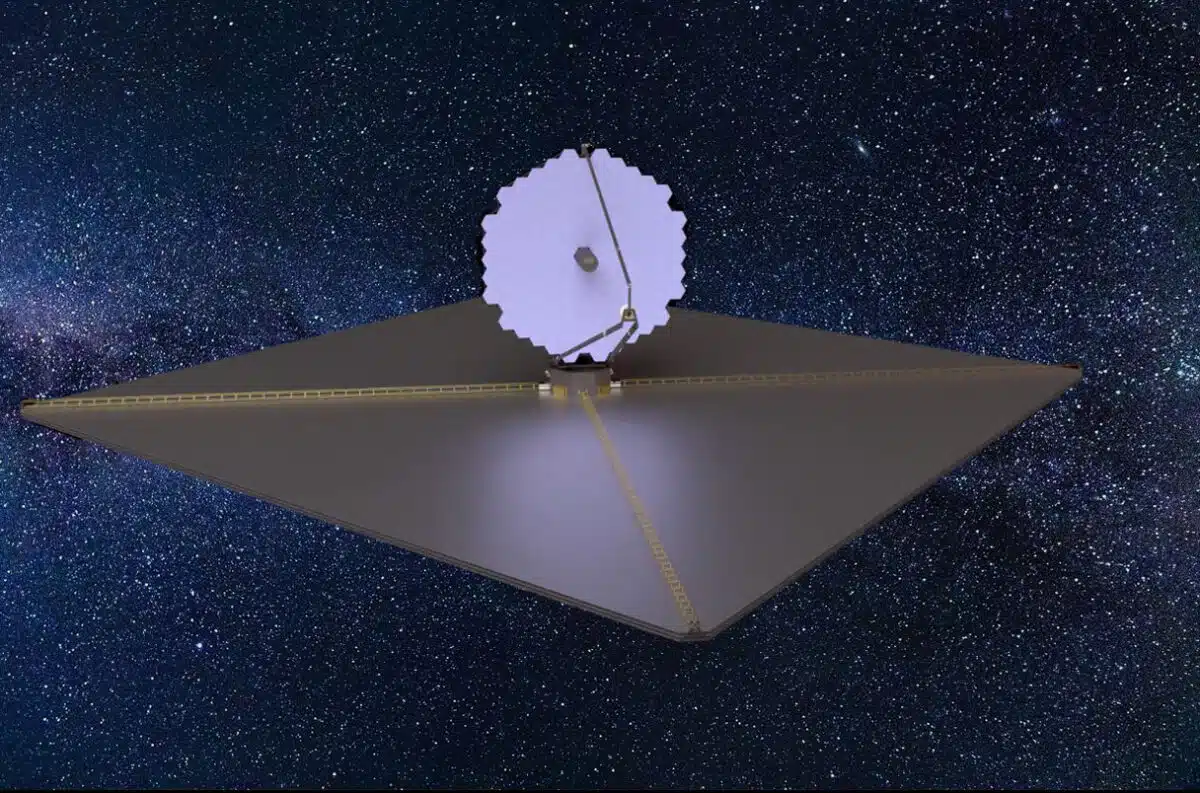 Concept of NASA’s HWO with segmented mirror and starshade. Credit: NASA Goddard Space Flight Center
Their simulations indicate that HWO could detect an Earth-like exomoon orbiting a Jupiter-sized exoplanet located 1 astronomical unit from its star. The signal, as explained in the study, would be observable from as far as 12 parsecs, or about 39 light-years away. The models also suggest sensitivity to moons as small as 0.5 times Earth’s radius.
Why Giant Planets Remain Prime Targets
The researchers argue that habitable-zone gas giants should remain on HWO’s target list. In the study, the authors wrote that:
“Exomoons are a place where we should think ‘outside the box’ about what HWO can find,” emphasizing that the observatory’s capabilities may extend beyond detecting Earth-sized exoplanets.
According to the study, lunar eclipses are highly sensitive events but may be time-inefficient for blind searches. Dedicated monitoring of large giant planets, the authors note, is likely to be scientifically productive. They also stress the need to plan how to characterize any candidate moons once detected.
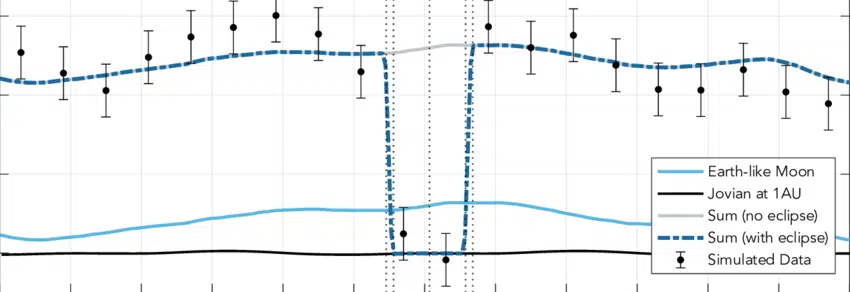 Simulated light curve of an Earth-like exomoon showing the dip caused by a lunar eclipse behind a Jupiter-sized planet. Credit: Researchgate
This focus mirrors our own solar system, where the largest planets host the richest moon systems. Jupiter and Saturn alone account for dozens of satellites, including several considered potentially habitable.
The Unresolved Status of Exomoon Candidates
Despite multiple claims over the years, confirmed extrasolar satellite remain elusive. Several candidates continue to be studied, including Kepler-1625b I, Kepler-1708b I, the Kepler-90g moon candidate, the Kepler-80g moon candidate, and the WASP-49b moon candidate.
According to previous findings reported in Nature Astronomy in 2023, the existence of Kepler-1625b I and Kepler-1708b I was questioned. A 2025 study in the same journal later concluded that their status remains open. Four of the listed candidates are believed to orbit gas giants, while the potential moon around Kepler-80g could circle a planet slightly larger than Earth.
NASA’s Habitable Worlds Observatory, currently scheduled for launch in 2041, is primarily tasked with identifying Earth-sized habitable exoplanets. Yet as the new study suggests, its instruments may also open a path toward confirming the first exomoon, if astronomers are prepared to look for the faint glow of a moon briefly hidden in shadow.