
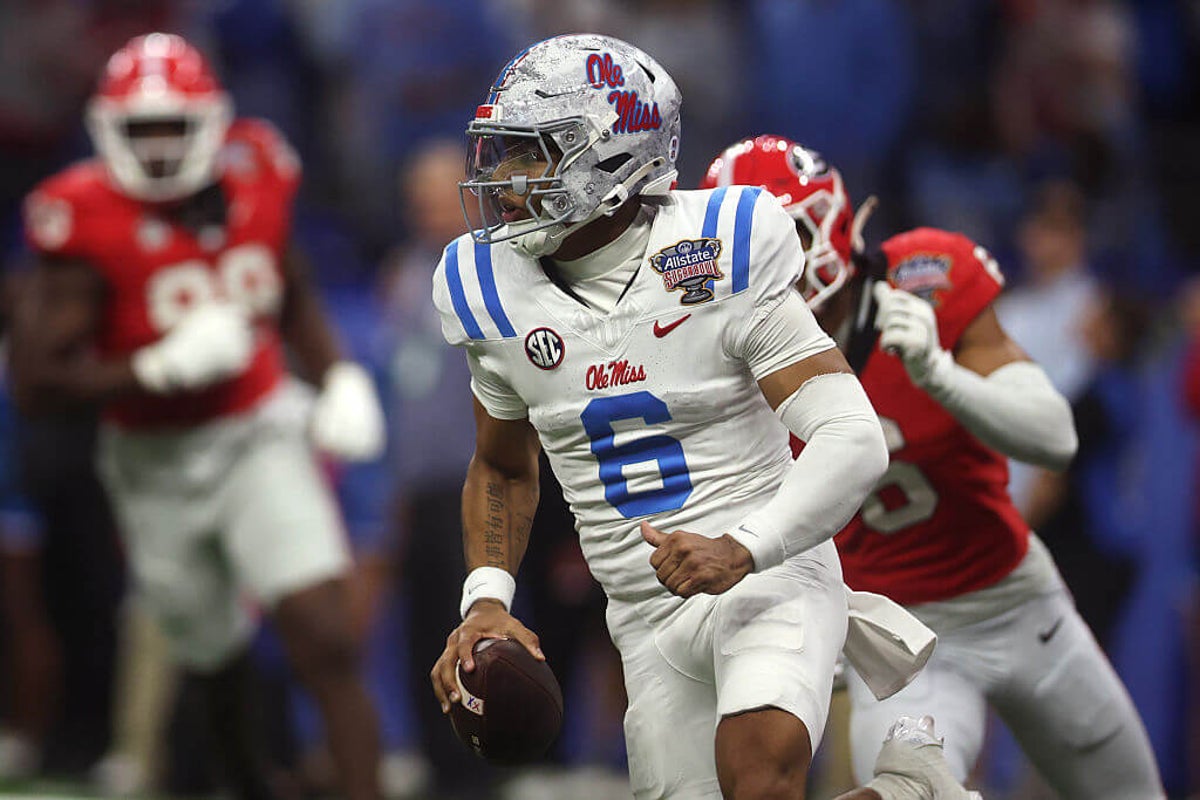
Trinidad Chambliss is back for another year, apparently. Good for Ole Miss. Joey Aguilar is not back for another year, apparently. Bad for Tennessee.
But still, the return of Chambliss isn’t just good news for the SEC team that went furthest in last year’s College Football Playoff. It means the SEC, in its quest to return to college football preeminence, should enter 2026 fairly loaded in a key area: experienced quarterbacks.
For all the focus on Indiana and other recent national champions having veteran rosters, it’s the experience at the most important position that stands out the most. Dating back even before the paying-players era, national champions have had veteran quarterbacks, even if it’s a transfer:
Indiana 2025: Fernando Mendoza, fourth year in college, third as a starter.
Ohio State 2024: Will Howard, fifth year, second as a full-time starter.
Michigan 2023: JJ McCarthy, third year, second as a starter.
Georgia 2021-22: Stetson Bennett, fifth and sixth years, second and third as a starter.
Alabama 2020: Mac Jones, fourth year, first as starter, but four starts in 2019.
LSU 2019: Joe Burrow, fifth year, second as a starter
Trevor Lawrence was a freshman when he led Clemson to the national title in 2018. Since then, however, it has been quarterbacks in at least their third year of college — and mostly fourth-year or more — with starting experience.
Even the national runner-ups over that span all entered their respective seasons with at least one year of starting experience and were in at least their third year of college: Miami’s Carson Beck (sixth year), Notre Dame’s Riley Leonard (fourth year), Washington’s Michael Penix Jr. (sixth year), TCU’s Max Duggan (fourth year), Alabama’s Bryce Young (third year), Ohio State’ Justin Fields (third year), Clemson’s Lawrence (third year).
The easy theory: As the talent gap flattened, having a quarterback who was not only good but also experienced was the final edge.
This isn’t saying it’s the only factor. But it’s clearly a key one. Which brings us to the SEC and its hopes of ending a three-year drought in the national championship game.
Chambliss winning his injunction means (presumably) that four of the five SEC teams that made last year’s College Football Playoff will return their starting quarterbacks. Two other schools return experienced quarterbacks, and two more signed experienced transfers.
Ole Miss: Trinidad Chambliss, sixth year, third as a starter
Georgia: Gunner Stockton, fifth year, second as a starter
Oklahoma: John Mateer, fifth year, third as a starter
Texas A&M: Marcel Reed, fourth year, third as a starter
Texas: Arch Manning, fourth year, second as a starter
South Carolina: LaNorris Sellers, fourth year, third as a starter
LSU: Sam Leavitt (Arizona State transfer), fourth year, third as a starter
Auburn: Byrum Brown (South Florida transfer), fifth year, third as a full-time starter
The story in the rest of the conference:
Alabama: It figures to either be second-year Keelon Russell or third-year Austin Mack, neither of whom has any career starts.
Missouri: A competition between Matt Zollers, who started four games last year as a freshman, and Austin Simmons, who started once but had extensive backup experience in two years at Ole Miss.
Vanderbilt: Five-star freshman Jared Curtis is expected to step in for Diego Pavia.
Florida: Aaron Philo transferred from Georgia Tech, where in two years, he had three starts.
Kentucky: Notre Dame transfer Kenny Minchey has never started but is in his fourth year.
Mississippi State: As a true freshman last year, Kamario Taylor started the Egg Bowl and Duke’s Mayo Bowl.
Arkansas: KJ Jackson, a backup the past two years, will compete with second-year AJ Hill, who came from Memphis with new head coach Ryan Silverfield. Jackson and Hill each have one career start.
Tennessee: Aguilar’s court loss means a wide-open competition: five-star freshman Faizon Brandon, redshirt freshman George McIntyre and Colorado transfer Ryan Staub. Josh Heupel’s offense has been at its best with experienced college quarterbacks such as Aguilar and Hendon Hooker in 2022. Joe Milton and Nico Iamaleava: not as experienced, not as good.
One big cautionary paragraph: Last year, six SEC teams returned their starters, and four of them (Florida, South Carolina, LSU and Arkansas) struggled. Aguilar and Chambliss came out of nowhere — summer transfers — to be the SEC’s second- and third-ranked passers, and first-time starter Ty Simpson led Alabama to the CFP quarterfinals. For the five SEC teams that made the Playoff, none of the quarterbacks were the starters for the previous season’s opener.
But maybe that’s all a lesson why the SEC flamed out again in the postseason. The goal is getting back to the national title game: Refer to the opening of this story for the history of those quarterbacks.
Of course, this doesn’t guarantee the SEC superiority. In the Big Ten, four of the top five-rated quarterbacks are back, giving Ohio State, Oregon, Washington and USC a great shot. Indiana went and snagged another experienced transfer in Josh Hoover from TCU. And Miami, which knocked off two SEC teams in the CFP, snagged Darian Mensah from Duke.
So it won’t be easy. By now, everyone in the SEC realizes football superiority isn’t a birthright. And it doesn’t look like 2026 will automatically be when the conference gets its swagger back.
But if having good, experienced quarterbacks is as important as it has seemed, then maybe it will.