
At a Manhattan drop-in center operated by the LGBTQ+ advocacy group New Pride Agenda, it’s common for staff to assist trans people coming from across the country with figuring out how to get on hormones or access other gender-affirming treatments in New York City, said Kei Williams, the organization’s executive director.
Williams and other advocates say the city’s reputation as an LGBTQ+ safe haven depends, in part, on robust access to care for trans and gender-nonconforming people.
“It must be accessible here in New York City,” Williams said. “If not here, then where?”
But the future of gender-affirming care for those under 18 is in question in New York and across the nation as the Trump administration threatens to pull funding from hospitals that offer these services.
New York lawmakers and LGBTQ+ advocates say they are feeling a fresh sense of urgency to secure new state funding and legislation to protect access to care after NYU Langone Health announced this week that it was closing its Transgender Youth Health Program in response to the “current regulatory environment.”
The U.S. Department of Health and Human Services is in the process of finalizing proposed rules that would block hospitals that provide treatments such as puberty blockers, hormones or surgeries to minors from receiving Medicare or Medicaid dollars — and that would bar state Medicaid programs from covering that care. A public comment period for the proposals just ended this week.
When the proposed rules were issued in December, federal health officials said “sex-rejecting procedures” were dangerous and unproven. But the American Academy of Pediatrics and other medical groups have pushed back, saying the Trump administration’s claims are not grounded in science.
City and state officials warn that health care providers could violate New York’s robust antidiscrimination laws if they deny patients treatment for gender dysphoria, a condition in which a person identifies with a gender that doesn’t match their biological sex.
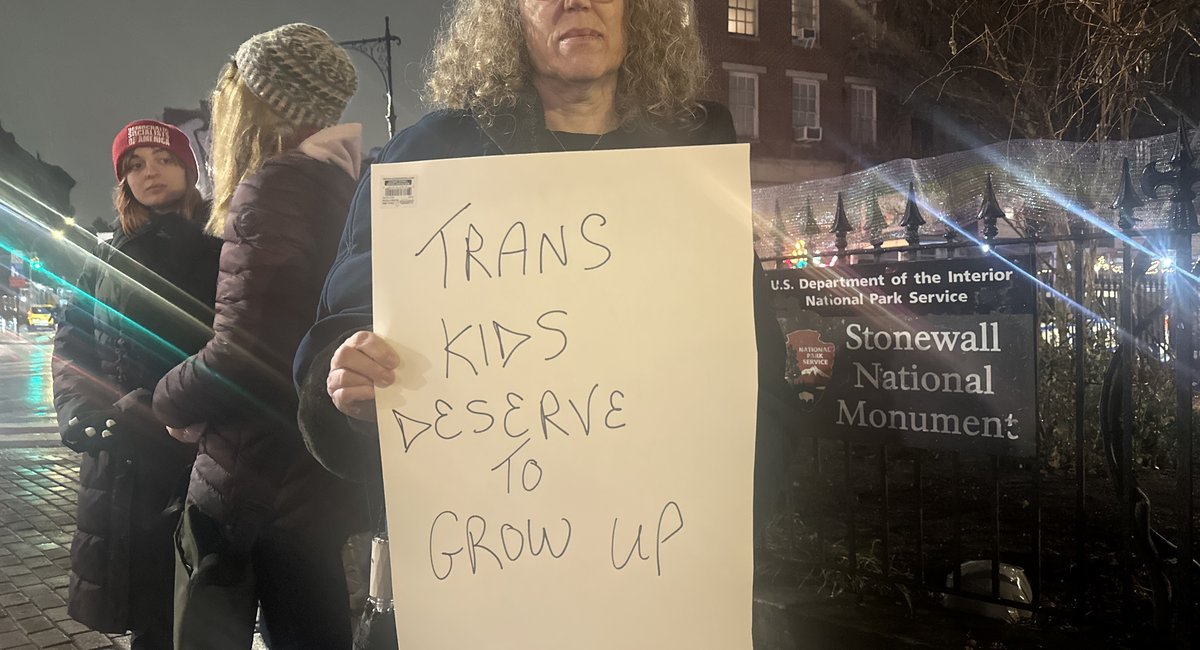
At a rally to protect care for trans youth at the Stonewall National Monument on Wednesday evening, protesters derided NYU Langone for capitulating to Trump and called on other hospitals in the city to stand up to his administration.
Lorelei Crean, an 18-year-old high school senior who attended the rally, said it can already be a challenge to access gender-affirming care. He said he spent all of last year trying to get an appointment before being seen by a provider to assist in his transition. He said he worried the delay was because he was still a minor.
“ Over the past year, I’ve become a trans youth activist because I had to,” Crean said. “The Trump administration has attacked every aspect of my existence.”
Protesters also talked about contingency plans. Members of the Democratic Socialists of America, which hosted the rally, proposed making gender-affirming treatments available at standalone clinics funded through state or local dollars, so the services would be more insulated from federal threats.
Some nonprofit clinics, including sites run by Callen-Lorde and Planned Parenthood, currently offer some gender-affirming treatments to minors, though they may not be as extensive as those offered by hospitals.
Planned Parenthood clinics, for example, offer hormone therapy for patients aged 16 and 17. But the center being shut down by NYU Langone also provided hormones to younger patients, as well as puberty blockers and other services.
State lawmakers in Albany have introduced multiple bills to protect access to gender-affirming care.
State Assemblymember Linda Rosenthal, a Democrat representing Manhattan’s West Side, has introduced legislation requiring New York’s Medicaid program to continue covering gender-affirming care regardless of any rule change from the Trump administration.
The bill, which was referred to the Assembly health committee last month, would also double down on prohibitions against discriminatory practices by hospitals, according to Rosenthal.
“We must pass bills that confront authoritarianism by arming people with the necessary tools to fight bigoted policies that erode our democracy,” Rosenthal said.
Another bill would create an $8 million gender-affirming care fund to support health care providers offering these services. That legislation is sponsored by state Sen. Kristen Gonzalez and Assemblymember Jessica Gonzalez-Rojas, Democrats representing parts of Queens, Manhattan and Brooklyn.
Are other hospitals following in NYU Langone’s footsteps?
Hospitals’ bottom lines depend on funding from Medicare and Medicaid, two massive public insurance programs. With that funding potentially at risk, major hospital systems in New York City are keeping mum about whether they will follow in NYU Langone’s footsteps.
Mount Sinai Health System declined to comment, as did the publicly run NYC Health and Hospitals.
Mayor Zohran Mamdani’s office declined to comment further on the matter and instead referred to his comments stating that the city “will continue to be a refuge for the LGBTQIA+ community.”
NewYork-Presbyterian spokesperson Rachel Packer said, “We continue to comply with applicable state and federal laws and regulations.”
The state Department of Health is “closely monitoring the chilling effect these federal changes are having,” said Cadence Acquaviva, a spokesperson for the agency.
In a letter to health care providers, the department pointed out that courts blocked the Trump administration’s previous attempt to pull federal funding from hospitals providing gender-affirming care.
The New York Civil Liberties Union, which has already sued the federal government to stop rollbacks on other legal protections for LGBTQ+ people, is also monitoring the situation.
“In the face of Trump’s transphobic bullying tactics and intimidation, our state’s hospitals must uphold their commitment to trans youth and their families,” said NYCLU Executive Director Donna Lieberman.
The U.S. Centers for Medicare and Medicaid Services said it is reviewing the comments that were submitted on the proposed rules. The agency did not give a set timeline for finalizing the policies.