
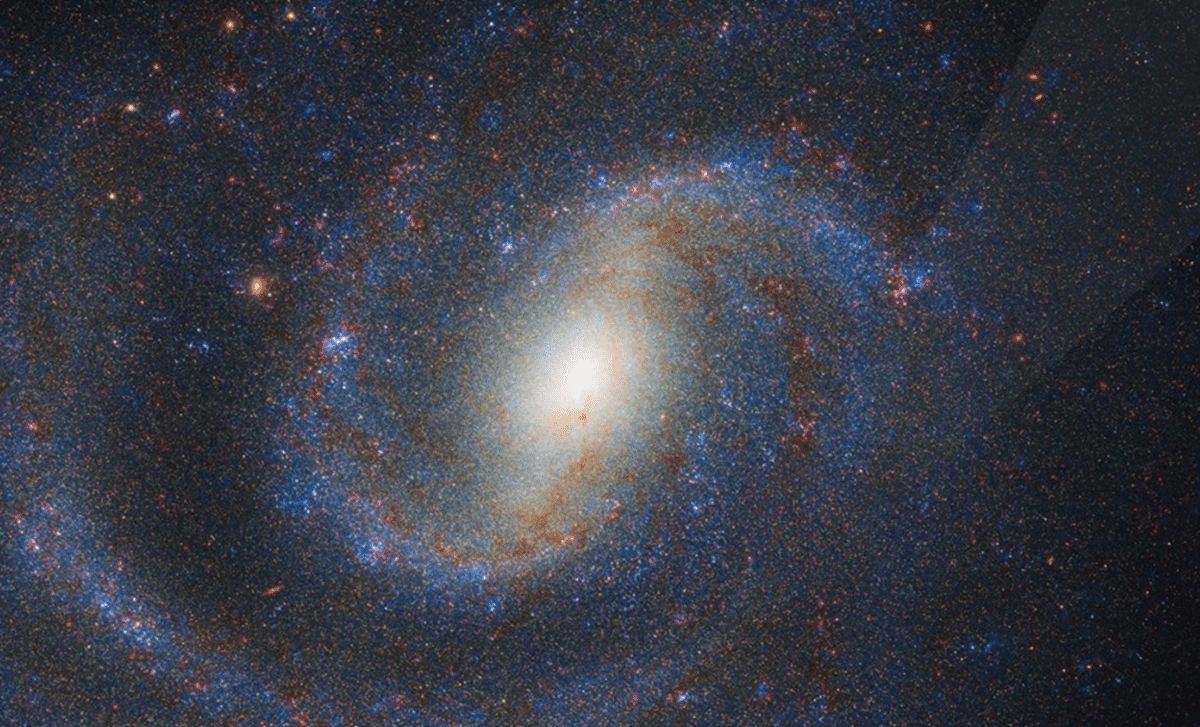
cientists using the James Webb Space Telescope (JWST) have identified the progenitor star of supernova 2025pht, a stellar explosion that occurred 40 million years ago in the galaxy NGC 1637. This discovery, detailed in a recent study published in Astrophysical Journal Letters, marks a significant milestone in astronomy, as it represents the first time a supernova’s progenitor has been directly detected using Webb.
A Historic Discovery: Webb Identifies the Progenitor of Supernova 2025pht
The search for the progenitor stars of supernovae has been a long-standing challenge for astronomers. Until now, it has been incredibly difficult to observe stars just before they explode, especially those in distant galaxies. But with the power of the James Webb Space Telescope, a new breakthrough has been made. In a rare event, Webb was able to detect the star that exploded as supernova 2025pht in the spiral galaxy NGC 1637.
This discovery, published in Astrophysical Journal Letters is particularly significant because it marks the first time a supernova progenitor has been successfully identified using the Webb telescope. As Charlie Kilpatrick, lead author of the study from Northwestern University, explains: “We’ve been waiting for this to happen – for a supernova to explode in a galaxy that Webb had already observed. We combined Hubble and Webb data sets to completely characterize this star for the first time.” By merging data from the two telescopes, the team could thoroughly examine the star before and after its explosive demise.
Webb’s sensitivity in the infrared spectrum was essential for this discovery. While the Hubble Space Telescope is invaluable for observing visible light, it struggles to detect stars that are enshrouded in dust. Webb, with its advanced mid-infrared capabilities, was able to peer through this cosmic dust and identify the star, revealing important details that had eluded previous observations. This breakthrough opens up new possibilities for studying the life cycles of stars in ways never before possible.
A Red Supergiant Revealed: The Star Behind Supernova 2025pht
The progenitor star of supernova 2025pht is a red supergiant, one of the largest and most massive types of stars in the universe. These stars are known for their enormous size and brightness, and they eventually explode in a spectacular display of energy known as a supernova. The discovery of this particular star’s role in the explosion provides valuable insights into the processes leading up to a supernova event.
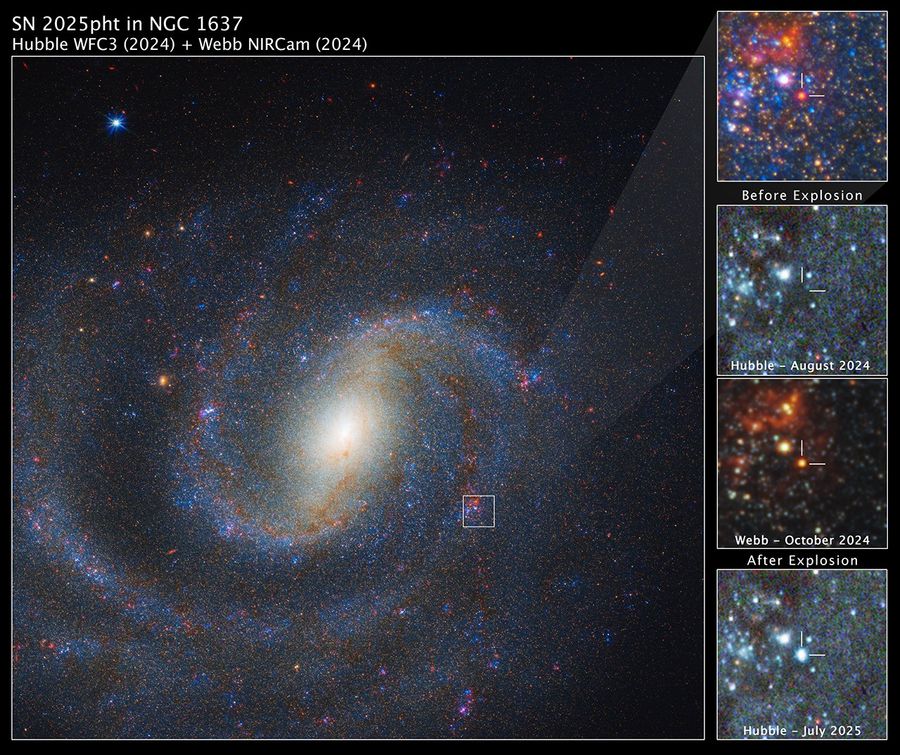 The main image at left shows a combined Webb and Hubble view of spiral galaxy NGC 1637. Panels at right show a detailed view of a red supergiant star before and after it exploded. Before exploding, it is not visible to Hubble, only to Webb. Hubble shows the glowing aftermath. Image: NASA, ESA, CSA, STScI, Charles Kilpatrick (Northwestern), Aswin Suresh (Northwestern); Image Processing: Joseph DePasquale (STScI)
One of the most surprising findings in the study was just how red and dusty the progenitor star was. “It’s the reddest, most dusty red supergiant that we’ve seen explode as a supernova,” said Aswin Suresh, a graduate student and co-author of the study. The intense redness of the star was an indication that it was surrounded by large amounts of dust, which had previously obscured its visibility in observations by other telescopes like Hubble.
Dusty Secrets: How Dust Around Stars Affects Supernova Detection
One of the central findings of the study is the discovery of the significant amount of dust surrounding the progenitor star. This dust is an essential factor in understanding why certain massive stars have remained elusive to astronomers. The presence of dust not only dimmed the star’s light but also altered its appearance. By analyzing Webb’s mid-infrared data, the researchers found that the dust surrounding the star was likely carbon-rich, a surprising result.
Kilpatrick noted that the discovery of such a dusty star supports a hypothesis he has long argued:
“I’ve been arguing in favor of that interpretation, but even I didn’t expect to see it as extreme as it was for supernova 2025pht. It would explain why these more massive supergiants are missing because they tend to be more dusty.”
The high dust content could be one of the key reasons why astronomers have struggled to detect the progenitors of the most massive stars before they explode.
The fact that Webb was able to detect the star despite the dust surrounding it highlights the importance of its mid-infrared capabilities. “Having observations in the mid-infrared was key to constraining what kind of dust we were seeing,” said Suresh. This breakthrough not only helps explain why red supergiants have been so hard to detect but also lays the groundwork for future studies of similar stars.