
By: Tal Beeri and Dana Polak
Amid escalating tensions and the potential for a direct military conflict between the United States and Iran, two key questions come to the forefront: What would Iran’s strike zones be in a direct war with the U.S., and what strategic rationale would shape its conduct?
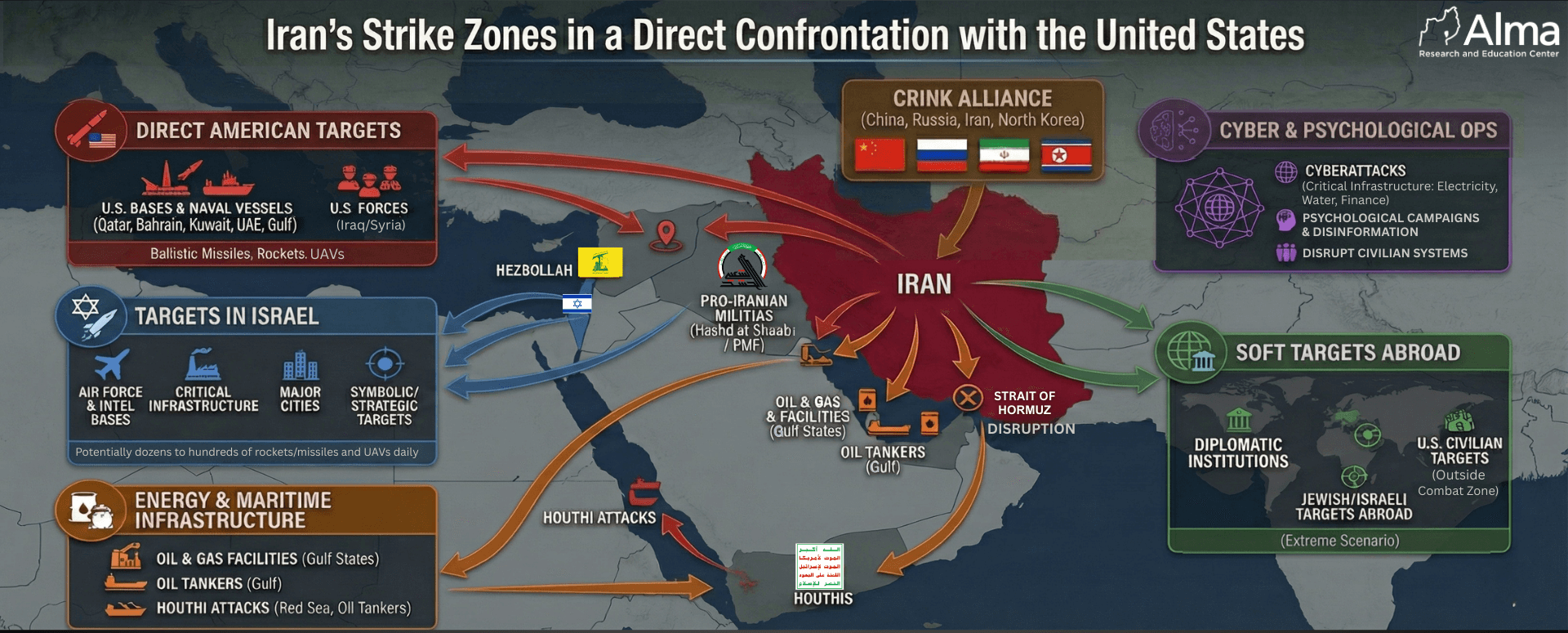
In the event of a direct confrontation, Tehran would likely pursue a multi-theatre warfare approach that blends its own state-based military capabilities with the mobilization of its regional proxies. Iran maintains a substantial arsenal of long-range ballistic and cruise missiles, a wide range of UAV platforms, sophisticated cyber capabilities, infrastructure for conducting worldwide terrorist operations, an extensive propaganda network aimed at shaping perceptions, and a regional proxy system that is currently rebuilding and could, if directed, be brought into the conflict.
In the event of direct confrontation, Tehran’s overarching objective will be to preserve regime survival, namely: prolonging the campaign without a clear military decision and maintaining the ability to manage a sustained response at varying levels of intensity. From the Iranian perspective, the U.S. has a limited window for the effective use of force: the longer the campaign continues, the greater the internal pressures within the U.S., the broader the international criticism, the higher the economic costs, and the greater the erosion of the legitimacy base for continued fighting.
Iran will attempt to harness the revisionist alliance (CRINK), with emphasis on the two powers (China and Russia), to act in its favor as part of its strike zones in the domains of cognition, cyber, intelligence, diplomacy, and the like.
Iran’s primary objective will be to endure and create a dynamic of accumulating costs, gradual erosion, sustained attrition, and mounting cognitive and economic pressure, where simply surviving and maintaining resilience are framed as a strategic victory.
Main Iranian Strike Zones Against the Americans
First-priority targets are expected to be direct American assets in the Middle East. American bases in the Gulf, including in Qatar, Bahrain, Kuwait, and the United Arab Emirates, constitute critical logistical and operational anchors for the U.S. Striking them with short-range missiles, rockets, or UAVs could disrupt air activity, damage refuelling and maintenance systems, and send a clear deterrent message both to Washington and to the host countries.
At the same time, American forces deployed in Iraq constitute a relatively accessible target for terrorist activity through Shiite militias. Attacks against them could raise the direct cost of the American presence and generate internal political pressure in the U.S. to reduce regional involvement.
The maritime arena is also expected to occupy a central place. The U.S. Navy’s presence in the Persian Gulf and the Red Sea serves as a clear symbol of American power and military dominance and, in the event of a U.S. strike, would also constitute a strategic target area. Iran may combine anti-ship missiles, UAVs, and asymmetric naval tactics to contest U.S. freedom of navigation and operational manoeuvrability. In this context, Tehran could also mobilize the Houthi forces in Yemen, which have already demonstrated considerable offensive capabilities in this arena.
Main Iranian Strike Zones Against Israel
Even if Israel is not a direct partner to the attack, it is highly likely to serve as a target for Iranian attack and as an additional central pressure arena. Israel may be attacked directly by Iran, using missiles and UAVs, but also through its proxies – Shiite militias in Iraq, the Houthis, and Hezbollah.
Like the 12-day war in June 2025, the targets in Israel that Iran will seek to strike include military targets (air force and intelligence bases), critical infrastructure (electricity, gas, ports, airports), central cities, and symbolic/strategic targets with cognitive effect. In the event that Hezbollah joins the confrontation, unlike June 2025, Hezbollah will likely be the central and most significant proxy. In this context see article – Has Hezbollah decided to join Iran in a possible war against it?
In a scenario of broad escalation, including direct Israeli involvement in an attack against Iran, Iran may – directly or through its proxies – also combine focused efforts to carry out terrorist and sabotage activity within Israeli territory. Such actions, even if their operational contribution is limited, carry high cognitive and deterrent value, as they are intended to undermine the sense of personal security and demonstrate penetration into the heart of the population.
Energy, Shipping, and Trade Infrastructure
The energy, maritime, and trade sphere represents a strategic lever with far-reaching global consequences. Oil and gas installations in the Gulf states could become targets of either direct or indirect attacks. Substantial damage to these facilities could disrupt the global energy market, trigger sharp price spikes, and intensify international pressure to de-escalate the conflict.
We recall the Iranian attack (September 14, 2019) against the main oil facilities of Aramco in Saudi Arabia, in Abqaiq and Khurais, using at least 18 UAVs and 7 cruise missiles, directly from Iranian territory. The attack caused severe disruption to approximately 50% of Saudi Arabia’s oil production capacity.
Additionally, interference with maritime transit through the Strait of Hormuz, through which a substantial share of the world’s seaborne oil flows, could function as a significant lever of pressure even without a complete blockade. Similarly, Houthi strikes on vessels in the Red Sea could broaden the geographic scope of the conflict and disrupt global supply chains.
Cyber and Cognition
Alongside military actions, Iran is expected to make extensive use of cyber capabilities and perception-based warfare. Cyberattacks targeting power grids, water infrastructure, financial institutions, and highly visible civilian systems could inflict cumulative economic harm and erode public confidence, even without causing mass casualties. This arena offers substantial plausible deniability and enables calibrated adjustments in the level of intensity. At the same time, disinformation efforts and perception-shaping campaigns may accompany each phase of the conflict, seeking to heighten feelings of insecurity, exacerbate internal divisions, depict the United States as unstable, and undermine the legitimacy of its offensive actions.
Overseas Attacks
The option of carrying out attacks against American, Israeli, and Jewish targets worldwide is always “on the table” from the Iranian perspective and can be implemented by them in any scenario and at any given time. This refers to personal harm to diplomats and their families and / or harm to diplomatic institutions such as embassies and missions or harm to any target identified with Israel / Jewish communities or the U.S.
In our assessment, the more the regime perceives a tangible threat to its survival — such as significant damage to key centers of power, particularly to Supreme Leader Khamenei — the higher the probability that it will resort to this course of action. The decision to employ more extreme measures will depend primarily on its evaluation of the threat to the regime’s continued existence.
The Revisionist Alliance (CRINK)
Iran does not act in isolation; its growing power stems in large part from its deep integration into the revisionist bloc known as CRINK (China, Russia, Iran, North Korea). Its strategic alignment with Moscow and Beijing effectively serves as Tehran’s economic and technological safety net.
China absorbs roughly 90% of Iran’s oil exports, while the reciprocal reliance between Moscow and Tehran has developed into a partnership that includes the transfer of advanced military technologies.
The shared interests of these actors are evident. In our assessment, China and Russia are likely to align themselves with Iran’s broader campaign and extend support against the United States across multiple domains, including cognitive warfare, cyber operations, intelligence, diplomacy, and related spheres.
Summary
A scenario of war between the U.S. and Iran is not expected to focus on a direct battle between two states, but rather on a dispersed regional (and even global) campaign based on missiles and UAVs, proxies, cyber, cognition, global terrorist infrastructure, and global and international economic pressure.
Iran’s primary objective would be to ensure the survival of the regime. To that end, Tehran would seek to shape a situation in which the regional and international costs of the conflict become high enough to compel restraint, constrain U.S. freedom of action, and redefine the strategic balance on terms it views as more advantageous.
