
In the rugged cliffs of southern Iran, a fascinating discovery has been made, shedding new light on the region’s rich biodiversity. During a nighttime survey in 2018, researchers encountered a creature with striking features that immediately caught their attention. After careful analysis, it was confirmed that this remarkable find was a previously unknown species. This newly discovered creature is a gecko, now officially named Asaccus authenticus, adding a unique chapter to the study of Iran’s wildlife.
The Discovery of Asaccus Authenticus
In 2018, researchers stumbled upon a new and peculiar gecko species while conducting a nighttime survey in southern Iran. Clinging to the dry river canyon walls and resting beneath Acacia trees, these geckos exhibited features unlike any known species. They had slender bodies covered with white spikes, elongated limbs, and large, expressive eyes, leading scientists to suspect they might be witnessing a species that had never been documented before. As the team continued their observations, it became clear that these geckos were not just a new variant but an entirely separate species, genetically distinct from all other known relatives.
This discovery was formalized through a detailed genetic analysis, confirming that the gecko was indeed a new species within the Asaccus genus, which previously included 19 recognized species across Iran, Arabia, and the UAE. The researchers’ genetic testing revealed a remarkable 23% genetic divergence from its closest relatives, highlighting how isolated this species had been from others in its genus. This 23% difference is significant, showing that Asaccus authenticus has been on its own unique evolutionary path for a long time. The study, published in Zootaxa, emphasizes how genetic divergence plays a key role in identifying distinct species and understanding their evolutionary history.
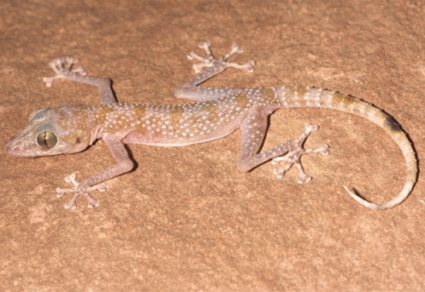 The new gecko species, Asaccus authenticus, in its natural habitat in Iran. Roman Nazarov Photo from Nazarov, Nabizadeh, Rajabizadeh, Melnikov, Volkova, Poyarkov and Rastegar-Pouyani (2024), shared by Roman Nazarov
Unique Physical Traits and Adaptations
Asaccus authenticus stands out for its distinctive physical traits, which are a clear departure from those of its relatives. The gecko’s elongated limbs, spiked body, and large eyes give it a dramatic and somewhat otherworldly appearance. These traits are likely adaptations to its environment, which consists of the steep, rocky walls of the canyon. The spiky features may help with camouflage against the harsh terrain, while the large eyes suggest a nocturnal lifestyle, enabling the gecko to navigate the dark, rocky surfaces it inhabits.
Despite its unusual appearance, Asaccus authenticus is a medium-sized gecko, measuring only about 4.5 inches in length. However, its physical form is a testament to the adaptability of species in such isolated and challenging environments. The canyon’s harsh conditions, including limited water availability and extreme temperatures, may have driven this species to develop such unique features, which aid in survival and make it stand apart from its relatives.
The Importance of Genetic Analysis
The genetic analysis of Asaccus authenticus played a crucial role in confirming its status as a new species. Through the examination of its DNA, scientists found a 23% genetic divergence from other Asaccus geckos, a finding that is both striking and significant in the field of evolutionary biology. Genetic divergence is a critical measure used to determine how closely or distantly related different species are, providing insight into their evolutionary history and development.
This 23% difference is not just a minor variation; it signals that Asaccus authenticus has evolved separately from its relatives for a long period. The study in Zootaxa emphasizes that such a level of divergence is a clear indication of the gecko’s long-standing isolation and evolutionary independence. In a broader sense, this discovery highlights the vast, untapped biodiversity in isolated ecosystems, where unique species can evolve in ways that are still largely unexplored by science.