
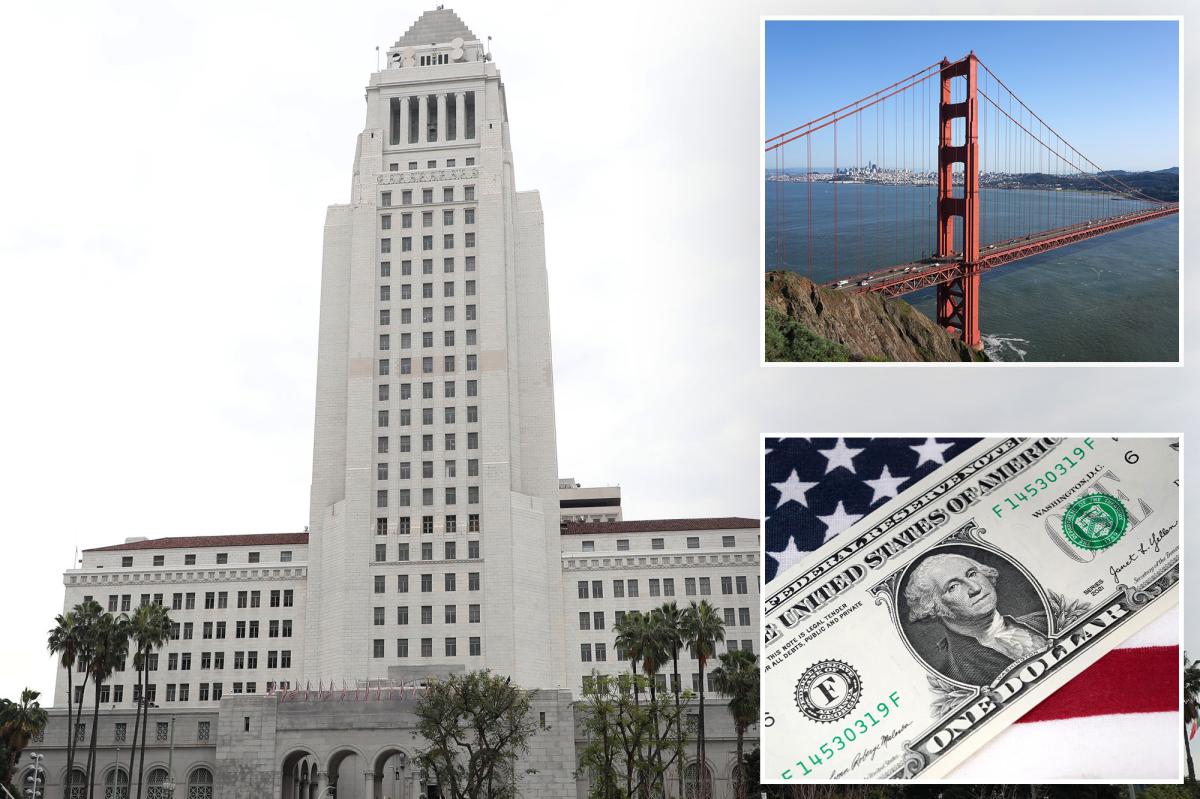
Even a $100,000 salary barely goes the distance in San Francisco and Oakland, where steep taxes and soaring housing costs have gutted the buying power of Californians.
California dominates the bottom of the rankings of a recent analysis by ConsumerAffairs, with San Francisco and Oakland coming in dead last among the 100 largest US cities analyzed.
San Jose, Los Angeles and San Diego also landed in the 10 cities where six-figure salaries stretch the least.
The San Francisco Bay Area ranks at the bottom nationally for how far a $100,000 salary stretches after taxes and cost-of-living adjustments, the ConsumerAffairs report found. IMAGN IMAGES via Reuters Connect
In the two Bay Area cities, taxes and housing costs shrink the real value of a $100,000 paycheck to roughly $62,000 after adjustments, the report found.
The study examined the nation’s 100 largest cities, factoring in federal, state and local taxes along with regional cost-of-living differences.
Earning six figures was once considered a ticket to a comfortable middle-class life.
Now, nearly two-thirds of six-figure earners nationwide told ConsumerAffairs that $100,000 is “survival mode,” highlighting how rising taxes and living costs are squeezing even upper-middle incomes.
Download The California Post App, follow us on social, and subscribe to our newsletters
California Post News: Facebook, Instagram, TikTok, X, YouTube, WhatsApp, LinkedIn
California Post Sports Facebook, Instagram, TikTok, YouTube, X
California Post Opinion
California Post Newsletters: Sign up here!
California Post App: Download here!
Home delivery: Sign up here!
Page Six Hollywood: Sign up here!
California’s tax structure plays a direct role in the state’s ranking among the least affordable locales.
Unlike no-income-tax states that dominate the top of the rankings, California layers one of the highest state income tax regimes in the country on top of federal and payroll taxes — further reducing take-home pay before high living costs even enter the equation, according to ConsumerAffairs.
In Los Angeles, a six-figure income ranks among the least effective in the country once federal, state and local taxes and regional price differences are factored in. David Buchan for CA Post
The San Francisco Bay Area’s overall price level sits about 18% above the national average — and housing costs run roughly double — dramatically shrinking what six-figure earners can actually afford, the report found.
Housing remains the biggest pressure point.
The California Post is here. Sign up for Morning Report.
Get the perfect blend of news, sports and entertainment delivered to your inbox every day.
Thanks for signing up!
In San Francisco and Oakland, a $100,000 salary translates to roughly $62,371 in real purchasing power after taxes and cost adjustments — nearly $27,000 less than what the same income buys in top-ranked Laredo, Texas, according to ConsumerAffairs.
In Southern California, Los Angeles and San Diego rank among the 10 cities where a $100,000 salary stretches the least, with adjusted purchasing power landing in the mid-$60,000 range, according to ConsumerAffairs.
The image above shows Irvine, Calif., where high housing costs and California’s tax burden are eroding the purchasing power of six-figure earners, according to a ConsumerAffairs analysis. Jacob – stock.adobe.com
Even in the Inland Empire, where housing is generally cheaper than coastal California, Riverside fails to offer major relief for six-figure earners.
ConsumerAffairs found that after federal, state and local taxes — and adjusting for regional price levels — a $100,000 salary in Riverside still loses substantial purchasing power compared to lower-cost states.
Some of America’s largest cities also land far from the top of the rankings.
New York and Chicago trail lower-cost metros once state and local taxes are factored in, while Houston and Dallas perform significantly better thanks in part to Texas’ lack of a state income tax
In Southern California, Los Angeles and San Diego rank among cities where a $100,000 salary stretches the least. REUTERS
Texas cities dominate the top of the rankings, with Laredo, Texas, leading the nation. In Laredo, a $100,000 salary delivers roughly $89,864 in purchasing power after taxes and cost-of-living adjustments — the strongest showing among the 100 largest US cities analyzed by ConsumerAffairs.
El Paso, Lubbock, Corpus Christi and San Antonio also rank near the top, benefiting from a combination of lower housing costs and the absence of a state income tax. In those markets, six-figure earners retain significantly more real buying power compared to high-tax, high-cost coastal cities.
The South and Midwest also perform strongly. Memphis, Tenn.; Tulsa, Okla.; Wichita, Kan.; and Fort Wayne, Ind., round out the top tier, where regional price levels sit well below the national average, allowing $100,000 salaries to stretch considerably further.
A $100,000 salary no longer guarantees a comfortable lifestyle in many major US cities. Christopher Sadowski
Florida performs significantly better than high-tax coastal states, largely because it has no state income tax, allowing six-figure earners to keep more of their paycheck before cost-of-living adjustments.
Several Florida cities rank well above California metros in purchasing power, according to ConsumerAffairs.
While not topping the list like Texas, Florida cities such as Jacksonville, Tampa and Orlando generally land in the upper half of the rankings.
Even Miami, one of Florida’s pricier markets, outperforms the Bay Area once taxes and regional price levels are factored in, the analysis found.