
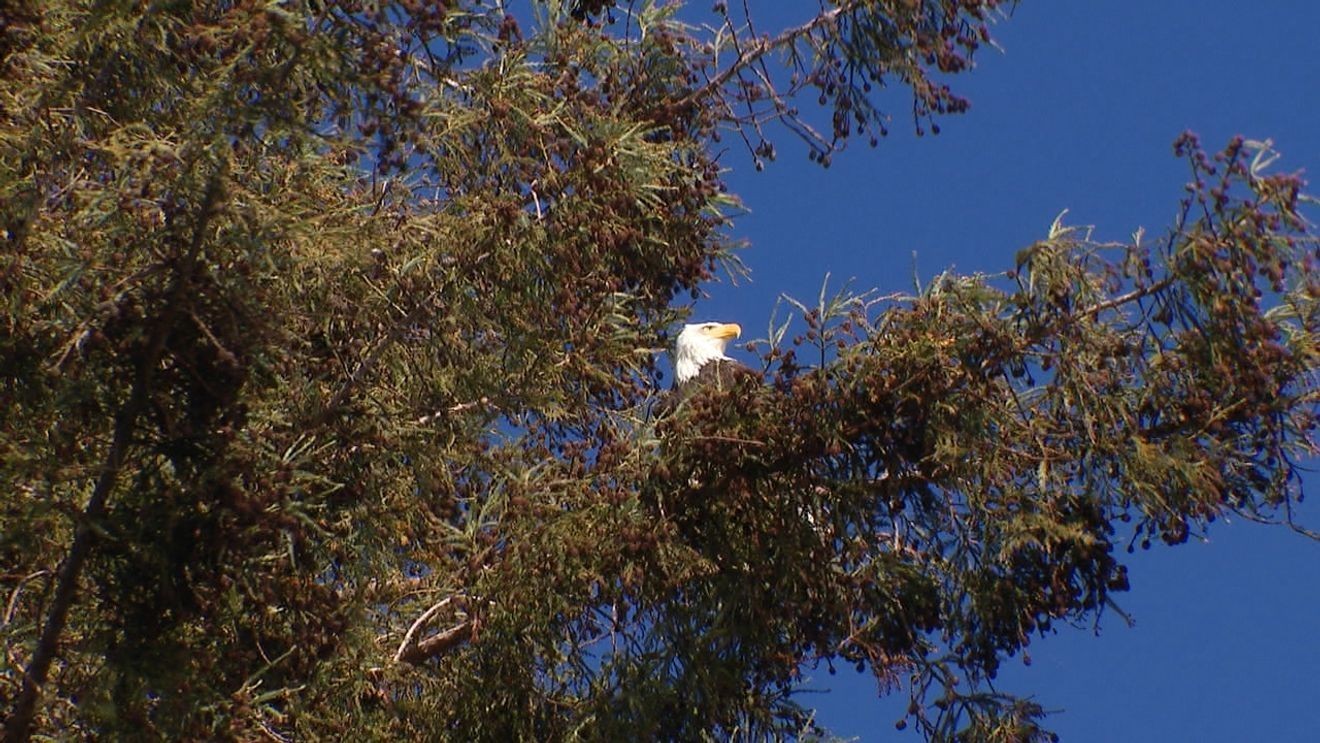
SEATTLE — A century-old redwood in Seattle’s Madison Park neighborhood was spared from the chainsaw after neighbors raised concerns that bald eagles have been using the towering tree as a regular roost. They said it’s possibly even a nesting site.
A tree-cutting crew arrived Thursday morning to remove the roughly 100-foot-tall redwood at 700 McGilvra Blvd. E, where the property owner has received a city permit to clear the tree to make way for a retaining wall ahead of building a new home.
RELATED | Neighbors rally to save redwood slated for removal in Seattle’s Madison Park
Just as neighbors gathered beneath the tree, a pair of bald eagles flew in and one landed on its upper branches. They quickly pointed that out to the tree-service workers.
“And as we’re telling them, an eagle flew and went into the tree. Yes, an eagle, and another one was just circling,” said neighbor Julie Tokashiki Skerritt.
The tree service company ultimately left without cutting the redwood, saying it did not want to risk violating state or federal wildlife protections.
Bald eagles, once endangered, remain shielded under the federal Bald and Golden Eagle Protection Act.
The law prohibits the removal or destruction of eagle nests, whether or not they are occupied, without a permit from the U.S. Fish and Wildlife Service. Federal guidelines also recommend buffer zones around nest sites and restrictions on certain activities during the breeding season.
Neighbors say they have contacted the Washington Department of Fish and Wildlife, which referred the matter to federal authorities.
“It is at the federal level,” Tokashiki Skerritt said, “and then we’ll just have to follow the laws and the guidelines.”
The property owner told KOMO News he used a drone to inspect the redwood and found no visible nest, but is seeking clarification from federal officials about what permits, if any, are required if the eagles are using the tree as a roost rather than for nesting.
The redwood is part of a grove of six mature trees on a 17,000-square-foot lot designated by the city as an Environmentally Critical Area.
An existing home sits on the upper portion of the subdivided property. The owner plans to build a retaining wall on the lower portion before constructing a new home for himself and his wife. No design plans for the new house have been submitted.
The owner said he spent 18 months working with arborists and engineers and modified earlier plans to reduce the number of redwoods affected from four to one. He said the retaining wall is needed to stabilize a slope that had been previously graded and that his plan preserves most of the grove.
Some neighbors and environmental advocates remain skeptical.
Sandy Shettler, with the grassroots group Tree Action Seattle, said the eagles have used the tree extensively in recent weeks.
“They have selected this specific tree – none of the other trees around, but this one – to spend time in for extensive hours every single day,” Shettler said. “We can’t tell if they’re building a nest or not. We know there’s another nest nearby.”
Shettler said late winter is a critical time for bald eagles as they establish territory and prepare to lay eggs. Shettler is also concerned that removing one redwood could weaken the rest of the grove.
“The trees are all interconnected,” Shettler said. “I would expect the rest of the grove to decline, even if it’s not outright removed, when the new house is eventually built.”
For now, the redwood remains standing as federal officials review the situation.
Tokashiki Skerritt and her husband actor Tom Skerritt, who appeared in such movies as Top Gun, Alien and Steel Magnolias, said they hope the project can be redesigned to preserve the redwood.
“Because the whole community loves and appreciates this small grove of trees,” Tokashiki Skerritt said, “and we especially love it when we see eagle activity.”