
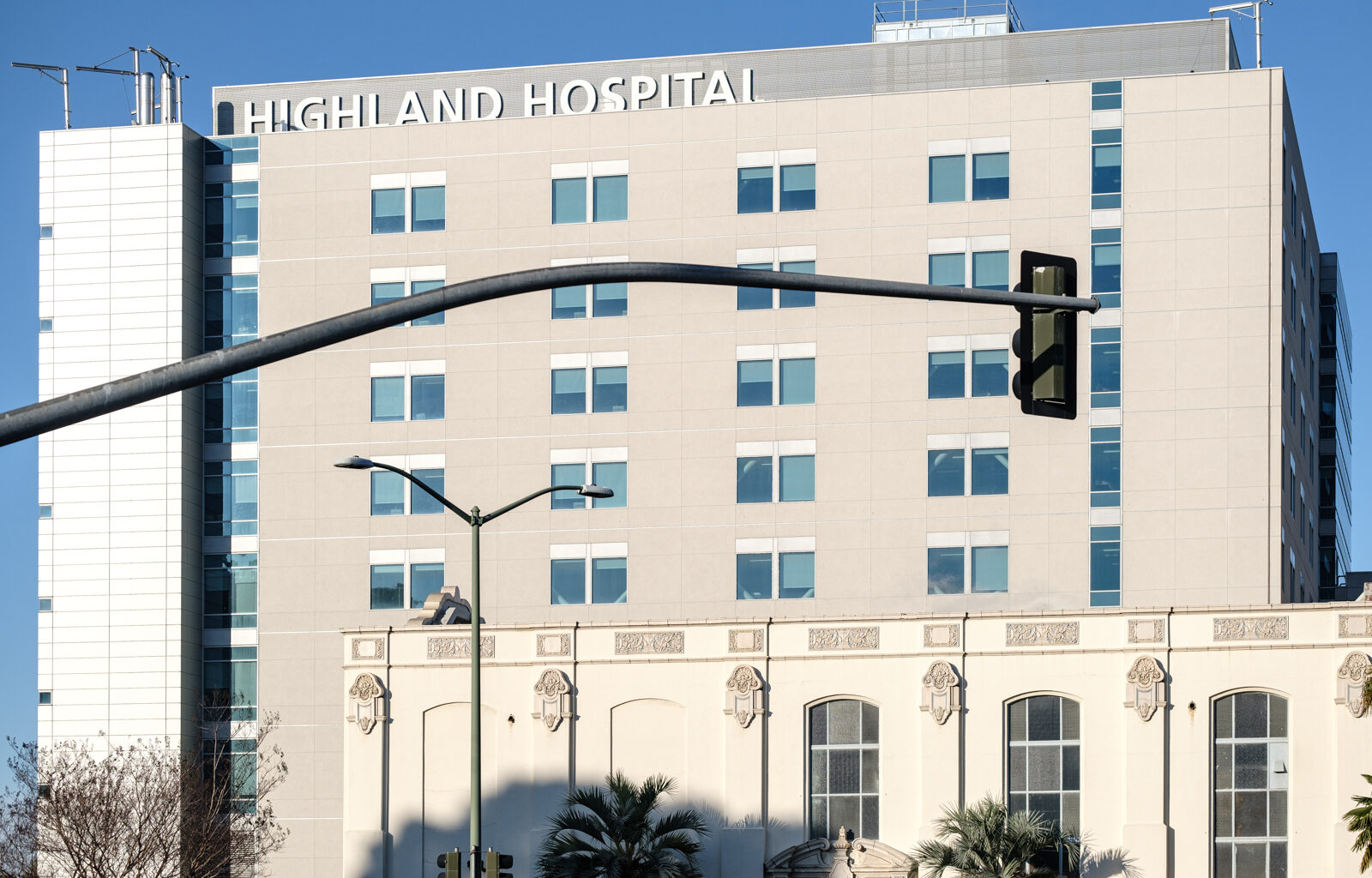
Faced with nearly 200 layoffs across the county’s safety-net healthcare system, the Alameda County Board of Supervisors is looking for a few spare million dollars to try to stem the bleeding.
The Alameda Health System, which operates Highland Hospital and Eastmont Wellness in Oakland, Alameda and San Leandro Hospitals, and other health care centers across the county, has projected that H.R.1, the “Big Beautiful Bill” that a Republican-controlled Congress passed and President Donald Trump signed last year, will cost it hundreds of millions of dollars in the next three years. To compensate it announced a plan to eliminate 188 staff positions, most of them currently filled.
At a public meeting Wednesday evening, current and former patients and their relatives said some of the behavioral health programs facing the deepest cuts had saved countless lives.
Doctors, nurses, therapists, social workers, specialists, administrators, custodians and food service workers painted a picture of a workplace already stretched past capacity. Union organizers lambasted AHS executives for taking five- and six-figure bonuses in practically the same breath as announcing layoffs and program closures.
Wednesday’s meeting was a Beilenson hearing — a legally required but largely procedural step before health systems like AHS can undertake these sorts of cuts. The meeting took nearly six hours; about 100 people packed into the supervisors’ chamber on the fifth floor of the Alameda County Administration Building on Oak Street in Oakland. Many more filled an overflow room, and more than 300 tuned in via livestream. And more than 100 people signed up to give public comments.
During the hearing, Supervisor Nate Miley asked the county administration to try to find at least $10 million to offset some of the job cuts, and proposed a working group of supervisors, AHS executives and labor leaders representing AHS workers to tackle the long-term effects of H.R.1.
“I do think there seems to be a disconnect between what the AHS executive team has decided to do and what we’re hearing from folks who are on the front lines,” Miley said.
The supervisors will meet on Tuesday again, just six days before the scheduled last day of work for those who have received layoff notices. The supervisors floated several approved ballot measures as possible funding sources:
Measure A from 2004, renewed as Measure AA in 2014, a sales tax originally conceived to directly fund AHS, already struggling at the time
Measure C, a 20-year sales tax from 2020 aimed at funding children’s healthcare
Measure W, another 2020 sales tax billed as targeting housing, homeless services and other uses
Seventy-four employees have already taken buyouts, 31 opting for voluntary resignation with severance and 43 for retirement with incentives, according to Jet Chapman, AHS’s human resources chief.
Nevertheless, the system’s finances are currently bleak. Expenses were $13.2 million higher than expected as of December (with only $4.6 million in higher-than-expected revenue), the system is projected to max out its credit line before the end of summer, and there are no cash reserves it can tap into, according to a presentation from Chief Financial Officer Kimberly Miranda.
“Just as a reminder to everyone, 92% of our payer mix is MediCal or other government-funded patients, so we are disproportionately affected as a hospital system and as a safety net system,” Miranda said. On top of that, she said, recent higher-than-normal inflation nationwide meant spikes in the salaries and benefits AHS has paid, while fee schedules for MediCare and MediCal — effectively, what AHS can bill — did not keep pace.
According to AHS, the programs hit hardest would be:
Highland Hospital Outpatient Behavioral Health Wellness Program
Fairmont Outpatient Behavioral Health Program
Highland Hospital’s Health Advocates program, which helps patients and their families navigate AHS and better access care
Highland Hospital’s Tele-sitter program, which helps AHS staff remotely monitor patients’ well-being while they’re hospitalized
Fairmont Hospital’s Kitchen Retail program, which provides meals to staff and visitors
AHS’s ambulatory plastic surgery program
Highland Hospital’s Complex Care Program, teams of staff who help people with multiple, chronic health issues who frequently need medical services
If the cuts go through, AHS said, each of those programs will be shut down.
Peter Masiak, an organizer for SEIU 1021, which represents several classifications of AHS workers, said executives had several times shifted their rationale for layoffs and failed to provide labor leaders pertinent information.
“Our team heard more details and analysis about the cuts today than we’ve ever heard in months of bargaining,” Masiak said, adding that AHS was using federal spending cuts as a pretense to get rid of workers.
“The Trump administration is an existential threat to public health everywhere. There may not be a way out of this, but that there ought to be, and should be, is collaboration,” Masiak said.
Besides layoffs, doctors and other AHS workers are worried about what they said is the hospital system’s apparent unwillingness to fill vacancies that already exist. Several doctors pointed to staffing shortages, especially in vascular surgery and anesthesia, and said they are already threatening patient care and Highland Hospital’s level-one trauma center certification.
“One of our anesthesia colleagues just worked 48 hours in a row to ensure we did not go on trauma diversion,” said Dr. Caitlin Bailey, medical director at Highland’s emergency department. “If we don’t staff our hospital, we cannot function.”
More than 300 doctors signed onto a letter to AHS leadership criticizing the proposed cuts; three of them read it aloud on Wednesday. They wrote the job cuts reflected “a longstanding pattern of poor judgment, lack of understanding of clinical care for the underserved and systemic mismanagement that directly threatens patient safety.”
The doctors asked the supervisors “to intervene decisively” in the trustees’ “mismanagement.”
Dr. Daniel Allen, chief of plastic surgery at Highland, said the cuts to his department meant the hospital would keep up with the roughly three-dozen “complex” cases it typically sees in a year, but drop the roughly 174 other ones it would take on. But those abandoned cases, he said, “include most of the skin cancers that we do, all of the complex wounds and exposed bone referrals … hidradenitis suppurativa, which is an absolutely horrible skin infection.”
The supervisors said they would take the matter up again at 2 p.m. on Tuesday, March 3.
“*” indicates required fields