
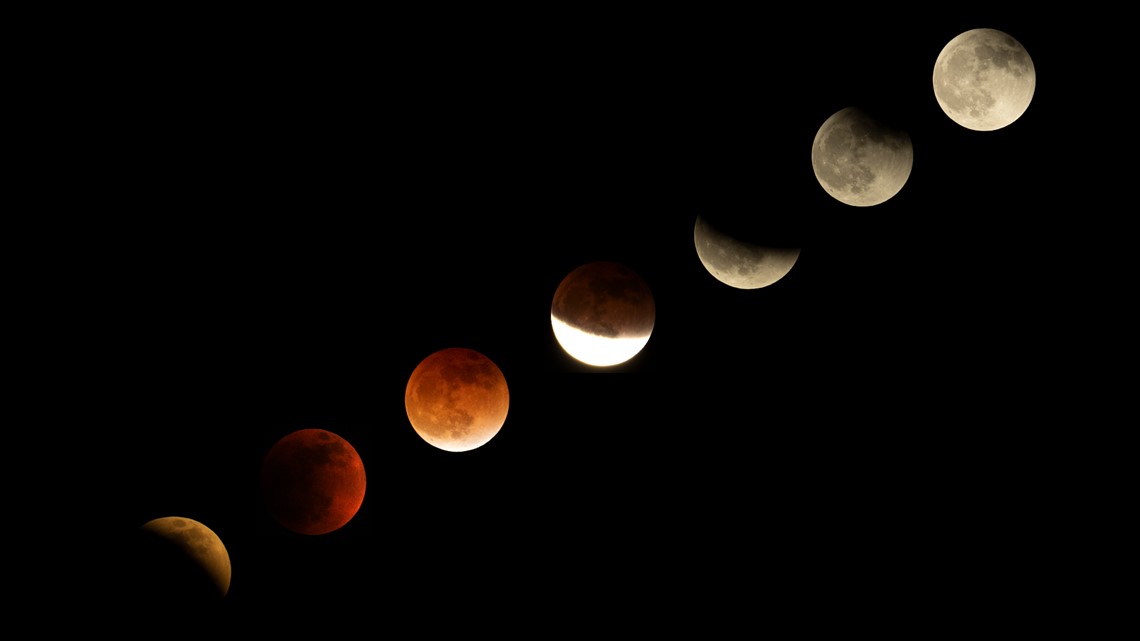
Get ready for a celestial spectacle as a total lunar eclipse paints March’s full moon red. Here’s when and how you can see it.
WASHINGTON — A lunar eclipse will make March’s full moon appear red Tuesday, March 3.
Lunar eclipses, the opposite of solar eclipses, happen when the Earth is positioned between the full moon and sun. This causes a shadow to paint the moon in a reddish-orange color, giving it the title of “blood moon.”
While the United States missed out on September’s lunar eclipse, this one will be easy to see — depending on weather. Here’s what to know.
When is the blood moon eclipse?
The full moon and eclipse will happen very early Tuesday, March 3 and totality will last roughly 59 minutes, according to NASA.
The eclipse will begin around 12:44 a.m. PST, 3:44 a.m. EST, 8:44 UTC with totality happening around 3:04 a.m. PST, 6:04 a.m. EST, 11:04 UTC. The total eclipse is expected to last about an hour, according to NASA. The eclipse will fully end around 6:23 a.m. PST, 9:23 a.m. EST, 14:23 UTC.
Will America see March’s blood moon?
Yes, America will see this lunar eclipse after missing out on the last one in September.
NASA said the total lunar eclipse will be seen, depending on local weather conditions, in the evening from eastern Asia and Australia, throughout the night for areas in the Pacific, and in the early morning hours for North and Central America. The eclipse will be partial for much of Asia and South America and will not be seen in Africa or Europe.
According to NASA, a partial lunar eclipse will be visible on Aug. 27-28. After that, our next total lunar eclipse won’t happen again until June 2029.
How to watch the blood moon
Lunar (moon) eclipses are different from solar (sun) eclipses in various ways, but namely because you do not need any special equipment to safely view a lunar eclipse.
NASA said all you need is a line of sight to the moon to see the eclipse and reddish hue.
Why does the moon turn red during a lunar eclipse?
The moon appears to turn crimson thanks to the same process that makes our skies blue and our sunsets red, NASA says.
When sunlight passes through Earth’s atmosphere, blue light scatters more easily while red light travels more directly through the air. During a lunar eclipse, some of the sunlight passes all the way through the Earth’s atmosphere and reaches the moon’s surface, giving it a subtle glow.
“It’s as if all the world’s sunrises and sunsets are projected onto the Moon,” NASA says.
The space agency says the intensity of the moon’s color depends on the amount of dust or clouds in the Earth’s atmosphere at the time of the eclipse — the more clouds or dust there is, the redder it appears.
Do you need glasses to see a lunar eclipse?
No, unlike a solar eclipse (when the sun is blocked by the moon), a lunar eclipse is perfectly safe to watch. They happen when the earth’s shadow blocks sunlight from hitting the moon, meaning there’s no direct sunlight to damage anybody’s eyes.
During a solar eclipse, the light of the sun is still visible around the edges of the moon, posing a danger to the eyes of sky watchers.
Usually when you look at the sun in the sky, the bright light damages the retinas in the back of your eyes. In fact, it can cause permanent damage in a matter of seconds, according to Scientific America.
Eclipse glasses, similar to masks used by welders, are often used to allow people to watch a solar eclipse.
Technically, you don’t need any eye protection during the height of a solar eclipse, when day turns to night and the sun is completely covered by the moon. In those minutes of complete darkness, the sun’s corona won’t be as bright, only appearing as streams of white light around the moon.
The Associated Press contributed to this report.