
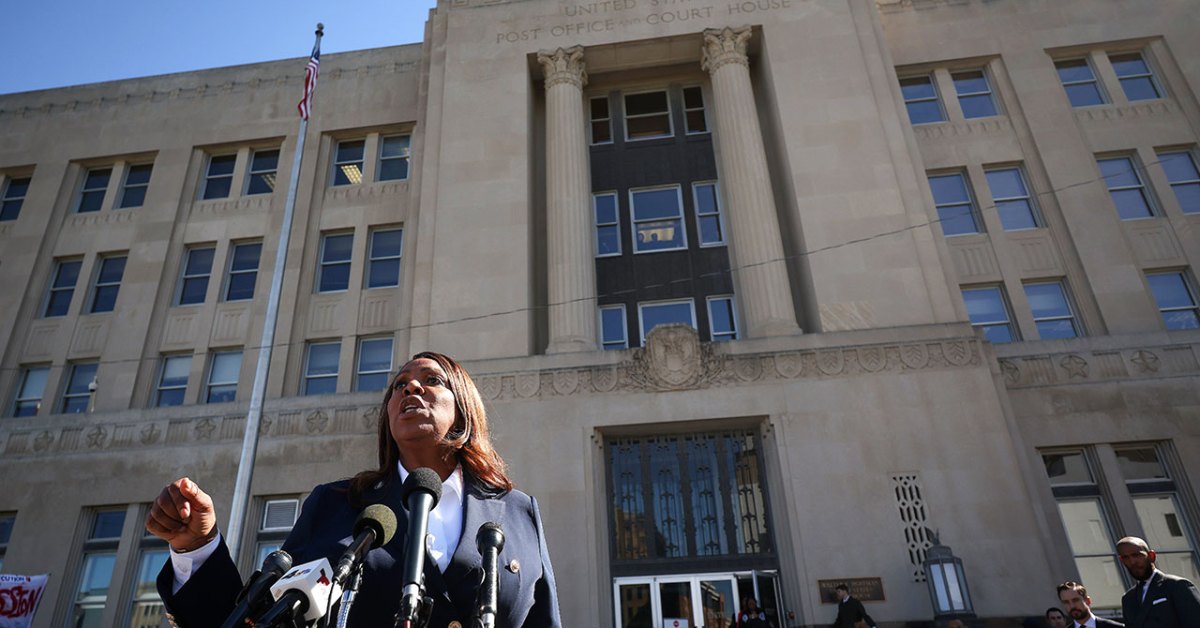
 New York Attorney General Letitia James, a Democrat, speaks outside a federal courthouse in Norfolk, Virginia, on Oct. 24, 2025. Two federal grand juries in the state recently declined to indict James on charges related to mortgage fraud. (Win McNamee via Getty Images)
Federal grand juries indict tens of thousands of people per year in the United States. Several times in the past year, however, they have made headlines for not indicting people the Trump administration has tried to prosecute, including six Democratic members of Congress and the Democratic attorney general of New York.
Here are answers to some common questions about federal grand juries, based on information from the Congressional Research Service, the Administrative Office of the U.S. Courts, the Bureau of Justice Statistics and other sources.
About this research
This Pew Research Center analysis answers common questions about federal grand juries, which have been in the news recently.
Why did we do this?
Pew Research Center conducts high-quality research to help the public, media and decision-makers understand important topics. This analysis is part of our broader work about criminal justice.
Learn more about Pew Research Center.
How did we do this?
This analysis primarily uses information from the Congressional Research Service, the Administrative Office of the U.S. Courts and the Bureau of Justice Statistics. For more information about these sources, follow the links in the text.
What exactly is a grand jury?
For many Americans, the most recognizable kind of jury in criminal cases may be the petit jury, which decides whether defendants are guilty or not. (Think “12 Angry Men.”)
Grand juries are fundamentally different from petit juries. Rather than decide whether a defendant is guilty, grand juries investigate crimes and determine whether the government has enough evidence to charge someone in the first place. If so, they produce a formal charging document called an indictment.
The federal government and many states rely on grand juries to bring charges for serious crimes. At the federal level, these juries are enshrined in the Fifth Amendment to the U.S. Constitution, which states: “No person shall be held to answer for a capital, or otherwise infamous crime, unless on a presentment or indictment of a Grand Jury.”
Federal grand juries are often described as both the “sword and the shield of justice,” as the Congressional Research Service noted in a recent report. The sword refers to how these juries can bring about justice by investigating potential crimes. The shield refers to how they can protect people from being prosecuted for crimes without sufficient evidence.
How do federal grand juries work?
The federal grand jury process typically begins when one of the more than 90 district courts in the U.S. – the trial courts of the federal government – summons people from the local community to serve as jurors. These juries can have anywhere from 16 to 23 members, with a foreperson and deputy foreperson.
They usually meet several times a month and hear evidence in multiple cases per session over the course of months or even years. Each session typically lasts around four hours, according to the latest available data from the Administrative Office of the U.S. Courts.
Federal grand juries meet in secret. They operate in a “non-adversarial” setting, meaning that they typically only hear evidence from prosecutors and witnesses, not from defense attorneys or suspects. And they must only decide whether there is probable cause that a suspect has committed a crime – unlike federal petit juries in criminal cases, which must decide whether someone is guilty beyond a reasonable doubt.
Crucially, federal grand juries do not need to be unanimous in their decisions. While they need at least 16 jurors to conduct business, they only need 12 jurors to agree to an indictment. By contrast, federal petit juries in criminal cases are typically comprised of six to 12 people and must unanimously agree that someone is guilty or not.
Who can serve on a federal grand jury?
People who serve on federal grand juries must represent a “fair cross section” of the community and cannot be struck from the jury pool because of factors like their race, religion or economic status.
They must be American citizens ages 18 and older; have been living in the judicial district of the court that summoned them for at least a year; be able to speak, write and understand English; and be physically and mentally able to serve.
Most people who have been convicted of felonies or are facing felony charges are not allowed to serve as federal grand jurors.
How many Americans serve on federal grand juries each year?
Fewer people serve on federal grand juries today than before the COVID-19 pandemic
Total number of federal grand jurors in session in the U.S., by fiscal year
Note: The federal fiscal year runs from Oct. 1 to Sept. 30.
Source: Administrative Office of the U.S. Courts.
PEW RESEARCH CENTER
Share on X
Share on Facebook
Fewer people serve on federal grand juries today than before the COVID-19 pandemic
Total number of federal grand jurors in session in the U.S., by fiscal year
Fiscal yearFederal grand jurors in session2014164,8562015161,4932016164,7332017161,7592018163,8592019167,3102020107,4892021110,9542022123,7702023130,7572024126,048
Note: The federal fiscal year runs from Oct. 1 to Sept. 30.
Source: Administrative Office of the U.S. Courts.
PEW RESEARCH CENTER
ChartDataShare
Around 126,000 Americans served on federal grand juries in the 2024 fiscal year. That worked out to an average of nearly 20 people in every grand jury session held that year.
The annual number of people who serve on grand juries is higher today than during the first years of the coronavirus pandemic, when the number of federal criminal cases declined sharply. But it is considerably lower than before the pandemic: In fiscal 2019, more than 167,000 Americans served on federal grand juries.
Related: Jury duty is rare, but most Americans see it as part of good citizenship
How many people do federal grand juries indict each year?
Federal grand juries routinely indict more than 50,000 people a year
Total number of defendants indicted by federal grand juries in the U.S., by fiscal year
Note: The federal fiscal year runs from Oct. 1 to Sept. 30.
Source: Administrative Office of the U.S. Courts.
PEW RESEARCH CENTER
Share on X
Share on Facebook
Federal grand juries routinely indict more than 50,000 people a year
Total number of defendants indicted by federal grand juries in the U.S., by fiscal year
Fiscal yearDefendants indicted by federal grand juries201455,890201556,164201655,227201755,818201863,877201970,078202055,233202157,816202253,388202350,397202449,862
Note: The federal fiscal year runs from Oct. 1 to Sept. 30.
Source: Administrative Office of the U.S. Courts.
PEW RESEARCH CENTER
ChartDataShare
In fiscal 2024, federal grand juries indicted just under 50,000 people. That was the lowest number in almost 30 years and well below the roughly 70,000 people who were indicted in fiscal 2019, before the pandemic.
On average, grand juries indicted nearly eight people in every session they held in fiscal 2024 – or almost two people every hour they were in session.
How often do federal grand juries decline to indict someone?
The federal government used to publish this information but no longer does. Based on historical data, however, it’s extremely rare for federal grand juries to take this step.
In fiscal 2016, the most recent year with available data, federal grand juries declined to indict just six people nationally, according to the Bureau of Justice Statistics. In the decade-long period between fiscal 2007 and 2016, they refused to indict an average of 15 people each year nationwide.
It’s been so rare for grand juries to decline to indict people in recent decades that former New York Chief Judge Sol Wachtler famously said in 1985 that any good prosecutor can get a grand jury to “indict a ham sandwich.” The expression, which refers to the sway that prosecutors typically have over grand juries, remains in widespread use today.
In an unusual twist, Wachtler himself was indicted by a federal grand jury in 1993. He served about a year in prison for harassing a woman with whom he had had an affair.