
Scholars discuss the balance between state and federal authority on immigration when ICE arrives.
In an interview with The New York Times, Minneapolis Police Chief Brian O’Hara stated there was “no question” that the encounter resulting in the shooting of Renee Good might have ended differently had her encounter been with a local police officer rather than a federal Immigration and Customs Enforcement (ICE) agent.
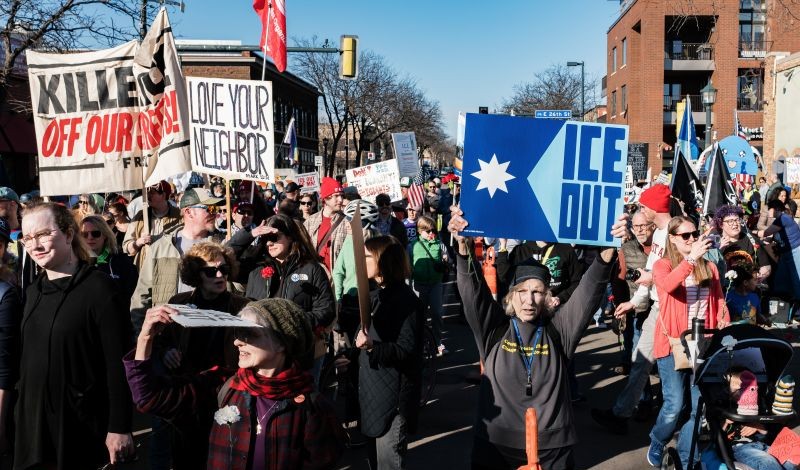
Renee Good was one of two Minneapolis residents—along with Alex Pretti—fatally shot by ICE agents after the federal government deployed over 3,000 federal agents in the city as part of Operation Metro Surge, an immigration enforcement action resulting in thousands of arrests conducted independently of local law enforcement.
Although unique in degree, the Minnesota crackdown resembles a trend of federal action in several states. Across the United States, ICE agents are carrying out expanded deployment orders as part of the Trump Administration’s broader effort to prioritize border security.
Within hours of President Donald J. Trump’s second inauguration in January 2025, he issued a directive significantly expanding federal immigration law enforcement nationwide. The directive rescinded a Biden‑era guideline barring ICE from conducting operations in “sensitive” areas such as schools, hospitals, and churches.
In the wake of the increased presence of federal agents in previously protected and state-dominated areas, broader questions of federalism and the balance of authority between state governments and the federal government now take center stage.
Some scholars argue that, under the Trump Administration, the balance between state and federal power takes both the form “cooperative federalism,” in which state information aiding ICE crackdowns, and “uncooperative federalism,” in which states adopt policies or legislation to resist executive directives.
Sometimes, the absence of cooperation lies not in state resistance but in federal dominance. For instance, the U.S. Attorney’s Office blocked the Minnesota Bureau of Criminal Apprehension—a state law enforcement agency dedicated to preventing, solving, and investigating crimes—from investigating the shootings of Good and Pretti, granting sole responsibility for the inquiry to the Federal Bureau of Investigation.
The decision breaks with longstanding norms of cooperation between state and federal authorities, and the federal government has not publicly offered a legal rationale for this shift.
Often, the state’s interactions with the federal government regarding immigration law enforcement occur through local municipalities like cities and towns, decentralizing state power and triggering internal conflict within the state.
For example, the 287(g) Program authorizes local law enforcement agencies to partner with ICE and assist the federal government in identifying and removing undocumented people and executing administrative warrants on ICE’s behalf. Recently, ACLU Minnesota sued Freeborn County, alleging that the county adopted a 287(g) agreement unlawfully by failing to implement it in a manner consistent with state and local laws.
In this week’s Saturday Seminar, scholars examine how federal enforcement powers clash with state and local authorities, including conflicts over jurisdiction, enforcement, and the regulatory frameworks that determine when federal agents may perform duties traditionally handled by state officials.
Tiffany J. Lieu of Harvard Law School’sCrimmigration Clinic argues in the Columbia Law Review that an accountability gap arises when ICE refuses to produce immigration detainees for criminal court proceedings, even under court order, leaving noncitizen defendants unable to contest pending charges. Because neither ICE nor criminal prosecutors face consequences for this refusal, defendants are deported on the basis of charges they had no opportunity to dispute. Lieu contrasts this with the Interstate Agreement on Detainers, which requires charge dismissal when detained individuals are not brought to trial within a set period. She proposes that courts dismiss obstructed charges and bar immigration judges from relying on pending or dismissed charges as grounds for detention or deportation.Kristina M. Campbell of Gonzaga University School of Lawargues in the Idaho Law Review that the federal government should exercise its plenary powers over immigration to protect family unity as a human right recognized under international law. Campbell traces how Biden Administration programs designed to preserve families—including Deferred Action for Parents of Americans and the Keeping Families Together parole-in-place program—were blocked through state-led litigation before taking effect. These failures, she contends, illustrate how federalism and congressional inaction have left international human rights norms without a domestic enforcement mechanism. Campbell concludes that Congress and the executive branch should collaborate to enact immigration policy that prioritizes family preservation over removal.In an Alabama Law Review note, Noah Harrelson explains that state and local officers deputized under federal task-forces are often treated as acting under federal—not state—law, narrowing constitutional remedies for misconduct. He points to court decisions that presume federal status for task-force officers, leaving plaintiffs limited, fact-specific routes to more generous remedies available against state law actors. Harrelson warns that courts may treat an officer’s state employment as a reason not to extend remedies available under existing precedent, further narrowing federal recovery options. He urges clearer delineation between federally driven and state-driven operations to prevent agencies from exploiting ambiguity over whether conduct is under color of federal or state law to game recovery options.In a recent Yale Journal on Regulation article, David Chen of the New York University School argues that conventional scholarship on state-federal disputes related to immigration law ignore the role states play in determining immigration status. Chen explains that immigration has long been understood by legal scholars to fall entirely within the authority of the federal government, with states subject to federal enforcement and federal benefits. Through an exploration of empirical evidence across all fifty states, Chen discovers that several states have created their own regulatory immigration schemes, sometimes even in direct response to federal policy. Some examples Chen cites include judicial accounting for deportation risks in criminal charges and loosened requirements for noncitizen medical licensing.In an article for the Idaho Law Review, Stella Burch Elias of the University of Iowa College of Law explores the evolution of the state-federal relationship on immigration matters during the second Trump Administration. In her article, Elias coins the term “immigration federalism,” referring to the interplay of national, state, and local government in immigration regulation. Elias also discusses case law supporting a historical distinction between “immigration” and “alienage” law. She explains that the latter governs benefits to noncitizens already residing within the United States and may be enacted by states, whereas the former are exclusively federal and relate to the admission and removal of noncitizens. She ultimately concludes that collapsing the two risks the erosion of state sovereignty.An unsigned Harvard Law Review note argues that San Francisco’s selective cooperation with federal prosecutors and immigration authorities in cases involving undocumented, low-level drug dealers effectively sidesteps the city’s sanctuary-city policy by enabling removals that city officials cannot pursue under local law. The author explains that, in these “fast-track” cases, federal prosecutors offer de minimis sentences in exchange for rapid guilty pleas, relying instead on near-certain deportation as the primary penalty. The author argues that using deportation as a de facto sentence undermines federal sentencing uniformity, producing extreme disparities with guideline-based outcomes both locally and nationwide. The author questions the program’s efficacy in reducing overdoses and urges prosecutors to use conventional plea and sentencing practices rather than leveraging deportation.
The Saturday Seminar is a weekly feature that aims to put into written form the kind of content that would be conveyed in a live seminar involving regulatory experts. Each week, The Regulatory Review publishes a brief overview of a selected regulatory topic and then distills recent research and scholarly writing on that topic.