
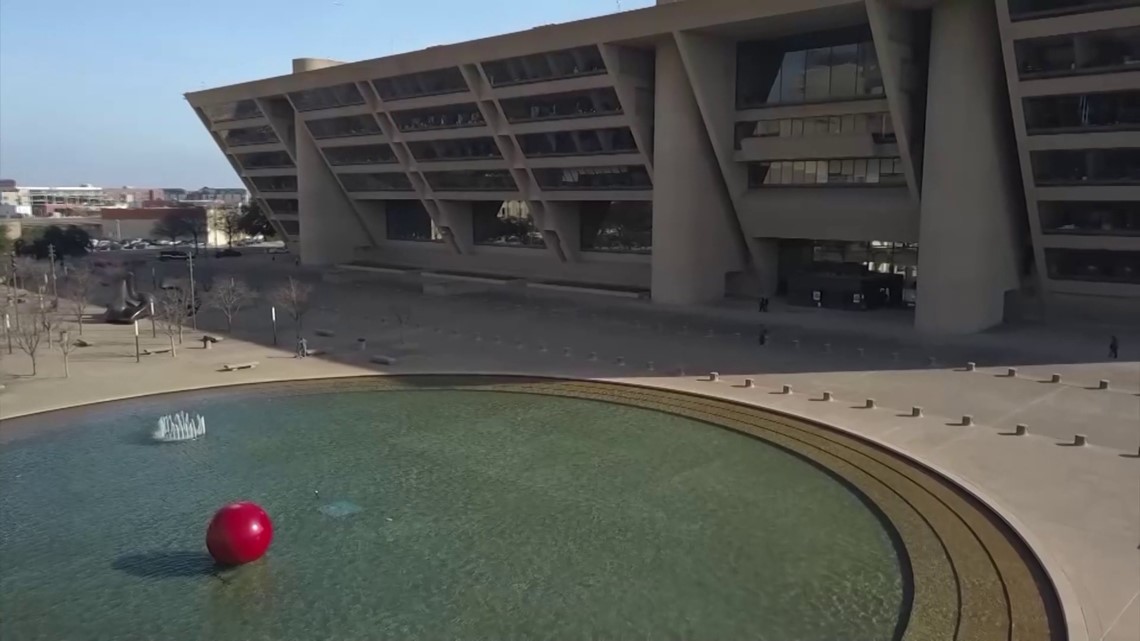
A new paper from the group accused the EDC’s report of being “built on faulty assumptions” with “inflated cost allocations.”
DALLAS — One week after the city of Dallas published a report finding the repair of City Hall would carry a $1 billion price tag, former presidents of the American Institute of Architects Dallas have released a paper finding the report not credible.
According to AIA Dallas’ paper, the report has several problems, including “an apparent bias toward relocation.”
AIA Dallas found that, of the $1 billion, about $329 million is what would actually be allocated to repairing city hall. But even that number, the paper says, is problematic.
One area in the report where AIA Dallas says it found faulty assumptions was in the claim that renovations would require City Hall to relocate its entire staff and leadership for five years, costing an extra $113-195 million. But, the paper found Dallas renovated and expanded Love Field while it stayed open every day, and even City Hall remained occupied and functioning as it underwent roof replacement and other upgrades and repairs.
“Relocation is simply not necessary,” the AIA Dallas paper writes. “For City Hall, as with other similar projects, a typical solution would be a phased construction approach, determined in partnership with a selected contractor after detailed programming, design and planning.”
With this approach, the paper estimates that renovations could be completed in about three years.
The paper also finds the EDC attributes several non-repair costs to staying at City Hall, like furniture, interiors, technology and operating expenses, but doesn’t point out these costs would be part of any relocation scenario, and aren’t unique to staying at City Hall.
According to the paper, the EDC also doesn’t account for interest costs on any alternative scenarios involving new construction either.
The paper claims that, based on these scenarios, more than two-thirds of the EDC’s $1 billion estimation is “based on faulty assumptions, incorrectly allocated to the ‘repairs’ of City Hall.”
Among other stated problems with the cost estimates, the paper found the EDC report ignores any potential help from historic tax credits, which could help offset repair costs by up to 45%.
“The taxpayers should know what it will cost to optimize the existing City Hall through phased improvements utilizing existing city-owned real estate to provide interim space during those improvements,” the paper argues. “The assumption that phased improvements are inherently bad options needs to be challenged.”
WFAA has reached out to the City of Dallas for comment on the paper.