
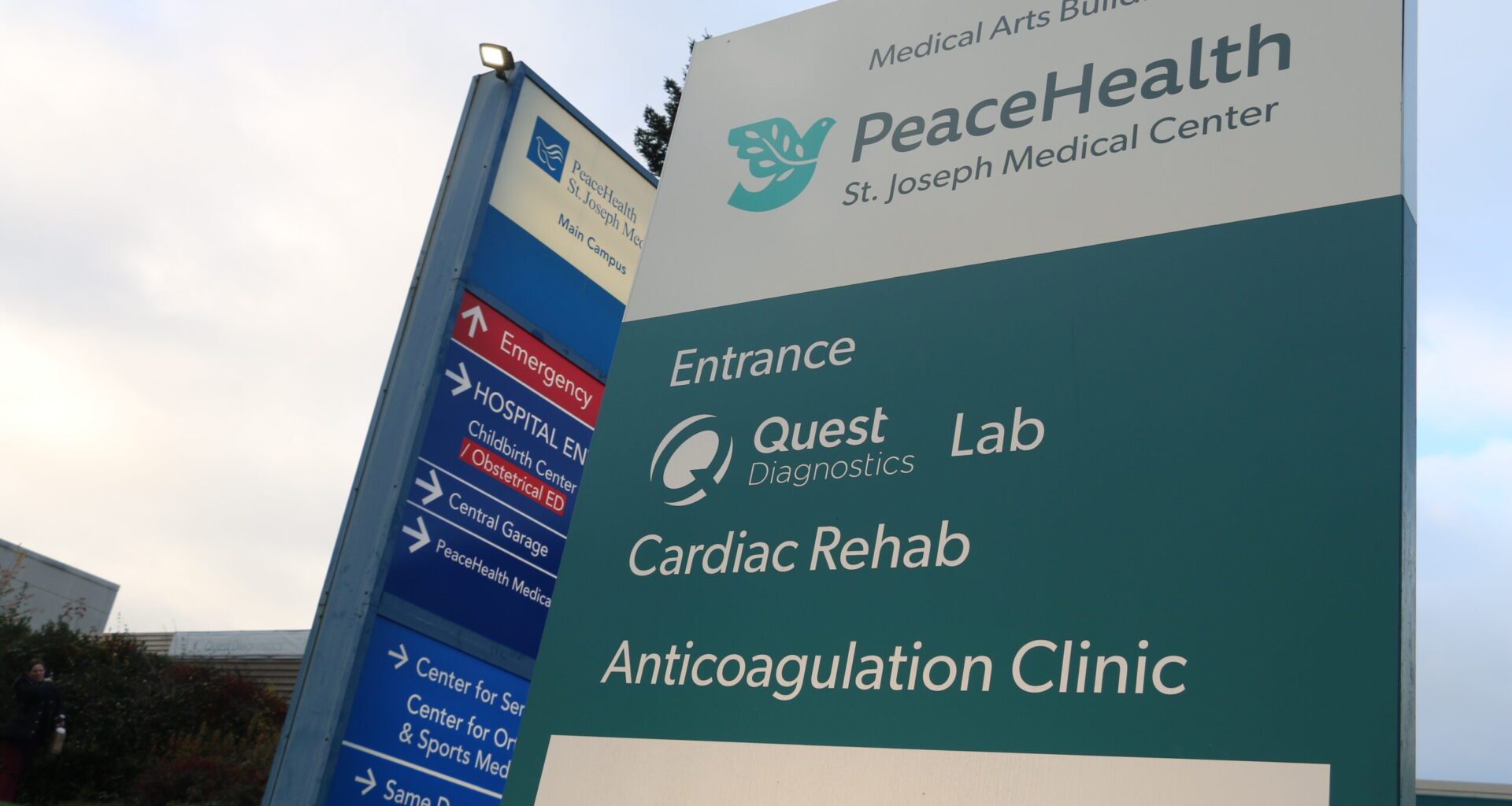
PeaceHealth plans to shrink an optional part of its cardiac rehabilitation services in Bellingham.
The third phase of cardiac rehab, which has traditionally been a supervised service on the hospital’s main Bellingham campus that some participants have attended weekly for more than a decade, will now be capped.
As of Feb. 26, current and prospective participants can stay in phase three for only eight weeks, Jerry Marschke, the executive director of cardiovascular services, told participants at a meeting for patients Thursday. Come the end of April, current phase three cardiac rehab participants won’t be eligible for the program when they’ve reached their eight weeks.
The announcement comes after PeaceHealth cut the cardiac rehab program’s supervisor in a round of layoffs in October, leading dozens of patients to sign a petition asking the hospital not to cut or close the program. Multiple patients sent letters to the health system’s regional executive, stating the importance of the program to their recovery. PeaceHealth St. Joseph has been talking with the YMCA about potentially outsourcing the program.
Now, PeaceHealth is developing a partnership with the YMCA, which is preparing to welcome phase three participants who’ve finished their eight weeks at PeaceHealth, the hospital said in a statement to Cascadia Daily News.
Phase three of cardiac rehab is an optional and final period of outpatient rehabilitation that follows initial phases that are more intensive, often required or highly recommended, and take place more immediately after a cardiac event. Previously, patients had the option to stay in phase three for as long as they’d like.
PeaceHealth has hosted twice-weekly open rehab sessions on St. Joseph’s Squalicum Parkway campus that allow people to maintain active movement following cardiac events. The optional phase three is not typically covered by insurance and costs participants around $50 per month.
“Our phase two program is growing so rapidly, we’re seeing it grow about 12 to 13 percent per year, and we need to create space for the phase two patients, because that’s the core of what we do in cardiac rehab, is phase two,” Marschke told patients, according to multiple audio recordings of the meeting provided to Cascadia Daily News by attendees of the Thursday meeting, conducted at the hospital’s health education center.
A Cascadia Daily News reporter attempting to witness the meeting was asked by a PeaceHealth official to leave. The person then summoned security to ensure the reporter’s departure, stating it was a private event.
After Marschke repeatedly said the decision to limit the program to eight weeks was due to space constraints and a growing phase two population, one participant suggested money could be raised to expand the space if the hospital would communicate to the public the fact that the patients highly value the caregivers.
Phase three will remain open to new patients coming out of phase two, PeaceHealth said in a statement.
“This approach helps ensure that we can prioritize access to Phase 2, which is the medically necessary and time‑sensitive stage of recovery following a cardiac event, while still supporting patients who wish to continue structured exercise in a non‑clinical format,” the hospital spokesperson said.
Skagit Regional Health’s Cardiac Rehab has no limit on the length of time a patient can remain in phase three, according to a spokesperson.
But many of the roughly hundred phase three patients who attended Thursday’s meeting say they won’t attend cardiac rehab elsewhere at places like the YMCA.
“We all know the stories of people who didn’t die because they were at cardiac rehab when they had a cardiac event,” one participant said.
Without the cardiac rehab program on St. Joseph’s campus, many program participants said they fear for their safety doing cardiac rehab without medical supervision and without the close proximity to the emergency room.
A few weeks ago in a phase three session, a participant fell face-first on their treadmill, according to a participant’s recounting Thursday.
“By the time I unhooked my safety strap and turned the machine off, two girls were over there helping her up,” the participant said. “That quick, you won’t find this in a commercial gym anywhere.”
Patients also said they fear that the scale-back will result in PeaceHealth treating more preventable cardiac events.
“The reality of it is, is to shorten this program to eight weeks guarantees that most of the people in this room will be back getting heart procedures much quicker than they would if the program continues. You’re sentencing us to shorter life expectancies,” one participant told Marschke Thursday.
When attendees lent a proverbial hand to Marschke, saying they knew he supported the patients’ plea and that the patients understood he’s in a tough spot, he said that the decision wasn’t made in Vancouver, Clark County, where the health system is based, but rather in Bellingham. The decision was his, he said.
The Catholic nonprofit’s announcement to its patients Thursday came the same day PeaceHealth published an “open letter to the community.”
“We are facing forces far beyond our local or even our system control,” the letter reads in part. “Federal action to significantly reduce healthcare funding is creating enormous strain on health systems across the country.”
Program participants asked Marschke if a committee that included patients could be established to determine an alternative route. Marschke said he would consider a committee, but can’t make any promises.
Owen Racer is a Report for America corps member who covers health care and public health in Whatcom and Skagit counties. Reach him at owenracer@cascadiadaily.com; 360-922-3090 ext. 101. Learn more and donate at cascadiadaily.com/rfa.