
Water resource managers in the Yampa Valley are happy when the watershed receives any type of winter moisture, yet the snowpack levels and summer water flow predictions remain bleak.
Three water resource officials and two agricultural producers laid out disheartening data during panelist updates on the snowpack, runoff forecast and drought outlook during the February community meeting of nonprofit Western Resilience Center.
“Still looks pretty grim,” Erin Light, division engineer for the Colorado Division of Water Resources office in Steamboat Springs, said Wednesday.
“The snow last week and forecasted for this week do not change my comments and concerns,” Julie Baxter, city of Steamboat Springs water resources manager, said Tuesday.
Since water managers consider snowpack a water reservoir, that means this winter’s low snowpack is predicted to lead to a short and low spring runoff and an overall lean water season this summer. That likely means increased residential restrictions on outdoor water uses, agricultural producers forced to be very efficient during a short irrigation season, recreationalists seeing a quick rafting or paddling season and citizens experiencing more closures on the Yampa River.
Michelle Stewart, executive director with Western Resilience Center (formerly Yampa Valley Sustainability Council), said the timely community discussion was meant to help residents “better adapt to and mitigate impacts.”
“The combination of record high temperatures and low snowpack have all of us worried this year,” said Stewart, in an online meeting with some 100 people listening.
Jayla Poppleton, resilient water and watersheds director at the nonprofit, noted experts say Colorado is in “snow drought.”
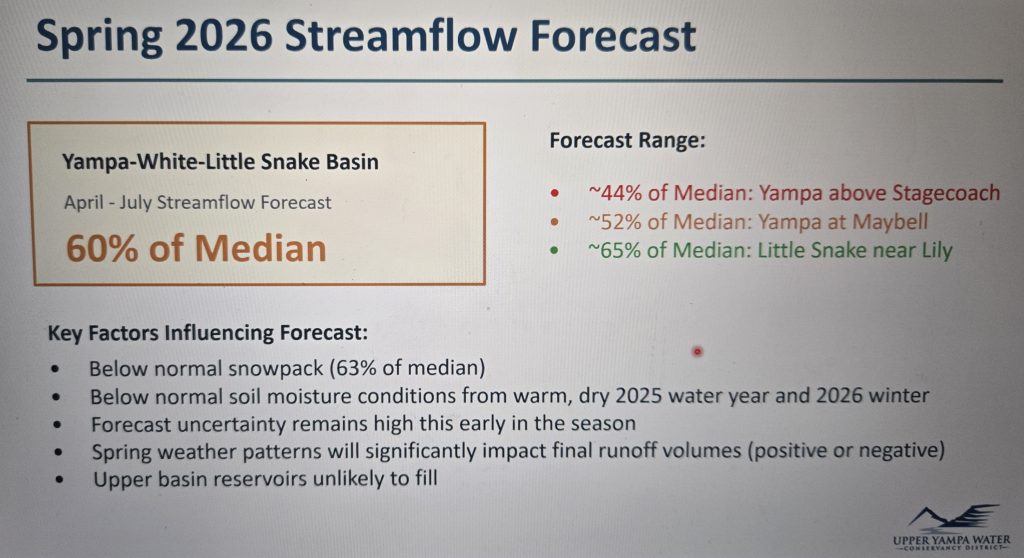 Upper Yampa Water Conservancy District notes the Yampa River spring streamflow forecast from April to July in the Yampa-White-Little Snake Basin is predicted to be 60% of median for 2026.Upper Yampa Water Conservancy District/Courtesy graphic
“When you live in the high country and you see as much bare ground as we do, it doesn’t take an expert to infer that outlook is grim,” Poppleton said. “It’s been widely reported at this point that our statewide snowpack is at a historic low based on records dating back to 1987 when our automated system of SNOTEl, or snow telemetry stations … came on line.”
Poppleton said at the Feb. 11 meeting that U.S. Department of Agriculture measurements show the worse snowpack in Colorado is more than 40 years, with the only winters where snowpack conditions were worse in 1976-77 and 1980-1981.
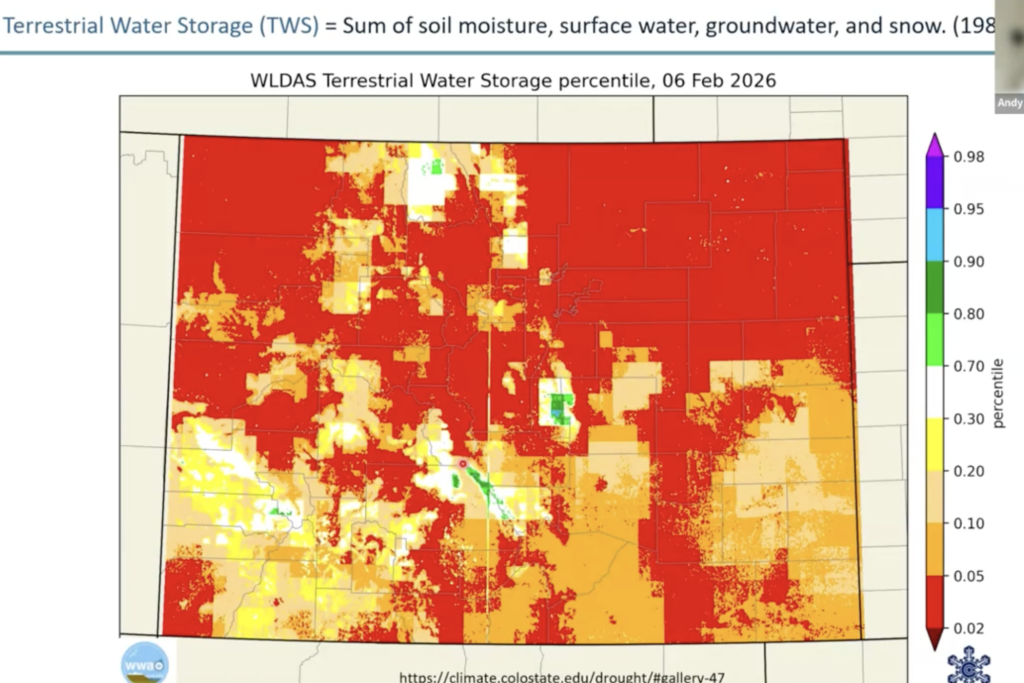
Presenter Andy Rossi, general manager for the Upper Yampa Water Conservancy District, said the stream flow levels in Colorado are shaping up to be a record bad year. Rossi said terrestrial water storage that includes soil moisture, surface water, ground water and snow across northwestern Colorado is at “all-time lows” since 1980 across northwestern Colorado.
“It’s not good news, and nothing that I am seeing out there is pointing in a different direction,” Rossi said.
Rossi displayed graphs of sobering data showing a current record low snowpack in northwestern Colorado dating to 1982.
“The only place we are seeing any kind of normal total water storage is probably above 13,000 feet or in close proximity to a reservoir,” Rossi noted of a statewide graphic.
Rossi noted snow-water equivalency is well below normal at 63% of the 30-year median from 1991 to 2020 in the Yampa-White-Little Snake water basin. The average December temperatures statewide were 8.9 degrees Fahrenheit warmer than normal, bringing more rain than normal. He noted reservoir storage was at 86% of median, and upper basin reservoirs are “really unlikely to fill” this summer.
“We’ve got not a very good chance at getting back to a normal snowpack year, but we also have an equally dismal chance of getting way worse than we are now,” Rossi said, explaining snow-water equivalent projections in the Upper Yampa watershed
Citing Feb. 1 measurements, Rossi said regional lower elevation SNOTEL sites are “experiencing great deficits.” The Elk River site at 8,710 feet measured 60% of median, and the Bear River at 9,100 feet showed 44%. The higher elevation SNOTEL sites of Tower at 10,610 feet measured 75% of median, Lost Dog at 9,350 feet at 72% and Dry Lake at 8,240 feet at 71%.
Rossi noted a “significantly low number” of only 3 inches of snow-water equivalent on the landscape at about 9,000 feet in the Bear River.
In the big picture, Rossi advised water managers and reservoir operators to plan for a record dry year and “to hold on to every last drop.” He advised that agencies should be reviewing drought response plans.
The spring streamflow forecast from April to July in the Yampa-White-Little Snake basin is 60% of median, Rossi said, calling that a “terrible outlook.”
Baxter said the city does have a drought response plan with specific triggers for the three stages. Residents should plan for stage two water restrictions this summer that include such measures as no outdoor running water features and no vehicle washing at residences. Baxter said citizens should expect to see greater enforcement of the existing lawn watering rules this summer.
“Unfortunately, I know there will be economic impacts, and we may expect the river to be closed a lot this season,” Baxter said.
Light with state water resources said agricultural water users will likely be turning on their water sources earlier this year and that water rights holders should see more calls for water that in past years.
“People are really going to have to think outside of the box how they can be most efficient with what water they have,” Light said.
Light advised that operable head gates and measuring devices will be imperative this summer even for the oldest of water rights.
Rancher Tyler Snyder in southern Routt County said in the dry year of 1976, his area saw hay crops at 18% of normal. Snyder also is concerned about summer wildfire dangers.
Rancher John Fetcher in northern Routt County noted water rights holders may not be able to count on the availability of water from smaller creeks and springs this summer.
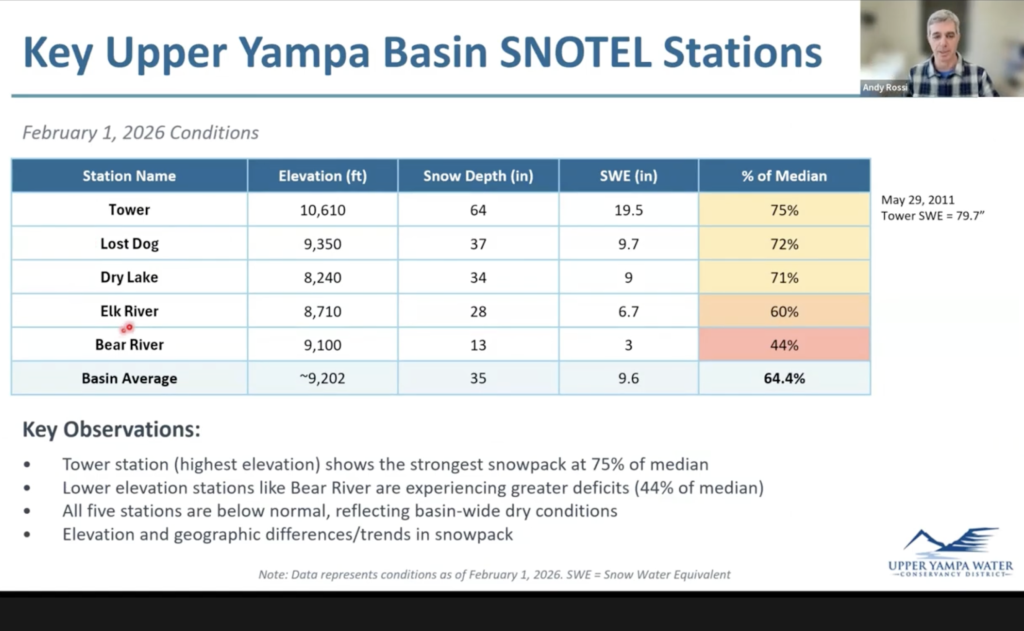 By Feb. 1 measurements, lower elevation SNOTEL sites are “experiencing great deficits,” according to Upper Yampa Water Conservancy District General Manager Andy Rossi.Upper Yampa Water Conservancy District/Courtesy graphic