
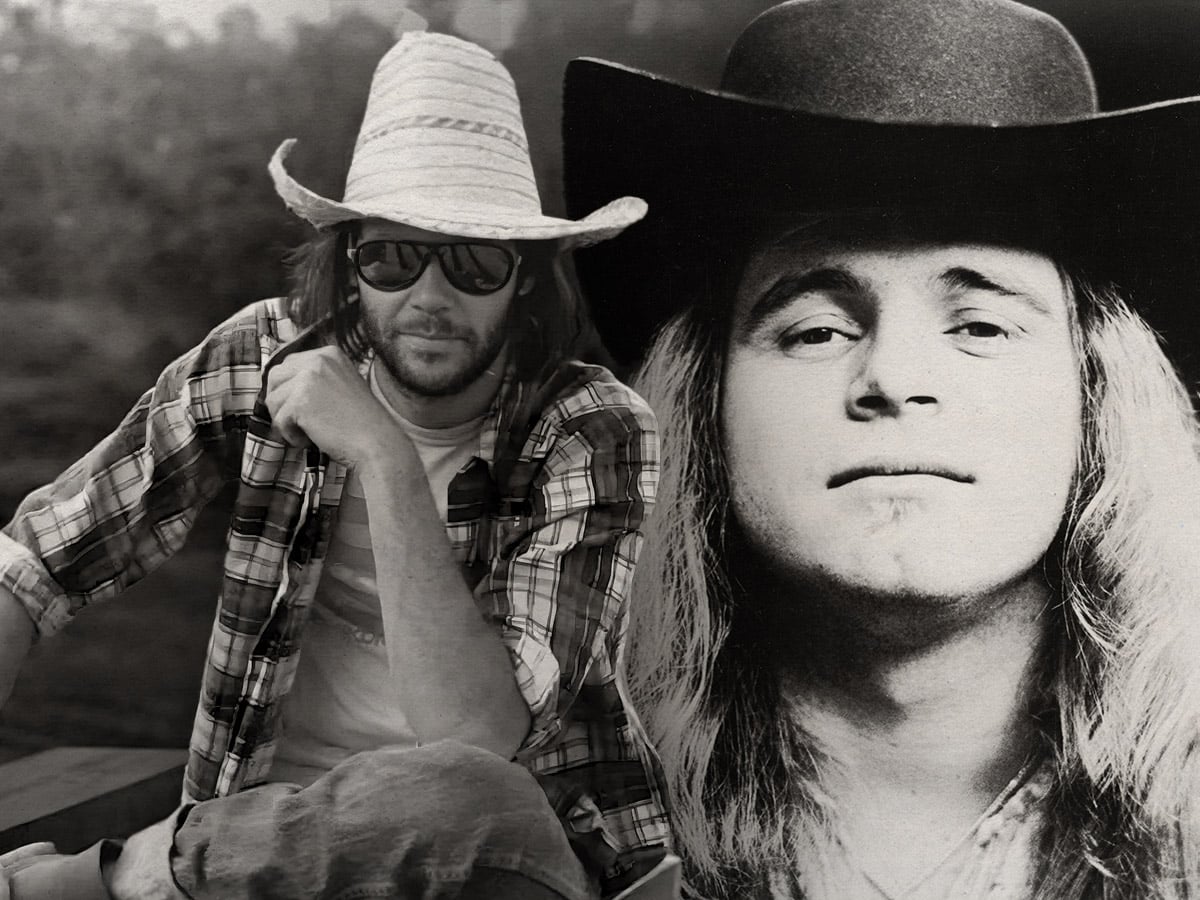
(Credits: Far Out / MCA Records / Analog Originals)
Tue 3 March 2026 15:24, UK
As one of the most outspoken men in rock music, it makes sense that Neil Young may have also irked people with the content of his songs. The most prominent instance of this involves southern rock masters Lynyrd Skynyrd.
The situation started with the material of Young’s After The Gold Rush classic, ‘Southern Man’, which was released in 1970.
The late frontman of Lynyrd Skynyrd, Ronnie Van Zandt, was a big fan of Young’s work and a friend of his, and he was even known to sport his T-shirt when playing live. However, he and his bandmates took the lyrics as a personal slight and an attack on their home culture, with sweeping generalisations such as: “Southern change gonna come at last / Now your crosses are burning fast”.
Skynyrd weren’t the only ones either; many fans from the American South were also enraged at being lumped in with the KKK. This resentment was stoked once more when, two years later, Young released what they saw as the incendiary ‘Alabama’. The track was like a lit match thrown on to a fuelled rag and the explosion was vast and pointed.
Young would later attempt to explain the stereotype of the South in his song ‘Southern Man’ by maintaining that the track was more about the civil rights movement than the region itself. In the liner notes for Decade, he says: “This song could have been written on a civil rights march after stopping off to watch Gone With The Wind at a local theatre.”
Van Zandt and the band were so incensed by Neil Young’s generalisation of the South in both songs that a portion of the lyrics from their most famous hit, 1974’s ‘Sweet Home Alabama’, is about the Canadian. Van Zandt sings: “Well, I hope Neil Young will remember / A Southern man don’t need him around, anyhow”.
 (Credits: Far Out / MCA Records)
Using one of the most famous songs in American history to take aim at a fellow musician is bold, but it speaks highly of the disdain they felt towards Young’s portrayal of their lands. One imagines if the band had taken a similar shot at Canada, Young would have felt the same.
Speaking to Rolling Stone that year, the frontman explained: “We thought Neil was shooting all the ducks in order to kill one or two. We’re southern rebels, but more than that, we know the difference between right and wrong.”
Looking back on the spat with Lynyrd Skynyrd in his 2012 autobiography Waging Heavy Peace, Neil Young expressed regret and agreed that ‘Alabama’ was worthy of criticism. He said: “My own song ‘Alabama’ richly deserved the shot Lynyrd Skynyrd gave me with their great record. I don’t like my words when I listen to it. They are accusatory and condescending, not fully thought out, and too easy to misconstrue.”
Young felt so compelled to make amends that he even offered two tracks to Lynyrd Skynyrd in the late 1970s, ‘Powderfinger’ and ‘Sedan Delivery’. He first recorded ‘Powderfinger’ at Indigo Ranch in Malibu, California, in September 1975 and originally intended to release it on 1977’s Chrome Dreams. However, it would not be released until 2023.
Perhaps the most strange track to possibly give away, ‘Powderfinger’ might well be considered one of Young’s best. Set on bootleggin backwaters and riddled with the sadness of old America and the death of family members, the fact that Young can seamlessly integrate such a vibrant and unusual story into his music and still wrap it up in one of the most vulnerable and touching melodies is proof of his unstoppable talent.
Young sent the tape of ‘Powderfinger’ to Ronnie Van Zandt, and his band were due to use it on their next album. However, tragedy hit, and the vocalist was killed in a plane crash in 1977 alongside bandmates Steve Gaines and Cassie Gaines, assistant road manager Dean Kilpatrick, pilot Walter McCreary, and co-pilot William Gray. This catastrophe meant the group never recorded the song. That year’s Street Survivors became their last studio-length effort until 1991.
This meant that ‘Powderfinger’ and ‘Sedan Delivery’ were left to Neil Young. He used them on 1979’s Rust Never Sleeps and the nestled themselves along his other work to become a rich part of his legacy.
Listen to the songs below.