
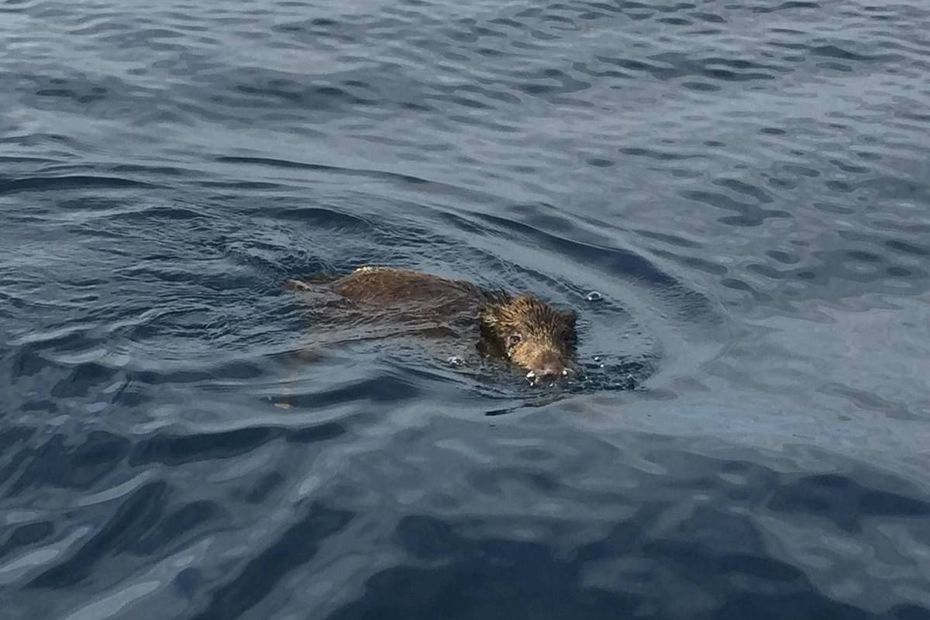
On the sun-washed islands off Hyères, swimmers have unexpected company: wild boars. Drawn by food and sanctuary, these resourceful animals now swim across narrow straits to colonize Île du Levant, Port-Cros, and Porquerolles.
Residents once felt serene, but many now hesitate to step out after dark. The challenge, locals stress, is not simple presence but the explosive growth in numbers.
Sea crossings and fast learners
Hardy and buoyant, boars are surprisingly capable in the water. They can cover several kilometers, propelled by powerful legs and insulated by dense fat. That’s how they likely reached Porquerolles, just 2.3 km from the coast, and Port-Cros, roughly 8.2 km from the mainland.
The same toughness shows on land, where boars can roam over 30 km in a single night. Their mobility, combined with food-rich shorelines and human refuse, encourages bold crossings that once seemed improbable.
Photo: © Frédéric Capoulade – iledulevanthodie.fr
Fragile ecosystems under hoof
Boars are supreme opportunists, and islands amplify their ecological impact. On Levant, repeated soil ploughing rips up terraces and exposes fragile roots. The damage extends below ground, where larvae and bulbs become easy calories for practiced foragers.
Cicadas suffer in particular, because their nymphs spend 5–6 years up to 80 cm underground. Boars can scent that subterranean larder, then pry into walls and restanques for a protein-rich feast. Fewer larvae mean fewer adults, and a quieter, less vibrant summer soundscape.
“It isn’t about whether boars exist here; it’s about how many now do,” said a long-time resident. “When nights fall, people feel trapped, and gardens look freshly overturned by morning.”
When adaptation meets abundance
Across Europe, populations have risen with startling speed. Warmer winters, abundant maize, and edge habitats near towns boost survival and reproduction. A single sow can produce two litters a year, with as many as eight piglets per litter, pushing local densities beyond ecological tolerance.
In France, hunting totals have soared from roughly 35,000 culled in the 1970s to over 800,000 in 2021. Yet on islands with complex land tenure—including military zones—pressure can be uneven. Sanctuaries with little disturbance become de facto refuges, from which animals spill into neighboring neighborhoods.
Road safety also feels the strain, with an estimated 30,000 boar-related collisions each year. Beach paths, gardens, and hiking trails now host unexpected encounters that unsettle both newcomers and regulars.
What response can work now
Officials and locals are testing layered measures, aiming to protect biodiversity while keeping people safe:
Coordinated civil–military operations, preventing animals from slipping through jurisdictional gaps.
Targeted trapping with baited cages, backed by alert-enabled camera traps.
Selective culls by licensed teams, focused on hotspots and sensitive habitats.
Reinforced fencing and buried mesh, designed to resist determined digging.
Public guidance on waste management, feeding bans, and safe night-time movement.
Ongoing data collection—counts, DNA, and mapping—to align action with real-time trends.
These approaches aim to reduce overall density, not erase the species. The ethical balance is to minimize suffering while defending nests, seedlings, and fragile island soils.
The social fabric of a small paradise
Tourism and resident life depend on a feeling of ease, but conservation demands decisive choices. When boars uproot dunes or raid nests, treasured species lose ground; when measures feel heavy-handed, communities lose trust.
Success will hinge on sustained coordination across agencies and patient, science-led iteration. With steady effort, the islands can safeguard both biodiversity and everyday life—proving that the real test is not animal presence, but managing abundance to a level nature and people can bear.