
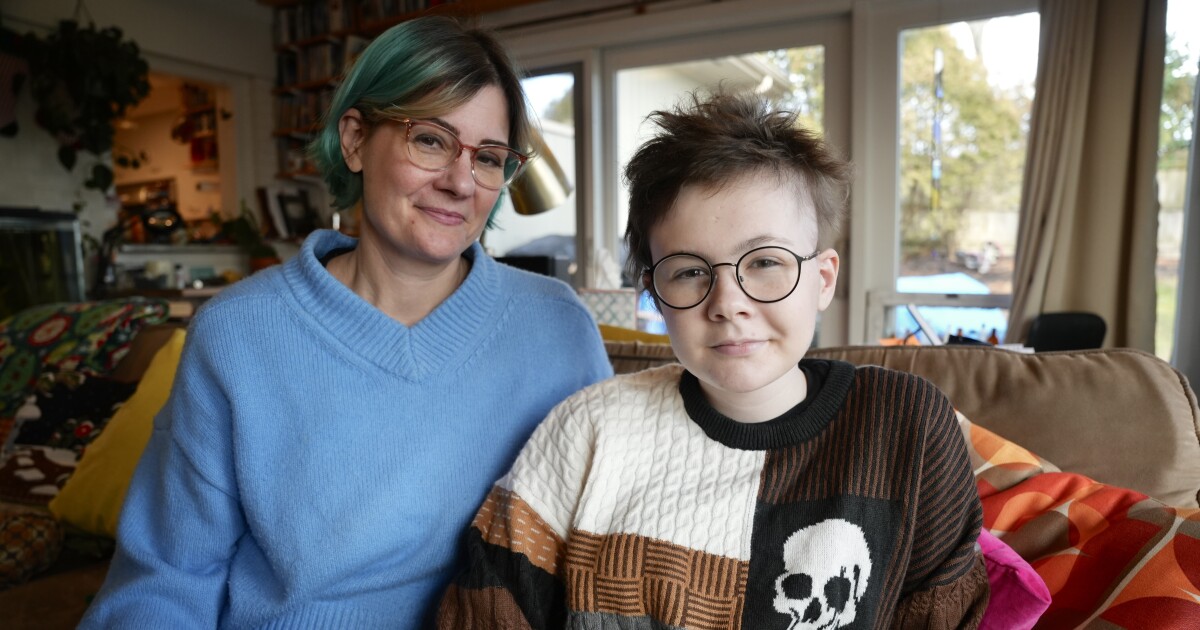
Eliza Cowey was just 12 years old when she was diagnosed with an extremely rare brain cancer in 2022. In the four years since then, she and her family have been strapped into an emotional rollercoaster as Eliza goes through surgeries, scans, chemotherapy and radiation — not to mention puberty.
A gut-wrenching turn in the track came late last year when a scan revealed that Eliza’s cancer spread to a new part of her brain: an inoperable one.
“Some of the growth had come back and one of them was in a place that was not… accessible,” said Eliza’s mother Jody Handley. “And that’s been our fear — that she would get it in a place that we couldn’t really reach.”
Eliza’s astroblastoma is so rare that many of her care options are experimental. Bloodwork revealed a genetic marker that made her a good candidate for a pair of chemotherapy drugs that could slow the growth of the tumors. Jody said the treatment plan at this stage isn’t focused on curing Eliza’s cancer but extending the time she has left.
“We’re looking at buying time,” she said. “We are not looking at curing this anymore.”
The new chemo drugs were the latest effort to buy more time. But before Eliza’s doctor could administer them, he needed to get prior authorization from Aetna.
Prior authorization requires doctors to get approval from a patient’s insurance company before they’ll cover a procedure, prescription or a service such as an imaging exam. Insurance companies use the process as a cost-control tool to prevent unnecessary, high-cost or inappropriate care.
But who determines whether care is appropriate?
Dr. Ed Balaban, a retired oncologist, said prior authorization requests require doctors and patients to navigate a complex approval pathway that can result in delayed or denied coverage for care. Different insurance companies have different authorization pathways. The process can even vary among different plans under the same insurer. And Balaban said when it came to denials, he was often left in the dark about why his treatment plan wouldn’t be covered.
“You never really knew why things were denied,” Balaban said. “It wasn’t a conversation; it was a mandate.”
Prior authorization can be particularly burdensome for cancer patients who often need urgent treatment or symptom management. That includes Eliza Handley.
Aetna approved one of the new chemo drugs Eliza’s doctors wanted to try. But they denied the second one. Children’s Hospital of Pittsburgh explained to Jody that they must be taken together.
After the denial, Jody got to work. She made call after call to Aetna, trying to navigate the appeals process for the prior authorization. Eliza’s doctor worked on the appeal from his end while Jody kept the phone ringing at Aetna with every spare moment.
She found the process demoralizing and stressful. Jody said it felt like her daughter’s life was in the hands of an insurance company rather than a medical provider.
“People behind a phone who have no skin in the game; who don’t know that [Eliza is] an amazing artist; who don’t know that she’s a very kind person who loves horror movies and Adventure Time,” she said.

Kiley Koscinski
/
90.5 WESA
Eliza’s pill planner sits next to her artwork in the Handley’s kitchen.
Part of the appeal process requires a peer-to-peer call between a treating physician and a third-party doctor hired by the insurance company. But the insurance company’s doctor won’t always have the same training as the treating physician, according to Balaban.
“It was very rare that I would actually be talking to another medical oncologist,” Balaban said.
In Eliza’s case, her doctor made an appointment to speak with Aetna, but the call never came. It’s unclear if the company called and left a voicemail. UPMC declined WESA’s request for comment and did not make Eliza’s doctor available for an interview.
But Jody said since the doctors didn’t connect, the authorization was denied. She worried that people falling through a gap like this isn’t a flaw in the system, but part of its design.
“That is a system that is designed to fail expecting that a pediatric neuro-oncologist has two and a half hours in his week that he can just set aside in his office and wait for a phone call that might not even come,” Jody said.
She took her frustration to social media where she heard from several families having similar experiences. One user introduced her to Mike Gartner, the founder of Persius, a Philadelphia-based organization that helps people appeal their insurance coverage denials.
Jody shared her struggle with Persius and although she had already appealed the denial, the group was still able to help by drafting a report that laid out why Aetna should cover the chemo drugs.
“We produced a letter that was roughly 11 pages by the next day which summarized the argument of the oncology team but also summarized the contractual language in this particular health plan,” Gartner said.
Together with Jody and Children’s Hospital, Persius got Eliza’s medication approved. And according to the data, that shouldn’t be a surprise: the overwhelming majority of prior authorization denials are overturned on appeal, according to the American Medical Association.
But few people appeal their prior authorization requests. Just one in eight denied requests were appealed in 2024, according to KFF.

Kiley Koscinski
/
90.5 WESA
Eliza and Jody sit on the couch in their Squirrel Hill home while Eliza works on an illustration on her iPad.
Gartner said Persius was created to change that statistic. The organization offers free help to people navigating how to appeal an insurance company’s decision to deny coverage. Gartner said he started the organization after experiencing his own coverage denial.
“It’s really crazy that there’s a need for this sort of service,” he said. “But I don’t foresee this problem going away anytime soon.”
Last year, the nation’s major health insurers — including CVS Health’s Aetna and UnitedHealthcare — pledged to scale back the number of claims subject to prior authorization and increase the number of claims for which responses can be completed in real time.
Major health insurers have promised to overhaul the process before, but little has changed. Insurers said in June they would standardize electronic prior authorization by the end of 2026. The changes are voluntary. But Trump administration officials have pledged to explore regulations if insurers don’t make progress.
Aetna would not comment on Eliza’s case directly, but claimed that the company has the fewest medical services subject to prior authorization compared to similar companies.
“We recognize that navigating the US health care system can be frustrating, and Aetna is working with other industry partners to simplify the process and help patients navigate through it,” the company said in a statement.
Some major insurance companies have implemented so-called “gold card” programs that exempt approved doctors from the prior authorization process. Insurers reward doctors whose past prior authorization requests were typically approved by admitting them into the gold card program, exempting them from the red tape.
Several states have enacted gold card laws, requiring insurers to award doctors with a high prior authorization success rate freedom from the prior authorization process. Balaban said gold card programs could be “part of the formula” to address the burden of prior authorization, but he warned that a doctor VIP list is not a silver bullet.
“This is a band aid on a big problem,” he said.
In the meantime, Gartner said he hopes more organizations like his can step in to help people get coverage for their care.
“These wrongful coverage denials… have dire, life-threatening implications for the people they affect and yet the accountability and enforcement for corporations who are administering these wrongful denials are minimal if existent,” he said. “But that’s in our power to change. There is support out there.”