

More than 20 years ago, Nathan Good’s friend asked the architect and engineering consultant to design a home for his family.
After some convincing, Nathan did. He loved the process. His son, Forrest, who had recently graduated from Sprague High School, inspired him to lean into that joy and create his own architecture firm.

“He kind of turned the tables on me and said, ‘Well, you’ve always told me to follow my bliss. Why don’t you follow yours?’” Nathan recalled.
Since starting the downtown Salem firm in 2005, Nathan Good Architects has designed homes and commercial buildings, refurbished historic structures and won awards from Sunset and the National Association of Home Builders, among others.
Now, Nathan is handing over the reins to the son who helped inspire the business.
In November, Nathan Good Architects changed its name to Studio Good Architects. Forrest has assumed the title of owner and principal.
Through their father-son partnership, the Goods have been able to navigate a changing technology landscape. Nathan was interested in architecture from early childhood and took four years of drafting, or technical drawing, in high school. He then went on to earn a master’s in architecture from California Polytechnic State University.
As the firm was starting up, Forrest received a degree in engineering from Oregon State University, then went to work for his dad. He went back to school for his master’s in architecture before returning to the firm in 2010.
“That was my good fortune, and the rest is history,” Nathan said.
Having studied engineering and architecture in the 2000s, Forrest incorporated more digital 3D modeling into the pair’s workflow.
“It’s part of how our collaboration worked so well together. (Nathan) would do drawings, sketches, put things down on paper and then early on in my career, my task would be to take those and to make them into visualizations, 3D models, studies, to help kind of modify that design,” Forrest said.
Throughout their interview, the two couldn’t let the other go without praise.
“I mean, the things that Forest can do in a day maybe would take me a week to do before,” Nathan said.
Forrest compared his father to a conductor, “directing the symphony and … bringing all these pieces together visually.”
Despite the new name, an expanded staff and changing tools, both architects said the interpersonal capabilities of their small firm will remain a point of pride continuing through the transition.
In designing a tasting room for a vineyard in Yamhill County a decade ago, they knew that the owner of the property, a friend, had Irish heritage and wrote his doctoral thesis on religious symbology, Nathan said.
The owner had originally planned to use a prefab structure for the tasting room, but Nathan offered to do a mock-up of a design free of charge.
Using 3D modeling, the Goods were able to digitally walk the owner through a rendering of the room while testing out how the lighting would interact with the space depending on the season and time of day.
They drew from ancient Irish architectural motifs in their design, ultimately creating a cairn-like structure with a grass roof and a labyrinthian stone garden. Forrest said that the design process alone for their projects can take 10 to 12 months.
 Fairsing Vineyard tasting room in Yamhill County was designed by Nathan Good Architects with an eye on ancient Irish architecture. It was completed in 2015. (STUDIO GOOD ARCHITECTS photo)
“I’m really reaching here, but there’s something very monastic about what we do that’s hard to explain to other people in terms of architectural design,” Nathan said.
From the outset, the firm has staked its name on a commitment to “green” building practices. That includes a focus on the design of “net-zero” homes, which create as much energy as they use through the use of renewable energy sources like solar. They also work to use locally sourced, natural materials in their practice.
In 2015, Nathan became a fellow of the American Institute of Architects through advocacy of green building practices.
The Goods’ environmental goals in design have shifted over time in light of worsening climate change.
“I think we’ve lost the battle for reducing the impact of climate change,” Nathan said. “I don’t think we can bring it back through our own actions. So now I think it’s time to design what I would call a resilient future whereby our homes and our businesses and our schools can withstand severe weather, fire, air quality.”
Forrest said that a Bend residence the firm designed recently survived a wildfire that surrounded the property. He said a focus on metal roofs, fire-resistant materials, careful placement of plants around the home and a sprinkler system were the home’s saving graces.
Forrest added that climate responsiveness can also stem from creating buildings that support mental health.
“Something we learned through Covid, through being more in touch with our environments, is that our spaces have a big impact on our mental health,” he said. “When we’re dealing with really heavy issues locally, nationally, globally, it’s also important to have a peaceful space and a comfortable space and not a bunker to seal yourself in.”
The Goods bill theirs as a “local firm with international capabilities.” But Forrest, who grew up in Salem and went to Sprague, said he hopes to focus on more local projects in the future.
“When I was the top dog, probably 90 to 95% of our work was not in Salem. … Forrest is more Salem-centric,” Nathan said. “Maybe it’s cause he grew up in town. He has relationships in town, he went to high school here, he played soccer here.”
Besides residences in the Salem area, the firm designed the refurbishment of the historic Greyhound baggage station at 500 13th St. S.E., adding sleek, modern awnings.
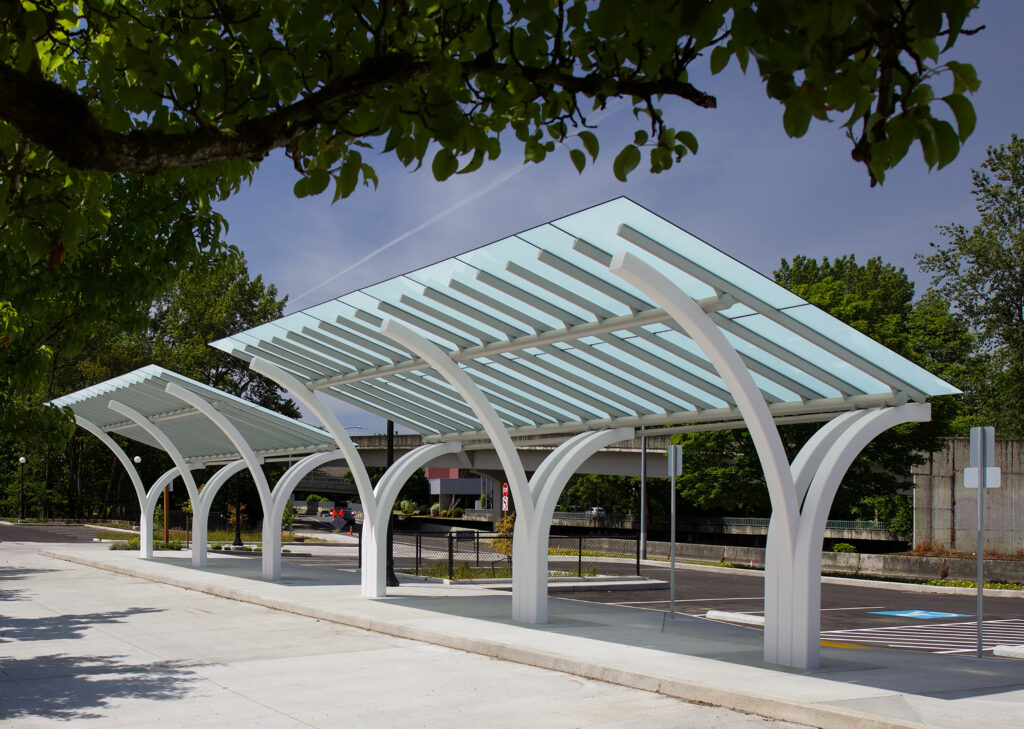 Nathan Good Architects was responsible for the design of these awnings as part of the restoration of the Greyhound baggage depot at the Salem train station completed in 2018. (STUDIO GOOD ARCHITECTS photo)
“I love residential design and homes and the whole process … it’s an architect’s dream. But when you design a home in a place in a remote location … it’s experienced by such a small group of people,” Forrest said.
He hopes to lend his expertise to more local commercial spaces in Salem so “those sorts of experiences can be felt by much larger groups.”
As for his continuing role at the firm, Nathan has taken on the title of “architect emeritus.”
“Forest is the main man now and I avail myself on an as-needed basis,” he said.
Contact reporter Skeet Starr: [email protected].
LOCAL NEWS DELIVERED TO YOU: Subscribe to Salem Reporter and get all the fact-based Salem news that matters to you. Fair, accurate, trusted – SUBSCRIBE

Skeet Starr joined Salem Reporter in 2026 as a multimedia intern. A senior at Willamette University, he is also the editor-in-chief of The Collegian, the university’s independent student newspaper.