
I know we’re all eagerly awaiting Friday’s Save College Sports roundtable at the White House, where surely all of college sports’ ills will be solved on the spot.
In the meantime, let’s distract ourselves with some early College Football Playoff talk for next season.
Last year’s Playoff had four returning teams and eight new teams. How much turnover do you predict this year? — Martin D.
I looked back at what the 12-team fields would have been from 2021-23, and seven to eight new teams appear to be the norm in the following season.
From 2021 to ’22: Seven
From ’22 to ’23: Eight
From ’23 to ’24: Seven
From ’24 to ’25: Eight
Ohio State and Georgia were the only teams to make it all four seasons. Alabama, Oregon and Penn State made three. Eight schools made two and 16 others were one-timers.
So, we already know my early Top 25 will be wildly wrong since it has all but four of last season’s CFP teams in the top 12. (And two of the ones left out are Group of 6 teams.)
I see no reason why this year’s field won’t see similar turnover. It’s just hard to predict who falls out. Right now, it’s hard to envision any of Oregon, Ohio State, Georgia or Miami not making it, but I would have said the same thing last March about Texas, Penn State, Clemson and Notre Dame.
Why don’t we do this? I’m going to reorder the 2025 field from most likely to least likely to return in 2026:
1. Ohio State
2. Oregon
3. Georgia
4. Miami
5. Indiana
6. Texas A&M
7. Texas Tech
8. Oklahoma
9. Alabama
10. Ole Miss
11. Tulane
12. James Madison
I’d say the first cliff where I start to feel less confident is right at that 4/5 line. Miami lost a lot, but it’s still the clear favorite in the ACC and arguably upgraded at quarterback with Darian Mensah. That being said, the Hurricane don’t have a long track record of reloading yet. And ditto Indiana, which lost a ton of NFL prospects, including the No. 1 pick.
Beginning with them, it’s not as hard to see how things could go wrong. And then starting with Texas Tech, it’s anyone’s best guess. So, seven to eight new teams seems right on the money.
Who they will be is anyone’s best guess, but the non-CFP teams I had highest in my rankings were:
1. Notre Dame
2. BYU (before top receiver Parker Kingston was expelled from school)
3. USC
4. Missouri
5. Michigan
6. LSU (which I would have higher now)
7. Louisville
Plus, the highest-ranked G6 team: Boise State
Now watch none of them make it, while Cal, Minnesota, Houston, Wisconsin, Washington, Florida and UNLV take their place.
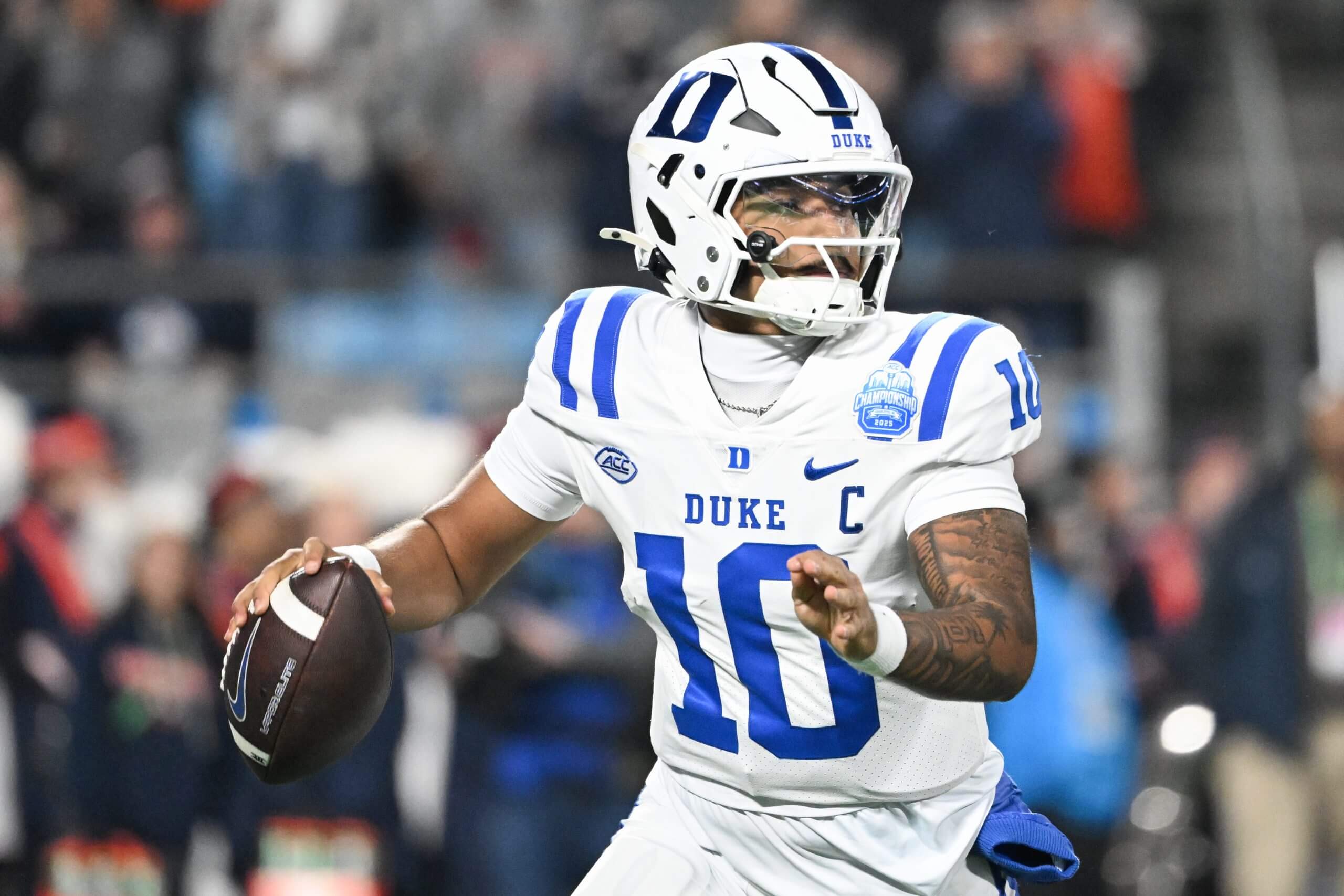
Miami could be back in the CFP mix after landing quarterback Darian Mensah from the transfer portal. (Bob Donnan / Imagn Images)
Draft season is upon us … It seems that this year and last year, the QB classes have been a bit underwhelming. Obviously, some years are better than others, but could we be seeing a drop-off in QB (and other positions potentially, at least at the top of the draft) because of all of the transferring and players not developing in one system for several years? — James S.
Quite possibly. But then again, only two years ago we had a draft with Caleb Williams, Jayden Daniels, Drake Maye, Michael Penix Jr. and Bo Nix, which could go down as an all-timer. And four of those five (everyone but Maye) played at more than one school.
We also had several quarterbacks this year who were expected to be high-round picks going into last season but who flopped or got injured in their senior seasons — Cade Klubnik, Drew Allar and Garrett Nussmeier. And those three all happened to play their whole careers at one school.
May I offer another theory? Is it possible these classes are lighter than in years past because more guys opt to return to school thanks to the NIL money? How differently would we be talking about this year’s QBs if Arch Manning and Dante Moore had turned pro? Or even LaNorris Sellers, who had a disappointing 2025 season but would probably have been, at worst, No. 3 behind Ty Simpson.
So, I wouldn’t panic just yet. Manning, Moore, Sellers, CJ Carr, Julian Sayin, Trinidad Chambliss, Mensah, Brendan Sorsby and many more have a chance to play themselves into high-round status in 2027, not to mention the inevitable Mendoza-, Simpson- or Cam Ward-level riser. But if a year from now we’re still playing the “This class isn’t great but next year’s should be better” game, the NFL may have a problem.
Among the top 10 in this year’s Heisman Trophy voting, six of those players will be entering the NFL Draft. Which school has the most difficult time replacing its guy? Some might reflexively think that the answer is Fernando Mendoza at Indiana, but Vandy’s Diego Pavia and Georgia Tech’s Haynes King were their teams’ entire identity and offensive production. — Michael M.
I’ve got to say Pavia. He wasn’t just the heart and soul of his team; he was the engine behind the complete transformation of Vanderbilt’s program, culminating in the Commodores’ best season since 1948. Pavia finished the 2025 season at No. 2 nationally in total offense (4,401 yards in 13 games) and No. 3 in passer rating (170.4). And it wasn’t just his arm and scrambling ability that took them to such heights; the entire team fed off his brash confidence.
Coach Clark Lea pulled a recruiting coup last year when five-star QB Jared Curtis from Nashville decommitted from Georgia and opted to stay home at Vandy. He will be Pavia’s presumed successor this fall. But it’s rare for a true freshman to come into any offense and excel from Day 1. See Michigan’s Bryce Underwood last season. So while Curtis and the Commodores have a bright future ahead, they will almost certainly take a step back in production at QB next season.
You could also make a strong case for King, who threw for 2,951 yards and ran for 953 last season. Georgia Tech did not lose just its QB1, but also his heir, Aaron Philo, who followed OC Buster Faulkner to Florida. But I’m intrigued by who Brent Key landed in the portal: Indiana’s Alberto Mendoza, younger brother of the soon-to-be No. 1 pick.
Finally, Notre Dame will obviously miss No. 3 finisher Jeremiyah Love and his sidekick, Jadarian Price. They combined for 2,863 all-purpose yards. But I worry less about the Irish than the Commodores or Yellow Jackets because Notre Dame still has standout QB CJ Carr and a bunch of talented receivers.
True or false: A G6 team will win a CFP game within the next five seasons. In other words, will we see the equivalent of the expected annual 12-over-5 seed upset in March Madness? — Tom W.
Absolutely. Which is why the Tulane/James Madison discourse last year was maddening. Not only was it fluky that two of those teams made it, and unfortunate timing given neither was all that great, but you only had to go back one year for proof of a competitive G6 team.
That 2024 Boise State team with Ashton Jeanty was very good. One might say the Broncos got too much credit for a moral victory loss at Oregon in Week 2, but that was also their only loss prior to the Playoff. They also swept an 11-win UNLV team and crushed an 8-5 Wazzu team. And most importantly: They would have been the No. 9 seed in the current format, not the No. 12 seed. They would have faced a beatable Indiana team instead of No. 5 seed Notre Dame.
Now, how often will a team like that come along in the new era? Every two years? Three? Four? No idea. But a five-year window seems plenty realistic.
As a United Kingdom NFL fan who’s taking an increasing interest in college football, could you recommend a team for me to root for? Ideally, a scrappy underdog located in the Central/Eastern time zone who is fun to watch. — Jonathan P.
The Kansas Jayhawks. The longtime doormats had a breakthrough 9-4 campaign in 2023, prompting me to rank their coach, Lance Leipold, second best in college football, but they have since regressed with back-to-back 5-7 seasons.
But I have not lost faith in Leipold, who is now reunited with his longtime OC Andy Kotelnicki. Jump on the bandwagon now before they become this year’s Indiana.
It feels inevitable for the SEC and the Big Ten to conduct another round of pilfering the ACC and Big 12 hen houses when the current media rights deals expire. Do you believe that the commissioners and their respective members will prioritize acquiring bigger schools/brands (such as FSU and Clemson) or schools with more recent on-field success (Texas Tech, Miami)? — Thomas D.
Your question assumes that the traditional conference model will remain intact beyond the mid-2030s, when everyone’s deals expire. Despite that, the model is now straying so far from its traditional intent. And despite the fact the entire intercollegiate model is a raging five-alarm fire, where it increasingly feels inevitable that the only way to extinguish it is to replace the old model with something new.
Coincidentally, Dallas was the site of a “secret” meeting on Tuesday, where the private equity firm Smash Capital pitched its vision of pooling FBS members’ media rights to form a centralized football entity.
Not a Super League, per se, but part of a growing movement to fight back against the SEC/Big Ten hegemony by trying to convince their schools’ board members that even they will make more money by abandoning the piecemeal conference-by-conference rights deals.
Don’t know whether that’s realistic yet. For one thing, it would require Congress to amend the Sports Broadcasting Act of 1961 to allow a similar antitrust exemption as the NFL’s. Not coincidentally, the SEC and Big Ten sent a letter to Congress last week urging it not to do that, given that they benefit quite nicely from the status quo.
All of which is my way of saying: I don’t have a great answer to your question. It’s hard to make concrete predictions about 2030s realignment when we don’t yet have the foggiest clue where all this other stuff is headed.
Hey Stew, as a lifelong Alabama fan, it’s a weird feeling going from the most dominant team in America to an afterthought behind the Big Ten and Georgia and Texas. I believe Kalen DeBoer is a good coach, but what are some reasonable expectations for Alabama fans for the next few years? — Tom R.
In some ways, it worked out well for Nick Saban’s eventual successor that Saban waited until the NIL/portal era to retire, because even the most ardent Tide fan must realize at this point that his level of year-in, year-out dominance is not going to be realistic in the new era.
That being said, it’s fair to expect something better than back-to-back four-loss seasons. Last year’s 11 wins, SEC championship appearance and first-round CFP win were all notable accomplishments but marred by three blowout losses — to Florida State (31-17), the second Georgia game (28-7) and the CFP quarterfinal against Indiana (38-3). The Tide suffered key injuries down the stretch that highlighted how hard it is now to stack depth the way Saban did for so long.
Realistic expectations for Alabama should include annual CFP appearances, near-annual SEC contention and regular national title contention. Basically, what Georgia has become since 2023. Kirby Smart’s program has not made the semifinals the past three seasons, but it has won back-to-back SEC crowns, earned No. 2 seeds and remains widely regarded as one of the sport’s elite programs.
There’s no reason DeBoer can’t get there, but I do fear 2026 could be another choppy ride. At a time when championship teams are getting older, Alabama will be young again this season, especially on offense. Receiver is its only position with considerable experience. Mercifully, the Tide’s early schedule is light, but come mid-October, they’ll face a run of Georgia, at Tennessee, Texas A&M and at LSU.
So there will be growing pains. But with ample retention, virtually that entire side of the ball could be back in 2027, at which point DeBoer would have a team capable of meeting those expectations.
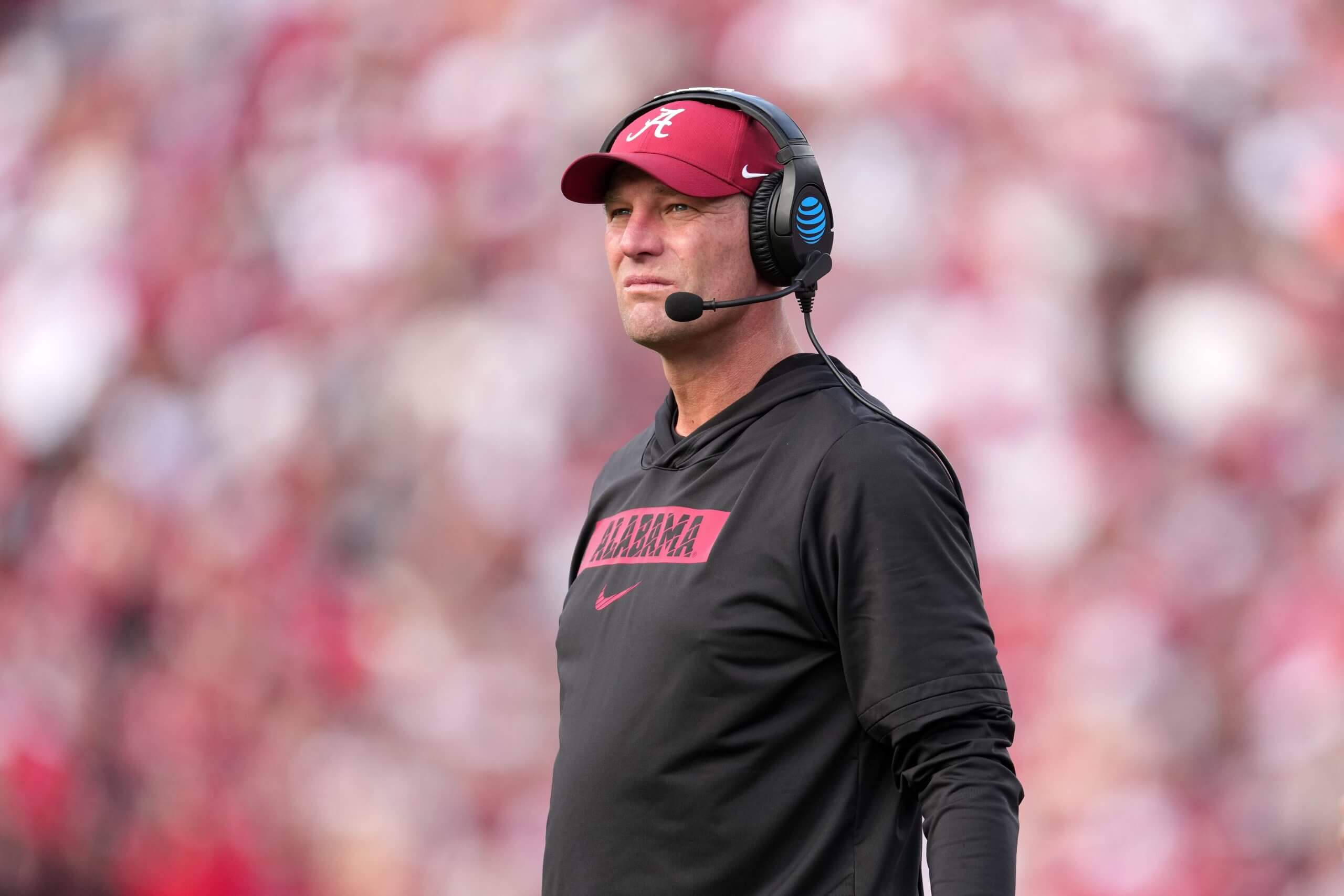
Alabama fans may have to adjust to a new reality of less consistent dominance in the modern college football era. (Kirby Lee / Imagn Images)
Stew: This fall I had to wait until 8 p.m. CT to watch the Huskers play at UCLA in football. This week I had to wait until 10 p.m. CT to watch them play at UCLA in basketball. I understand game times won’t be ideal when two schools in the same conference are multiple time zones apart, but aren’t TV networks risking losing a good chunk of viewers who value their sleep? — Nicholas R.
I sympathize with the 10 p.m. thing, especially given Nebraska’s amazing hoops season right now, but 8 p.m. on a Saturday night? Really? Does this mean you sleep through every big prime-time ABC game as well?
But I’m admittedly spoiled living in Pacific time, where even the latest college football games (save for Hawaii home games) kick off by 7:30.
Ultimately, this is the tradeoff the Big Ten made in exchange for all that money. Bringing in USC, UCLA, Oregon and Washington increased the value of their media rights deals, but with the understanding that Fox/CBS/NBC/Peacock hold ultimate authority over the times of the games. Only those four schools can host games in those late-night windows, so there’s no way around the other 14 playing the role of visitor.
As for that risk of losing viewers, note that Fox doesn’t often put “big” games in that window. When it set the basketball schedule last fall, it probably did not envision Nebraska being a top-10 team in March, so that game was mostly just a means to fill two hours of programming.
But more broadly, all of these ridiculous cross-country conference moves begin with the central assumption that fans love their schools so much they’ll watch the games whenever they’re on.
Remember, at any point, the conferences could opt to just take less money in exchange for more control over their kickoff times. … Hey, stop laughing!
Hey Stewart, does the new Pac-12 have a decisive leg up on getting that Group of 6 bid to the Playoff this year? Two things that seem to be in its favor: 1) It has seven solid teams with no bottom dwellers and 2) Flex Schedule Week 13 will allow the league to strategically keep its teams ranked higher. — Josh from Boise
I’ve seen that the new Pac-12 is already selling itself as a “top five league in football,” citing a bunch of five-year data that shows its new lineup is stronger than any other G6 leagues’ lineup. That may be the case, but I’d hardly say it has a “decisive” leg up on the American, for one.
The biggest thing the Pac-12 has going for it is Boise State, which is unquestionably the strongest G6 program. None of the top American schools (Tulane, Memphis, USF, Army/Navy) has won at a consistently high level for so long. And just like in 2024, when they made the Playoff, the Broncos have a chance to establish credibility with a trip to Oregon. San Diego State and Fresno State have been solid programs as well.
But after that? We have no idea yet whether Utah State, Colorado State or Texas State will come in and compete. Oregon State is in full-on rebuild mode, and Washington State is on its third coach in three seasons. I do love the flex schedule idea, but it won’t make much difference if there aren’t any respectable opponents for the league’s top CFP contender.
It does help, though, that the American is going through a massive amount of coaching transition this season. Tulane (Will Hall), North Texas (Neal Brown), Memphis (Charles Huff) and USF (Brian Hartline) all have new leaders. Don’t be surprised if East Carolina, which went 9-4 in coach Blake Harrell’s second season, emerges as the league’s top CFP contender.
That’s not to say the CFP team can’t come from another G6 conference — perhaps New Mexico in the Mountain West or Western Michigan in the MAC — but most years, that berth will likely come down to American vs. Pac-12.
Is going 5-7 in Year 5 at Kansas finally enough for Lance Leipold to jump to the top of your annual head coach rankings? — Reggie C.
Ha, ha, ha.
You’ll find out soon enough. The 2026 edition is coming next week.