

The Texas Department of Transportation has told the city of Austin it must accept a proposed funding agreement for a $25 million boardwalk along Lady Bird Lake, or risk losing the project altogether.
The boardwalk would replace a narrow stretch of the Ann and Roy Butler Hike and Bike Trail, in front of the Hyatt Regency between South First Street and South Congress Avenue. When it rains, puddles narrow the path even further.
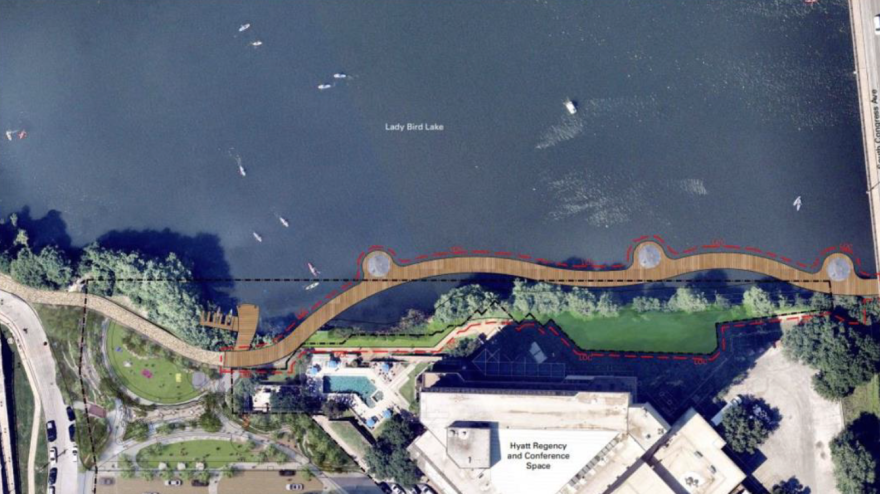
The boardwalk would run directly in front of the Hyatt Regency. TxDOT included this image in its federally-required study of the I-35 expansion.
In a letter to Mayor Kirk Watson dated Feb. 5, TxDOT said it will remove the boardwalk from its environmental approval for the I-35 expansion if City Council does not accept the agency’s proposed advanced funding agreement.
“The city can sign the AFA for the boardwalk or decline it,” TxDOT engineer Tucker Ferguson wrote.
The boardwalk proposal was unveiled in 2023 as part of a package of measures to soften the blow of the I-35 Capital Express Central project. The estimated $4.5 billion expansion, already under construction, includes adding two high-occupancy vehicle lanes in each direction from Ben White Boulevard to U.S. 290 East.
Lorianne Willett
/
KUT News
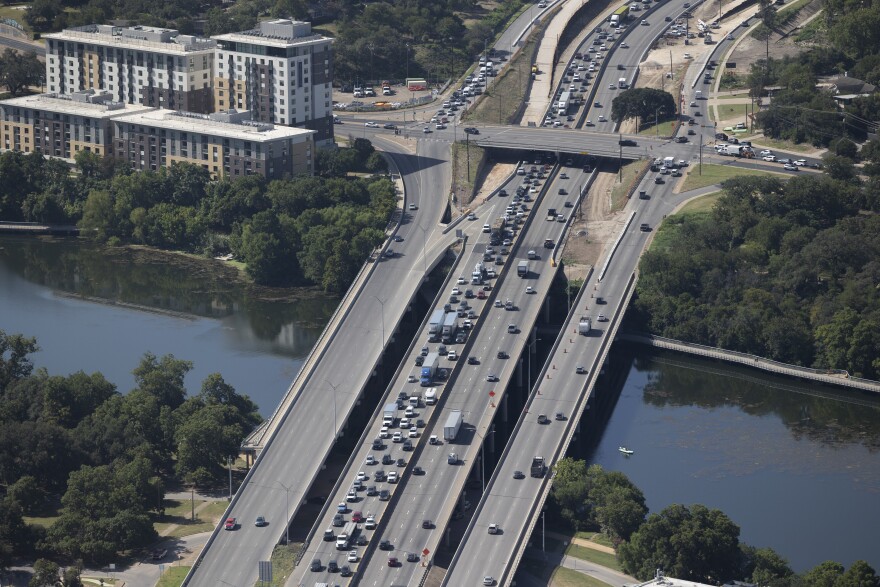
TxDOT is completely rebuilding the I-35 bridge over Lady Bird Lake to create space for more lanes as part of an estimated $4.5 billion expansion of the freeway through Central Austin.
The highway project will permanently claim at least 0.8 acres of parkland, according to TxDOT’s latest figures, and temporarily occupy 2.5 acres while the I-35 bridge over Lady Bird Lake is reconstructed. The numbers were revised downward from initial plans that called for I-35 to absorb 1.3 acres of Waller Beach in perpetuity.
Under federal law, transportation agencies using public parkland for highway projects must offset the damage.
Last month, the city formally accepted $17.6 million from TxDOT to compensate for permanent and temporary impacts on parks including Waller Beach, Edward Rendon Sr. Metro Park and International Shores. The city says the money will be spent within two miles of the affected parkland.
The boardwalk falls into a different category.
Michael Minasi
/
KUT News
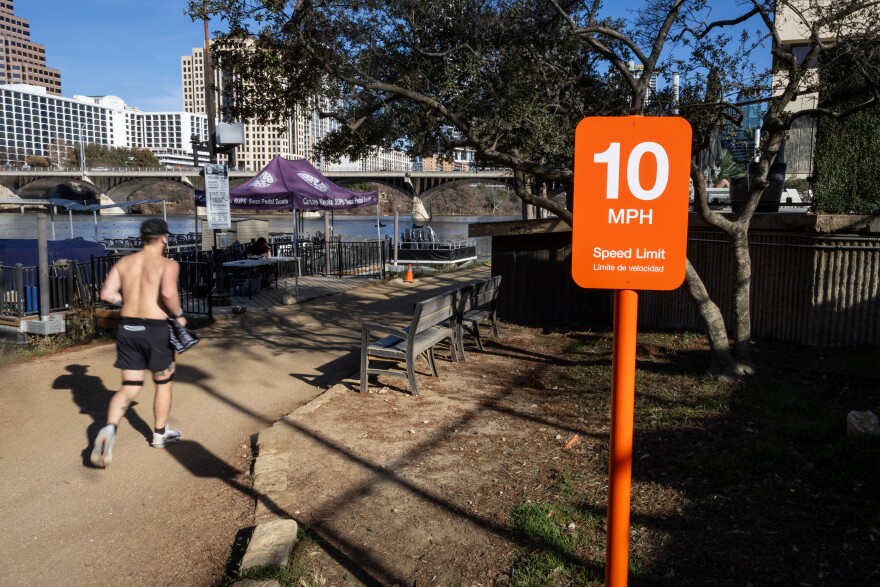
A 10 mph speed limit sign is pictured at a congested portion of the Ann and Roy Butler Hike and Bike Trail in front of the Hyatt.
TxDOT classifies it as “proposed mitigation,” an optional measure that goes beyond the minimum legal obligations. Such projects are often bundled into large urban highway expansions to help transportation agencies build support for controversial projects.
“It is over and above, similar to a lot of the things we did,” Heather Ashley-Nguyen, the TxDOT engineer overseeing Central Austin’s I-35 expansion, told KUT News in November. “This is a bigger [highway] project than Central Texas will ever see … and so there were a lot of partnerships with the community.”
In addition to the boardwalk, TxDOT’s discretionary mitigation package included:
nearly doubling the size of the Esperanza homeless shelter communitycommitting at least $100 million to “enhanced aesthetic treatments” along the highwaybuilding a flyover ramp for CapMetro buses to get from I-35 to the Tech Ridge Park and Rideadding a permanent noise barrier near Festival Beach Community Garden and Food Forestbuilding treatment ponds for I-35 stormwater before it’s discharged into the Colorado River downstream of the Longhorn Dam
Transportation attorneys say such sweeteners can also strengthen an agency’s position in lawsuits challenging a highway expansion by demonstrating efforts to minimize harm or respond to local concerns.
But behind the popular idea was a power struggle over who would control the project and who would receive the money.
Thousands of records obtained by KUT News under the Texas Public Information Act show that in 2023, the Trail Conservancy (TTC) — a nonprofit that operates and manages the Butler Trail under a long-term contract with the city — worked closely with TxDOT to advance the boardwalk proposal with little involvement from Austin Parks and Recreation or the City Council.
For months, the state agency and the nonprofit explored ways to route the $25 million directly to TTC, a plan ultimately thwarted by TxDOT’s own contract lawyers.
The Trail Conservancy
/
Related Companies
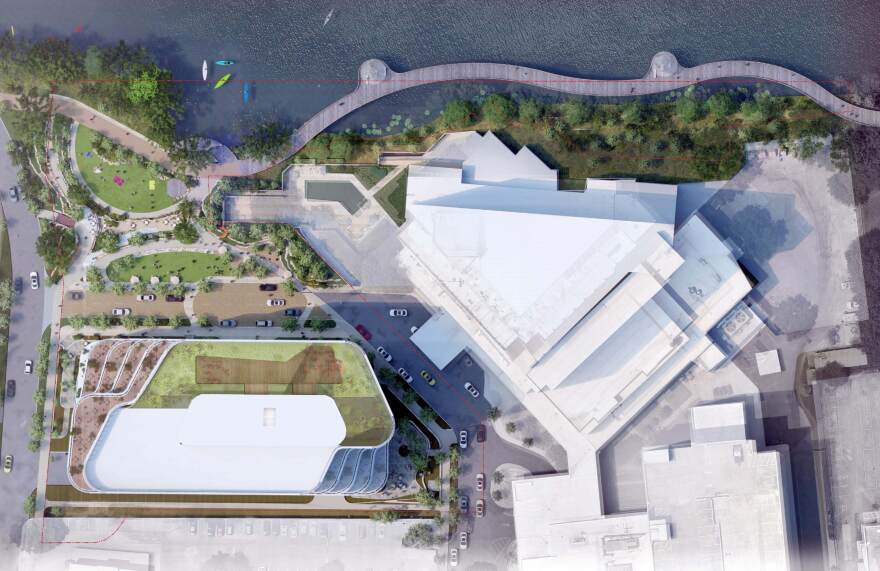
This “proposed concept plan” for the boardwalk was developed by the Trail Conservancy with the developer of One Lady Bird Lake, New York City-based Related Companies. The Trail Conservancy shared this graphic with TxDOT’s Austin district in May 2023, saying it was greatly needed and would be between 650- and 700-feet-long.
City parks officials later raised concerns about being sidelined and believed TTC over-represented its authority over the trail to TxDOT.
One senior official later argued the boardwalk was unnecessary, pointing to the nearby One Lady Bird Lake development under construction next to the Hyatt. The developer, New York City-based Related Companies, is already required to dedicate land capable of widening the trail at the same location.
Parks staff urged TxDOT to consider directing boardwalk funds to higher-priority park improvements. The list of critical projects includes long-planned upgrades to parkland directly affected by the I-35 expansion.
Now, Austin Parks and Recreation says it supports the boardwalk and intends to enter into an agreement with TTC to design and build the structure. The contract “will include milestones and accountability to ensure the project is designed and delivered in a way that meets required expectations,” the department said in a statement.
The agreement with TTC for design and construction of the boardwalk would require City Council approval, Austin Parks and Recreation spokesperson Kanya Lyons told KUT News.
The dispute has raised broader questions about the role nonprofit partners play in managing public parkland and how transparent those arrangements should be.
“Transparency in government becomes an incentive for people to behave ethically,” said Diana Prechter, a parks advocate who has been researching the boardwalk process. “By outsourcing government functions to non-government organizations, you break the continuity of transparency. Suddenly things are done that you can’t understand, that citizens cannot look into.”
Prechter has asked the city auditor to review the process.
A second story tomorrow will examine internal emails and negotiations that reveal how the boardwalk proposal appeared on TxDOT’s radar, and how tensions between TxDOT, TTC and the city of Austin brought the project to this point.