
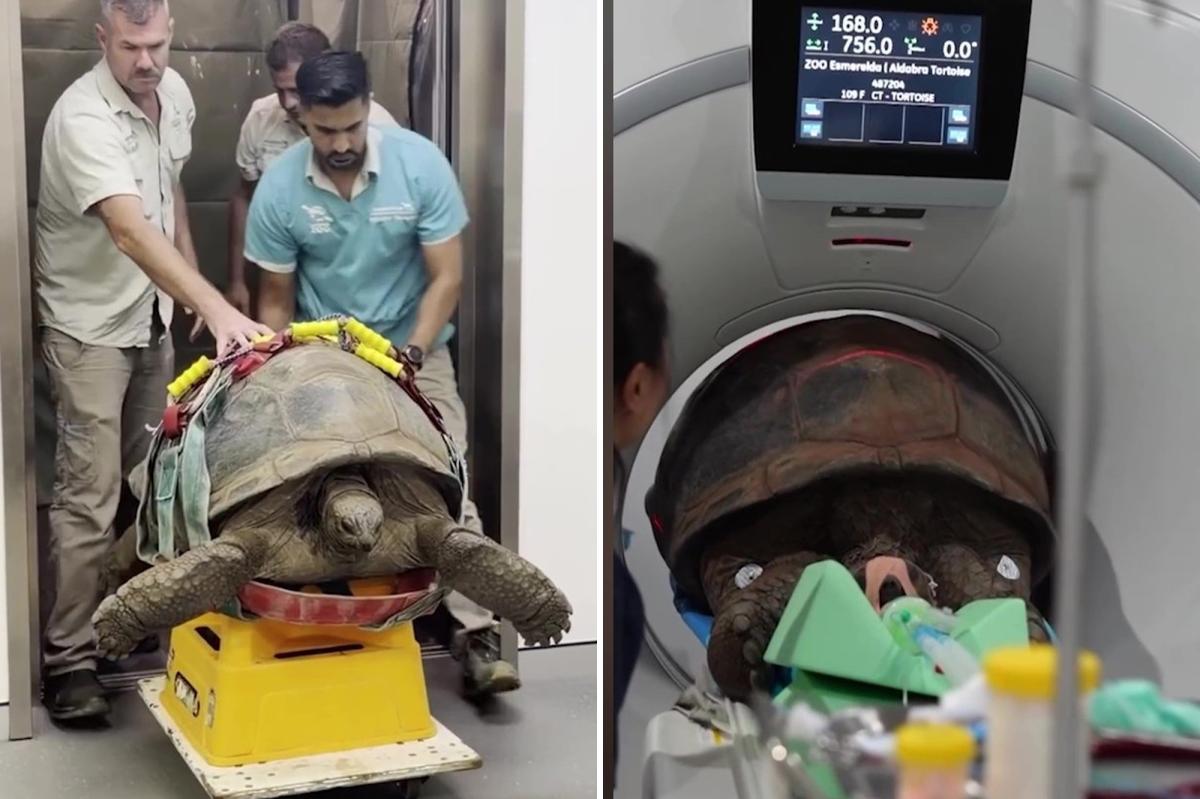
A 109-year-old Aldabra giant tortoise had advanced medical scans after keepers at an Australian zoo noticed neck swelling and breathing changes.
The 298-pound reptile, Esmerelda, was transported from Taronga Zoo Sydney to a specialist animal hospital in North Ryde for a CT scan and endoscopy.
Preliminary results revealed part of her food pipe had expanded, slowing digestion, with experts now developing a targeted care plan.
A 109-year-old Aldabra giant tortoise was transported from Taronga Zoo Sydney to a specialist animal hospital due to neck swelling and breathing changes. Taronga Zoo Sydney / SWNS
Preliminary results showed part of Esmerelda’s food pipe had expanded, slowing digestion. Taronga Zoo Sydney / SWNS
She has since returned to Taronga and is resting comfortably under close veterinary supervision.
Last week, Esmerelda — Taronga Zoo Sydney’s oldest resident — took a rare trip off-site for a comprehensive medical checkup.
Esmerelda was transported to the Small Animal Specialist Hospital (SASH) in North Ryde for a specialized endoscopy and CT scan.
The Aldabra giant tortoise was accompanied by Taronga’s veterinary and reptile staff after keepers spotted swelling on her neck.
Esmerelda was transported to the Small Animal Specialist Hospital (SASH) in North Ryde for a specialized endoscopy and CT scan. Taronga Zoo Sydney / SWNS
Esmerelda being taken to a medical checkup. Taronga Zoo Sydney / SWNS
Her caregivers had also noticed subtle changes in her eating habits and breathing, prompting further investigation.
At SASH, veterinarians employed advanced imaging technology to take a closer look at Esmerelda’s internal systems.
Using a CT scanner, which produces detailed three-dimensional images, and a small camera known as an endoscope, the team examined her throat, esophagus, and airways for signs of illness.
Veterinarians used advanced imaging technology to take a closer look at Esmerelda’s internal systems. Taronga Zoo Sydney / SWNS
The minimally invasive procedures allowed a thorough internal check without the need for surgery.
The examination was led by Taronga Veterinarian Dr. Kresen Pillay, who was joined by experts in imaging, medicine, and anesthesia from SASH.
“Given Esmerelda’s remarkable age, proactive and preventative health care is essential,” Dr. Pillay said.
“Aldabra Giant Tortoises are an incredibly resilient species, but like any ageing animal, they can develop conditions that require detailed diagnostic imaging.”
“The CT scan and endoscopy provide us with invaluable information to guide her ongoing treatment plan,” Dr. Pillay said, the scan examining her throat, esophagus, and airways. Taronga Zoo Sydney / SWNS
Dr. Pillay added: “The CT scan and endoscopy provide us with invaluable information to guide her ongoing treatment plan.”
Transporting a nearly 300-pound tortoise is no small undertaking.
The zoo’s team carefully developed a plan for her journey, using a specially designed support sling and monitoring her comfort throughout.
Esmerelda was lightly sedated and placed under general anesthesia so the scans could be safely completed. Taronga Zoo Sydney / SWNS
Esmerelda was lightly sedated to keep her calm, then placed under general anesthesia so the scans could be safely completed.
Preliminary results revealed that a section of Esmerelda’s food pipe had expanded, slowing how food moves through her system.
While specialists continue analyzing the findings, the early insights will help formulate a targeted care plan aimed at improving her digestion and overall health.
After her visit, Esmerelda was transported back to Taronga, where she is reportedly resting comfortably.
Her dedicated keepers continue to monitor her recovery and ensure she’s receiving the best possible care.
Aldabra giant tortoises, native to the Aldabra Atoll in the Seychelles, rank among the planet’s longest-living species.
Some have been documented living well past 150 years.