
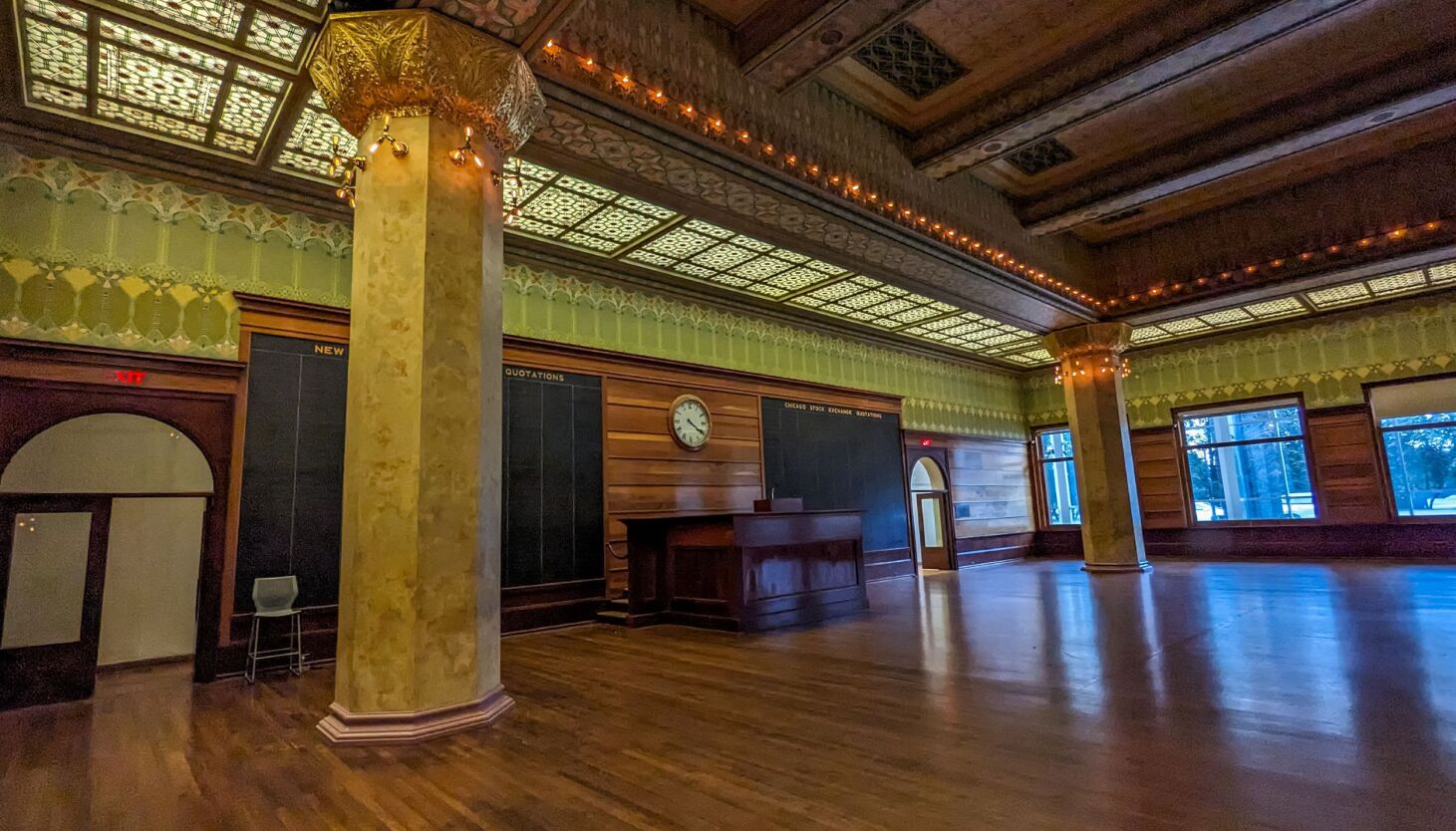
The old Chicago Stock Exchange Building trading room — Adler & Sullivan’s gilded age space rescued from demolition 54 years ago — could be uprooted from its longtime Art Institute of Chicago home under preliminary expansion plans being considered by the museum.
“As we have assessed which part of our campus has the most potential for expansion, the east side of the building — where the Trading Room is located — represents the area where gallery space could increase the most,” the Art Institute said Tuesday in a statement to the Chicago Sun-Times. “If our campus evolution did impact the Trading Room, our first priority would be to work with partners to find a new location for the space. No decisions have been made at this time.”
The statement marks the first time the Art Institute has publicly announced the possibility that the historic room could be affected by its expansion plans.
The trading floor is listed on Preservation Chicago’s 2026 list of the city’s seven most endangered places, announced Wednesday.
Located near the Columbus Drive entrance, the ornate two-level 5,700-square-foot trading room was the centerpiece of the Dankmar Adler and Louis Sullivan-designed Chicago Stock Exchange at 30 N. LaSalle St., a wondrously beautiful building that was wrecked in 1972 and replaced by a run-of-the-mill skyscraper.
But before the building was demolished, a team lead by architect John Vinci deconstructed the trading room piece-by-piece, then oversaw its reinstallation at the Art Institute.
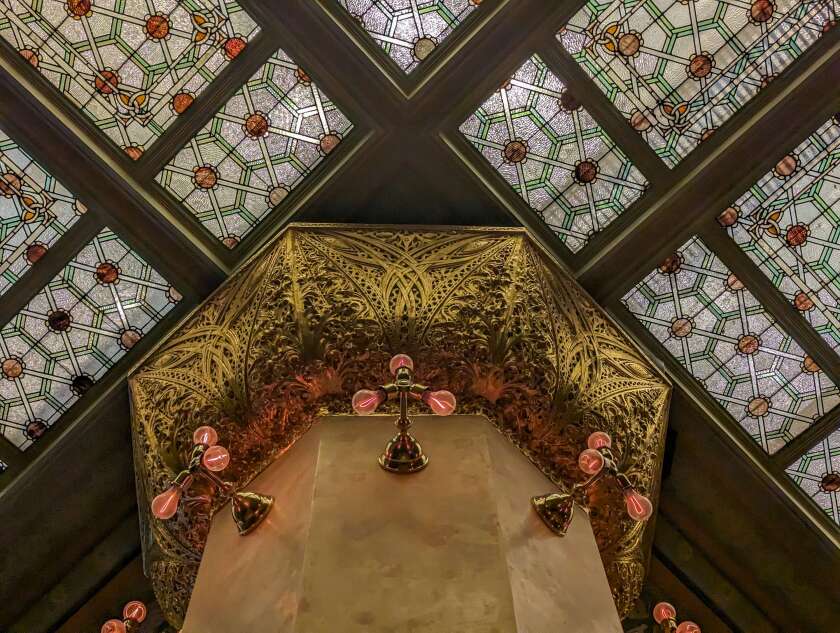
Ornate column capitals and an art glass ceiling are among the many details of the old Chicago Stock Exchange trading room at the Art Institute of Chicago.
Provided by Eric Allix Rogers/Preservation Chicago
The reconstructed space has been on exhibit — and an event venue for rent — since 1977.
The Stock Exchange Building’s entry arch was also moved to the museum and sits outside at Columbus Drive and Monroe Street.
In 2024, the museum received a $75 million donation from art collectors Aaron Fleischman, an Art Institute trustee, and Lin Lougheed to help fund campus expansion plans, including additional exhibition halls.
But Preservation Chicago Executive Director Ward Miller said the new spaces shouldn’t come at the expense of the trading room.
“We understand the need for these institutions to grow and for their collections to be exhibited,” he said. “But we’re of the opinion that these things can occur without damaging some of the really sacred and much-beloved spaces at the Art Institute of Chicago.”
Miller said the museum could instead build on the air rights above the sunken Metra tracks and busway that partly separate the Michigan Avenue side of the Art Institute from the Columbus Drive wing.
Preservation Chicago’s “Chicago 7″ list, and a bonus building, also includes the Art Institute’s McKinlock Court.
Miller said the group fears McKinlock could be lost or altered under the museum’s expansion.
Art Institute officials said there are no plans to remove the classical, open air courtyard.
Another endangered site is Pope Leo XIV’s boyhood church, the now-deteriorating and vacant St. Mary of the Assumption at 138th Street and Leyden Avenue.
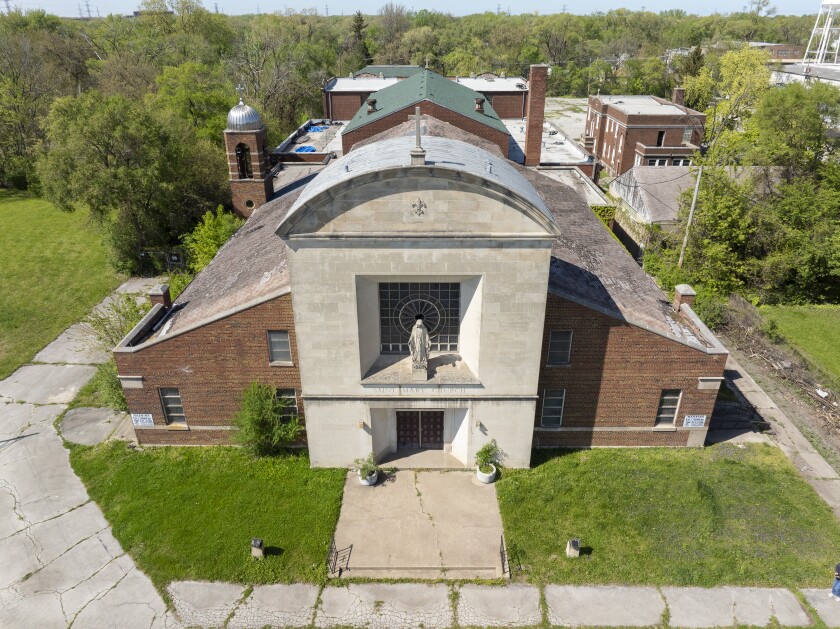
St. Mary of the Assumption, 310 E. 137th St., is Pope Leo XIV’s old childhood church.
Tyler Pasciak LaRiviere/Sun-Times
The brick-and-limestone structure, designed by architect George Smith, is part of a campus of parish buildings that includes a former school, rectory and convent that have all fallen into disrepair since St. Mary’s closed in 2011.
Nonprofit operator Joe Hall bought the complex in a 2020 auction with an eye toward putting his social services nonprofit, JBlendz Enterprises, there. But he lacks the funds to rehab the buildings.
Preservation Chicago recommends capitalizing on the Pope Leo connection, marshaling the funds needed to fix up the parish buildings and designating the campus a Chicago landmark so that it could “easily become a pilgrimage site for visitors from all over the world.”
Chicago’s endangered buildings
In addition to the Stock Exchange trading room and McKinlock Court at the Art Institute, as well as St. Mary, the other endangered sites include:
Chicago River bridges and tender houses: The bridges and tender houses along the main, north and south branch are in need of repair and, in some cases, replacement of the metal span, according to Preservation Chicago. For instance, the group pointed out the heavily trafficked Michigan Avenue DuSable Bridge, whose last significant rehabilitation was in 2009. “Ongoing maintenance is a concern and the limestone is showing staining and cracking,” Preservation Chicago said.Labor union halls: A number of union halls on the Near West Side are in need of repairs, with some listed for sale and others potentially facing demolition. The organization recommends preserving the properties, including for landmark designation, as they highlight the city’s union history. Chicago Loop Synagogue: The modernist synagogue at 16 S. Clark St. was designed in 1957 by Chicago firm Loebl, Schlossman & Bennett, and it includes a large stained glass window on its eastern wall that was designed by artist Abraham Rattner. Attendance has been declining at the Loop synagogue, and its finances were put under additional strain when boiler pipes burst in the past year because of cold weather. South Park Terrace Apartments: The two-story, 52-unit Prairie School-styled complex at 6116 S. King Drive has arched entrances and a large courtyard garden. Preservation Chicago called on the city to try and preserve the building, either through restoration efforts by a city department or through a development partner. Yukon building: The two-story Loop property at 400 S. Clark St. is described by Preservation Chicago as “one of the last structures of Chicago’s ‘Old Chinatown,’ before its move southward in the 1920s to the Armour Square Community.” They also said it should be given a landmark designation for its cultural and historical significance to the city.St. Mark Roman Catholic Church campus: Built in 1963, the Humboldt Park campus is listed for sale and residents, along with Preservation Chicago, have called for the church buildings to be preserved and reused.