
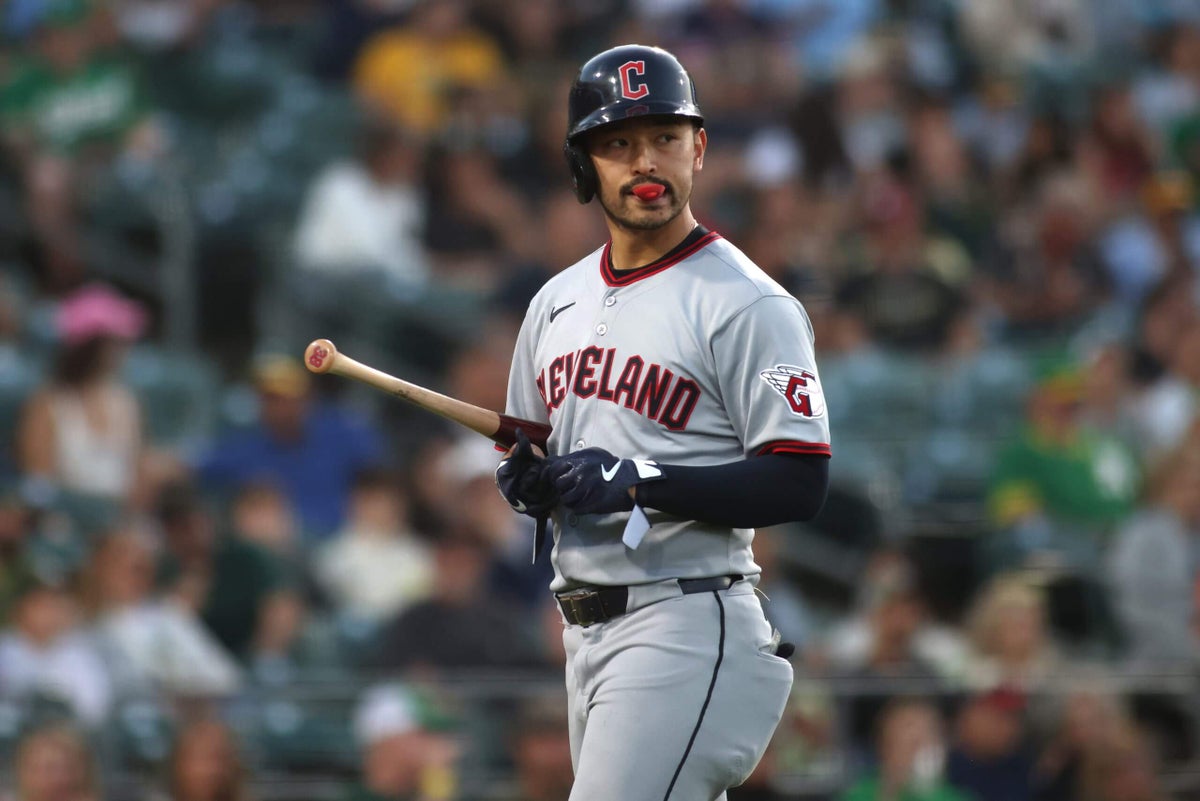
GOODYEAR, Ariz. — Steven Kwan watched a 3-0 fastball from Los Angeles Dodgers pitcher Roki Sasaki sail past home plate on Tuesday afternoon. The heater missed the zone by nearly three inches, but the umpire ruled it a strike.
The Guardians’ leadoff hitter tapped his helmet. The animation on the scoreboard supported his inclination. Kwan trotted to first base with a four-pitch walk.
That could be a regular sequence for a hitter whose grasp of the strike zone has fueled his rise to All-Star status. Since he broke into the majors on Opening Day 2022, Kwan has had 264 pitches mistakenly called a strike against him. That’s the third-highest total in the league in that timeframe, behind only Seiya Suzuki and Randy Arozarena, and just ahead of Mookie Betts and Aaron Judge.
The arrival of the ABS challenge system should remedy that.
“He’s going to walk so much,” said Cleveland catcher Austin Hedges. “Guys who truly know the zone like that are going to thrive.”
Kwan sure hopes so. He said he’s eager to “call some of the umpires out,” but described his temperament toward the innovation as more “cautiously optimistic” than “giddy.”
There’s some game theory to it. The Guardians are trying not to overload their hitters with percentages and probabilities, especially in spring training. Hitters have to determine instantly whether to dispute a call; they can’t sift through the various data points to arrive at a decision.
That makes spring training a experimental period. Challenge now and discuss the thought process later. The decision could hinge on the hitter, the count, the score, the pitcher, the inning, whether there are baserunners and other factors.
Kwan compared it to learning how to play blackjack by the book. If you know inherently when to hit, when to stay and when to double down, you’ll make swift, wise choices at the table.
“(As) we get more and more reps,” Kwan said, “we’ll know in that split-second.”
Most balls called strikes, 2022-25
Once the games count, there will be pressure not to make a false accusation. Kwan challenged a pitch last spring and was wrong, which had him wishing he could disappear from the batter’s box and the TV screen.
“You’re embarrassed,” he said, “because the fans see you’re wrong. The catcher is like, ‘Bro, what are you doing?’ It’s kind of a slight to the umpire. It’s like, ‘Did you really think that was a ball?’ It’s all of these factors that you have to push aside. But when we do, I think it’s going to be really helpful for the game.”
It should be beneficial for Kwan, too, especially on the heels of a season that left him unfulfilled. He received his second consecutive All-Star nod, but his wrist bothered him for a couple months after an awkward slide in May. Even after a midseason cortisone shot helped it heal, he couldn’t find his feel with his swing. His numbers suffered.
“I didn’t have this North Star or this compass to lead myself back,” Kwan said. “That was a little naive of me to just be like, ‘Oh, I know my swing and I know how to get there.’ … I didn’t have enough knowledge on my swing as I should have.”
Over the winter, Kwan worked on his bat speed, which he says is sitting at the best spot of his career. He wants to be more durable and not feel fatigued as a season unfolds. He’s also tackling a new assignment in center field.
The wild card to his season — and to how the Guardians and other teams value him as he inches toward an extension, a trade or free agency — could be how he exploits this new wrinkle within the game.
“He gets a lot of pitches called on him that are off the plate away,” said Guardians manager Stephen Vogt.
Just how far away those pitches are will be key. How bold does Kwan want to be? Can he spot the difference between a pitch that nicks the outside corner versus a pitch that misses by a whisker?
“All of these game theory things are assuming that the pitch is a 50/50 (call),” Kwan said. “You’re like, ‘Ahh, could have been a strike, could have been a ball.’ In (coaches’) minds, if it’s egregious, call it at any point. But now, it’s like, do people actually know what egregious is? You think it’s egregious and now it’s two outs, nobody on and you just wasted one. Now you’re gonna get that (privilege) revoked. It’s exploring, how well do people actually know the zone? If it’s egregious, they say rip it every time, no matter the situation.”
Steven Kwan vs. MLB umpires
YearBalls called ballsBalls called strikesPercentage correct
2025
926
52
94.7%
2024
741
70
91.4%
2023
948
66
93.5%
2022
885
76
92.1%
Total
3500
264
93.0%
Umpires, by and large, are really good at what they do. But for Kwan, on pitches out of the zone, they have called strikes 7 percent of the time during his career. That’s essentially one erroneous call for every 14 balls Kwan sees. It’s an average of 66 miscues per season, or 2.5 percent of all pitches he sees. Vogt said he can tell when Kwan feels he’s been aggrieved, based on a slight tell in the outfielder’s body language. Kwan has ranked in the top 21 of hitters in undeserved strike calls in each of his four seasons, and in the top 11 in three seasons.
Kwan will now have the authority to erase as many of those as he sees fit, provided the Guardians have a challenge in their holster. Teams get two per game, and a hitter, pitcher or catcher can initiate a challenge. If they are successful, the team keeps the challenge. The Guardians are prohibiting their pitchers from challenging, under the premise that pitchers can’t view the situation objectively.
Kwan is a competent hitter regardless of the count — .285 when behind and .280 when ahead — but a driving force for him the last couple years has been uncorking more aggressive swings when in a favorable spot. That’s when he’s more likely to get a pitch on which he can inflict damage, often an inside fastball he can yank to right field.
Kwan already boasts elite plate discipline and he makes sound swing decisions. He doesn’t chase and he almost never whiffs. Now he can avoid falling behind in the count because of an umpire’s gaffe. Perhaps, as Hedges noted, it leads to more walks. Or maybe it helps him earn more pitches he can ambush.
The Guardians need their leadoff hitter at his best, and maybe this helps him elevate what his best looks like.
“I think it allows me to execute that plan more often,” Kwan said, “because obviously, our idea is swing at strikes and when it’s in your zone, swing as hard as you can, (and) take the balls. So then when it goes awry, it’s like, ‘I took the ball that got called a strike, now I have to switch my plan.’ Now I can just be more convicted in that plan and not worry about the externals.”