
Peak newsletter | A version of this story first appeared in The Athletic’s weekly newsletter covering the mental side of sports. Sign up here to receive the Peak newsletter directly in your inbox.
Mack Brown won 288 games as a head coach, the seventh most in major college football history and just four behind Nick Saban. He won the 2005 national title at Texas and is a member of the College Football Hall of Fame.
When you’re down, pick them up
I was a young offensive coordinator at Oklahoma in 1984. We were the No. 2 team in the country, but we were without both our starting quarterback and our backup quarterback, so we had to start a true freshman who hadn’t played before and hadn’t really practiced with the offense. His name was Troy Aikman.
We played at Kansas, and Kansas was bad. There was nobody in the stands. Well, at halftime we were down 10-3.
I walked into the locker room and started screaming. I threw a metal chair against metal lockers; it was really loud. I told them they were awful. I told them they were going to lose the game. I told them I couldn’t believe they weren’t helping their freshman quarterback. I told them that it was embarrassing, and it made me want to throw up. Then I turned around and walked out.
We got beat 28-11. It was awful.
We were on the plane going home, and there was a seat next to me. Coach Barry Switzer sat down, and I said, “Coach, I’m sorry. You can’t be at Oklahoma and be one of the top teams in the country and lose to Kansas. I really apologize. We were just awful. I don’t know what happened.”
He said, “Well, you lose two quarterbacks, you’re probably going to have trouble winning. But let me tell you something. Those kids really love you, and they respect you, and they believe you. They’re going to listen to you, and at halftime, you told them they were going to lose. And we did.”
I felt about two inches high.
He said, “So don’t ever do that again. You put your thumb on them sometimes when they’re up to keep them from being complacent. But when they’re down, you pick them up.”
Twenty years later, in 2004, I was the head coach at Texas, and we were playing at Oklahoma State. We had to score with three seconds left in the second quarter just to make the score at halftime 35-14.
I was walking off the field and could feel coach Switzer on my shoulder saying: OK, it’s bad. When they’re down, you pick them up.
So I walked into the locker room and met with my coaches: “Hey, Oklahoma State is playing hard, but they’ve been lucky. We’re playing hard too, we’re just not playing good. But this is the best opportunity we’ve ever had. We’re going to have the biggest comeback in the history of Texas football, and we’re going to win this game. It’s your job to go out there and explain to these guys how we’re going to win the game.”
I walked into the rest of the locker room, wrote a winning score on the greaseboard and addressed our players.
“This is going to be the most fun we’ve ever had,” I told them. “The fans are going to be so excited that you came back.”
We won 56-35. After the game, I told the players I was sorry I had underestimated them — I had said we were going to win 42-35.
It’s OK to have fun
In 2005, we had beaten every team in the regular season by an average of 33 points. We were averaging about 50 points a game offensively. We were so good. We’d won 19 straight games, but we were playing a USC team in the Rose Bowl that had won 34 straight games.
There was so much commotion before the game. Our kids had trouble even getting in and out of the hotel without autographs or pictures and conversations.
The night before the Rose Bowl, we moved the team to Burbank. Nobody knew where we were; I didn’t know where we were.
I could tell our players were so uptight. The night before the game, I was sitting there trying to think. What do you do? I was in my room, and I saw Pat Riley talking about how USC was going to have a three-peat like the Lakers had. I thought, Well, that’s great.
And then I saw Jerry Springer.
I’d never seen his show before, and I sat there watching. I thought: Yeah, this is it. I sat there for an hour and a half.
On game day, I walked in and all the eyes were on me. I could tell they were uptight. Nobody was talking. We were probably three hours from the game.
I said, “Thank you. Thank you for getting us here. This is fun for your parents. Fun for our faculty. Fun for our alums. Fun for the high school coaches in the state. Fun for us as coaches. And it’s your team. You’re the ones who got us here. But let me ask you something. How many of you have ever seen the ‘Jerry Springer Show’ before?”
Just about every hand went up. I said, “OK, I’m going to tell you something that’s not only going to help you win this game, it’s going to change your life forever.”
I’ve got ’em. They’re so locked in. They think I’ve got this answer. And then I said: “If your wife or girlfriend ever asks you to go on the ‘Jerry Springer Show,’ don’t go. It ain’t good, brother.”
They died laughing. I mean, just died laughing.
I said, “That’s right. We’re going to have fun. We didn’t come out here to be uptight. We didn’t come out here to be nervous. We’re a good team. We don’t even have to do more than we normally do. We just have to be us.”
It was good to see them laugh and relax. I told them, “It’s OK to have fun. Of all the teams that play college football, only two get here. Understand you’ve earned this. Let’s enjoy it.”
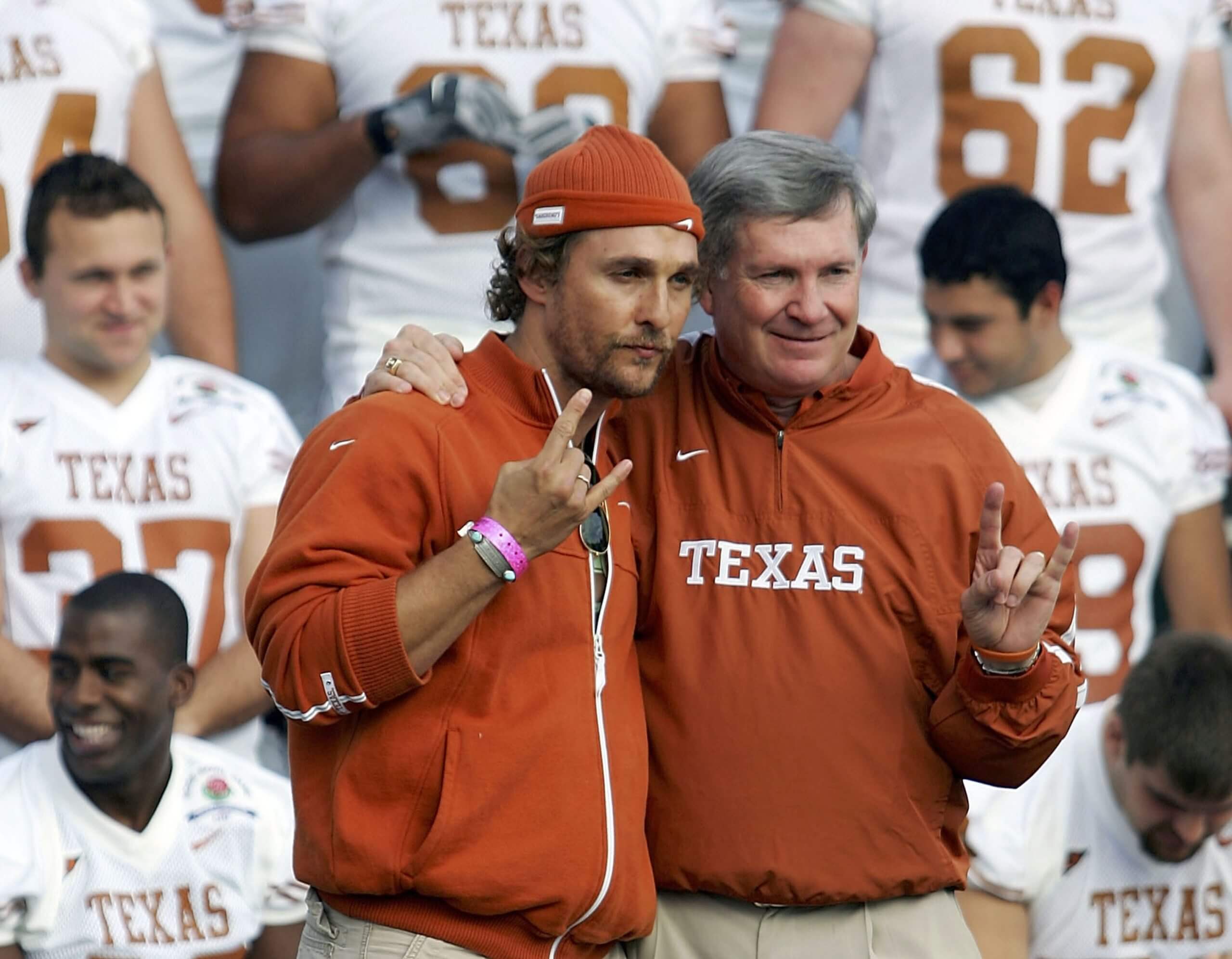
Mack Brown, right, and actor Matthew McConaughey at the Rose Bowl in 2006. (Harry How / Getty Images)
Messaging matters
So many coaches are angry after games and say stupid stuff when they’re mad. Coaches do not realize it’s fair for the press to ask hard questions because they’re trying to get the things that fans don’t know. During my five years at ESPN, I really learned that media members have a hard job, too. You have to find something that’s not just out there to get people to read your stuff or watch you and listen.
So many coaches don’t know that.
After a loss, you’re totally devastated. You only have 12 games a year. You’ve spent the other 360-something days preparing, and you’ve just lost one of them. You feel really, really guilty that you missed something. Where did it go wrong? You’re second-guessing yourself. You let the team down. You let your coaches down. You let your boosters down. You let your university down.
I read once that former Dallas Cowboys coach Tom Landry said: “You learn from losing, and that’s the only way it works because you’re going to make hard decisions after you lose.”
From a leadership standpoint, you really have to handle that. Former Texas coach Darrell Royal used to tell me: “When you win, you brag on the players. When you lose, you say you screwed it up.” And he always said: “The less you say, the less you have to take back, so don’t say much.”
I can just remember times where I thought: God, why did I just say that? Or: That was stupid.
You’re just in a very vulnerable moment, especially after losing a game you thought you were going to win.
“If you don’t think it’s an important game, just lose it,” former Texas A&M and Alabama coach Gene Stallings told me once. “And then it becomes important.”
That is so true.
This is where I thought it was a leadership lesson. When you’re talking to the media after a tough game, you’re talking to so many different groups. You’re still talking to your team. You’re talking to their high school coaches. You’re talking to their parents. You’re also talking to recruits. You’re also talking to your competitors.
You want to look disappointed, because you are, but you don’t want to look whipped. Otherwise, people will think: He’s stressed out. He can’t handle this.
I put thought into improving my messaging after losses. There’s a lot of messaging in those moments, even just with your body language. You don’t want to be arrogant. You want to be confident, but you also want to show remorse.
Some things are bigger than results
I was driving to work. It was Thursday before the Texas-Texas A&M game the following week. I heard on the radio that 12 kids had died in a bonfire incident at A&M, and others were injured.
The news actually made me pull off the road. As a father, I was thinking about my kids. What if that was one of them? What if that was one of my daughters? It got even worse when they said parents could call this hotline to check on their son and daughter, but then the hotline was so overloaded that they said parents had to drive to College Station. That got me, too.
I called my wife, Sally, and said, “This is awful. What do we do?”
She was so smart. She said, “Let’s start a blood drive because while we can’t help the families of the kids who are gone, we can help the kids who are still alive.”
So we had a blood drive in our football office. From a leadership standpoint, I was sitting there thinking: What do you do to help R.C.? R.C. Slocum was A&M’s coach and was a great friend of mine. I told him that I was fine if we didn’t play the game. It bothered me that much. More than anything else, I still had to be the head coach at Texas. But I also had to be in a very supportive role for R.C. and A&M. We played anyway.
At halftime, we were up 16-6 and got beaten 20-16. I don’t think I handled it well from the Texas head coach’s perspective to help us win the game. However, I did what I thought was right in a really critical situation.
I actually walked off the field after that game thinking: Maybe this is healing and more healthy for everybody.
— As told to Jayson Jenks