
Kennewick, Wash.
The Yakima River basin is entering its fourth year of drought, raising the possibility of restrictions this summer for people living in the Tri-Cities who water their yards and gardens.
The Bureau of Reclamation released it first April-September forecast of the season for the Yakima basin on Thursday, predicting that junior water right users will receive just 44% of their full water rights.
Those with senior water rights take priority and will receive 100% of their entitlements.
The Kennewick Irrigation District, which roughly aligns with junior water right users, is planning to start the irrigation season with the same voluntary watering schedule for lawns that it used last year.
Homeowners are asked to limit sprinkler operation to three days of the week on a morning or evening schedule, with 20 minutes of watering per zone.
Days and times are assigned based on the last digit of your address.
However, KID may need to move to a mandatory watering schedule later in the summer, said Matthew Berglund, spokesman for KID.
Conserving early will matter this year, which could help avoid or at least delay a mandatory schedule in the summer, according to KID. It called a fourth drought year “unprecedented.”
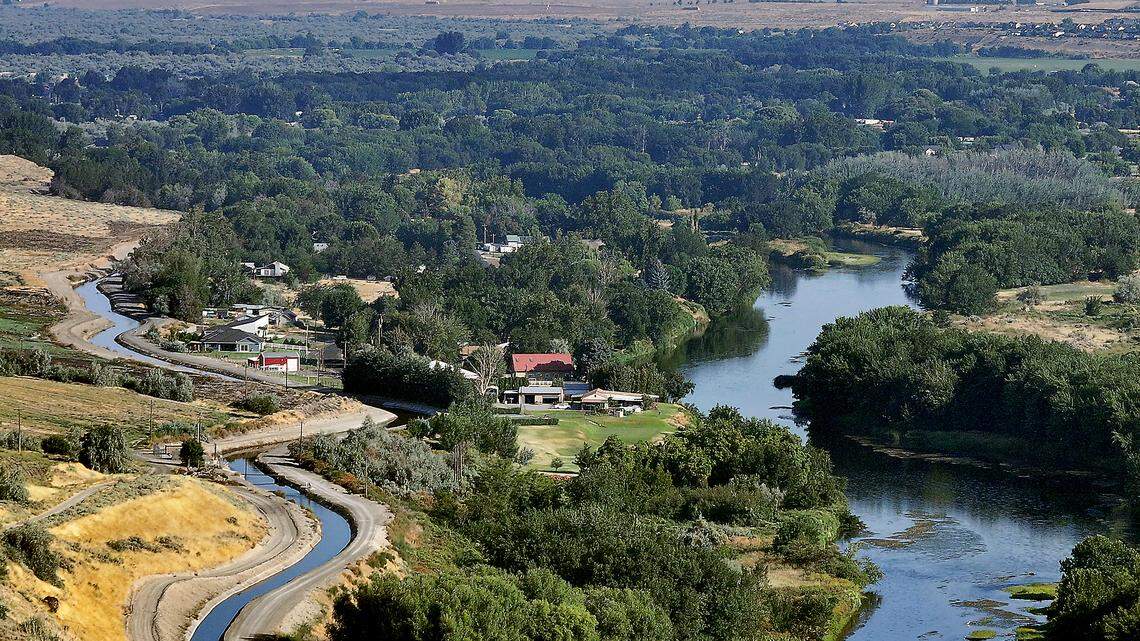
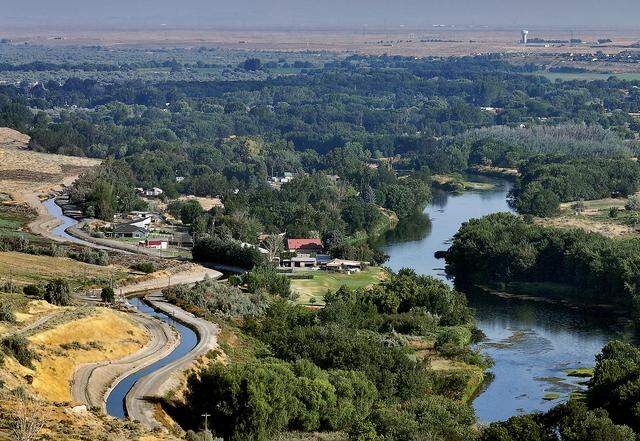 The Yakima River and an adjacent irrigation canal flows towards Richland in August 2025 Bob Brawdy bbrawdy@tricityherald.com Irrigation water supply
Irrigation water from the lower Yakima River relies on melting snowpack and water stored in five mountain reservoirs.
As of March 1, the reservoirs were 76% full, holding 806,000 acre-feet of water, according to the Bureau of Reclamation. That is 128% of average.
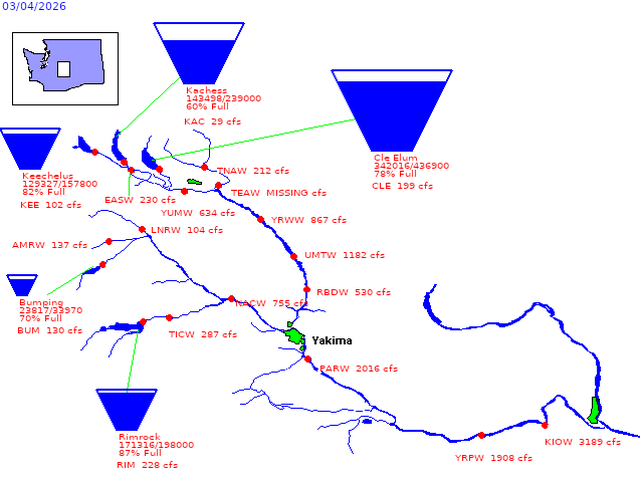 The reservoirs that store water for irrigation and fish in the Yakima River basin are a total of 76% full. Bureau of Reclamation
But the Yakima basin needs 2.5 million acre-feet of water from April through September for irrigation and for fish, according to the Washington state Department of Ecology.
That’s a problem with an unusually low snowpack this spring in the mountains.
The water equivalent in the snow that feeds the lower Yakima River is just 33% of average, according to the Bureau of Reclamation.
Precipitation from October to February was 107% of normal despite just 51% of average precipitation in February.
But the water year, which starts in October, has been the warmest on record in Washington state. That meant more precipitation falling as water rather than snow and snow melting during the winter.
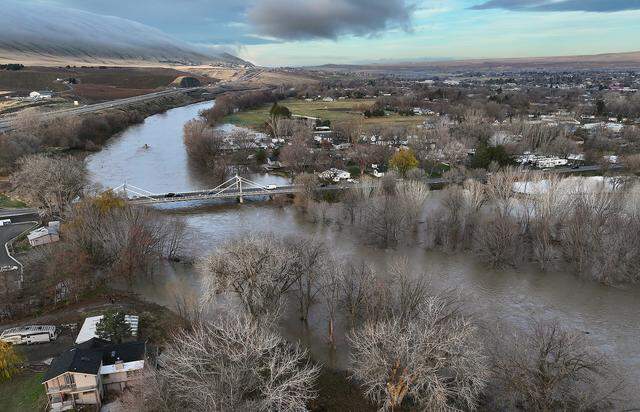 Traffic crosses the bridge over the swollen Yakima River off Interstate 82 at Benton City. Bob Brawdy bbrawdy@tricityherald.com
The Bureau of Reclamation captured as much water as possible in reservoirs during the December flooding of the Yakima River, said Scott Revell, manager of the Roza Irrigation District which supplies water primarily to farms.
The reservoirs were low as the winter began after three previous drought years.
Most of central Washington currently is under a state drought emergency declaration.
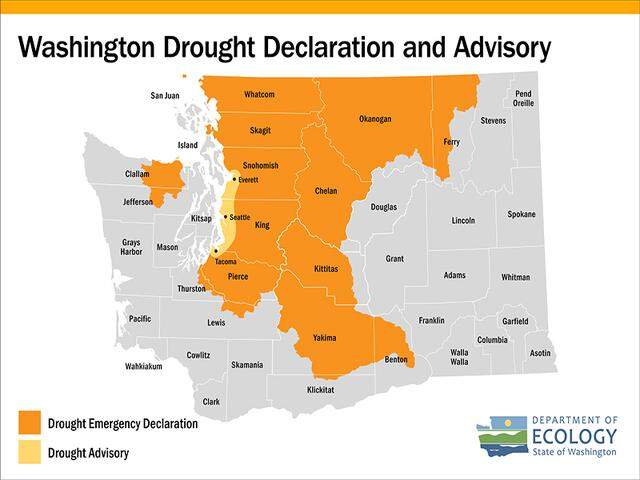 Much of central Washington is under a drought emergency declaration. Washington state Department of Ecology
A record-breaking amount of snow would be needed by April to return the mountains to their normal peak snowpack, according to Karin Bumbaco, deputy state climatologist for the Department of Ecology.
The Bureau of Reclamation bases its water supply forecast on river and stream flows, precipitation, snowpack and reservoir storage at the first of the month, along with estimates of upcoming precipitation and river flows.
Future weather conditions that determine the timing of runoff also will be critical for the upcoming irrigation system.
The agency will continue to update its Yakima basin water forecasts monthly through at least July.
Water conservation urged
Last year enough KID customers followed the voluntary watering schedule to avoid the need for a mandatory irrigation schedule, as was implemented in the summers of 2015 and 2024.
The 2025 season did end a few days early, however, when the state ordered a stop to diverting water due to an inadequate supply for those with senior water rights.
A year ago the forecast for junior water rights in the lower Yakima River basin was slightly higher than now at 48% of their entitled amount expected to be available.
The problem then was the opposite of the current one, with 2025 spring reservoirs much lower at 36% of normal but snowpack much higher at 81% of usual.
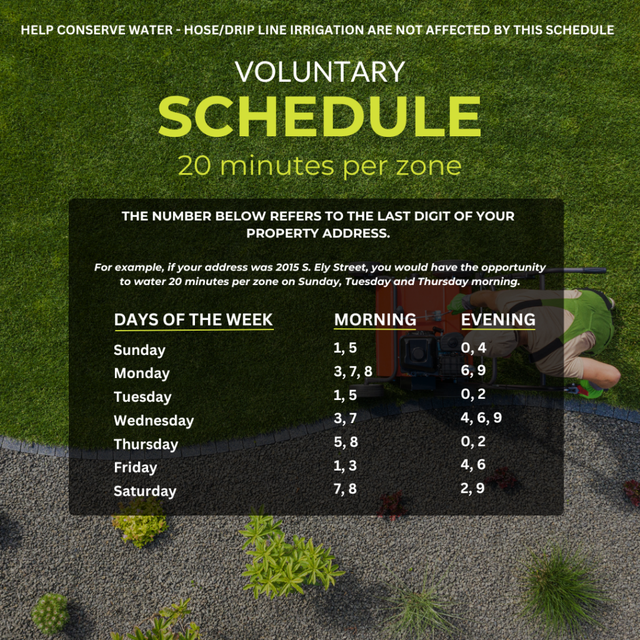 The Kennewick Irrigation District’s voluntary watering schedule. Kennewick Irrigation District
To address drought-year water shortages KID has been lining and widening its main canal with the intention of building the equivalent of a 12,000-acre-foot reservoir. That would be roughly the size of the water between the cable and blue bridges.
KID does not have water rights to use the Columbia River, which it sits above.
KID is grouped with Yakima River basin junior water right holders, but it gets the irrigation water that returns to the Yakima River between the Parker Gauge downriver from Union Gap and the Prosser Dam. Historically, it has gotten a little more water than the percentage available for holders of junior water rights.
The district is preparing customers for this summer by posting tips on how to protect lawns, why brown grass isn’t necessarily dead grass and ways to conserve water at kid.org/your-kid/drought-information.
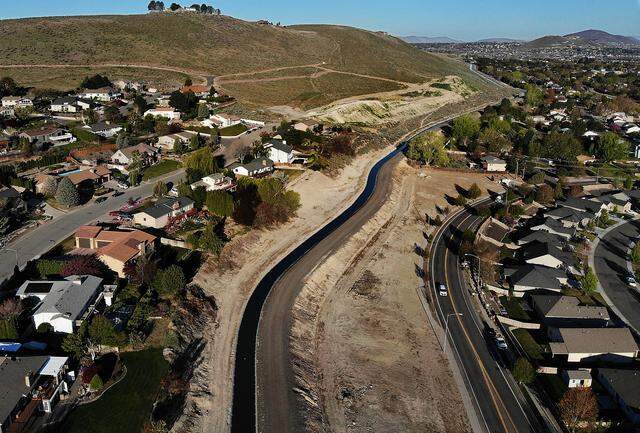 The KID irrigation canal runs along the base of Thompson Hill past Panoramic Heights and Creekstone housing developments in Kennewick. Bob Brawdy bbrawdy@tricityherald.com
Homeowners are encouraged to conserve water use with a drip system or a hose attached to their irrigation valve, which are not limited to the watering schedule.
KID customers could see some water in the canals starting Monday as KID tests areas and looks for breaks needing repair before the irrigation season starts.
KID serves 62,000 customers and delivers water to about 32 square miles.
Farmers may face tough year
The Roza Irrigation District, which supplies Yakima River water to 72,000 acres, may have two mid-season shutdowns of the water supply to stretch out its allotment, Revell said.
Almost all of its acreage is farmland, with 80% of that used to grow high-value perennial crops such as tree fruit, hops, and wine and juice grapes.
 The Roza Irrigation District may have two water shutdowns mid-irrigation season to keep more water in a drought year for perennial crops, such as apples, later in the season. Mike Powles Getty Images
In the 2015 drought when it received 47% of its entitlement, crop losses totaled more than $100 million, in today’s dollars, according to the district. Most of the farming in the district is done by second- and third-generation family farms.
The district could shut down the water supply for 10 to 14 days as soon as the Bureau of Reclamation starts pro-rationing its water supply this year, Revell said. That could be as soon as mid-April.
Water could be shutoff for up to two weeks again, possibly in mid-May, depending on the weather forecast and whether there is more snowfall to feed the basin this month.
The shutdowns would save water supply for later in the season when apple, hop and grapes need it.
The district’s goal is to have water for crops through the end of September, Revell said.
Related Stories from Tri-City Herald