
Favorite Hole
No. 2, par 4, 305 yards
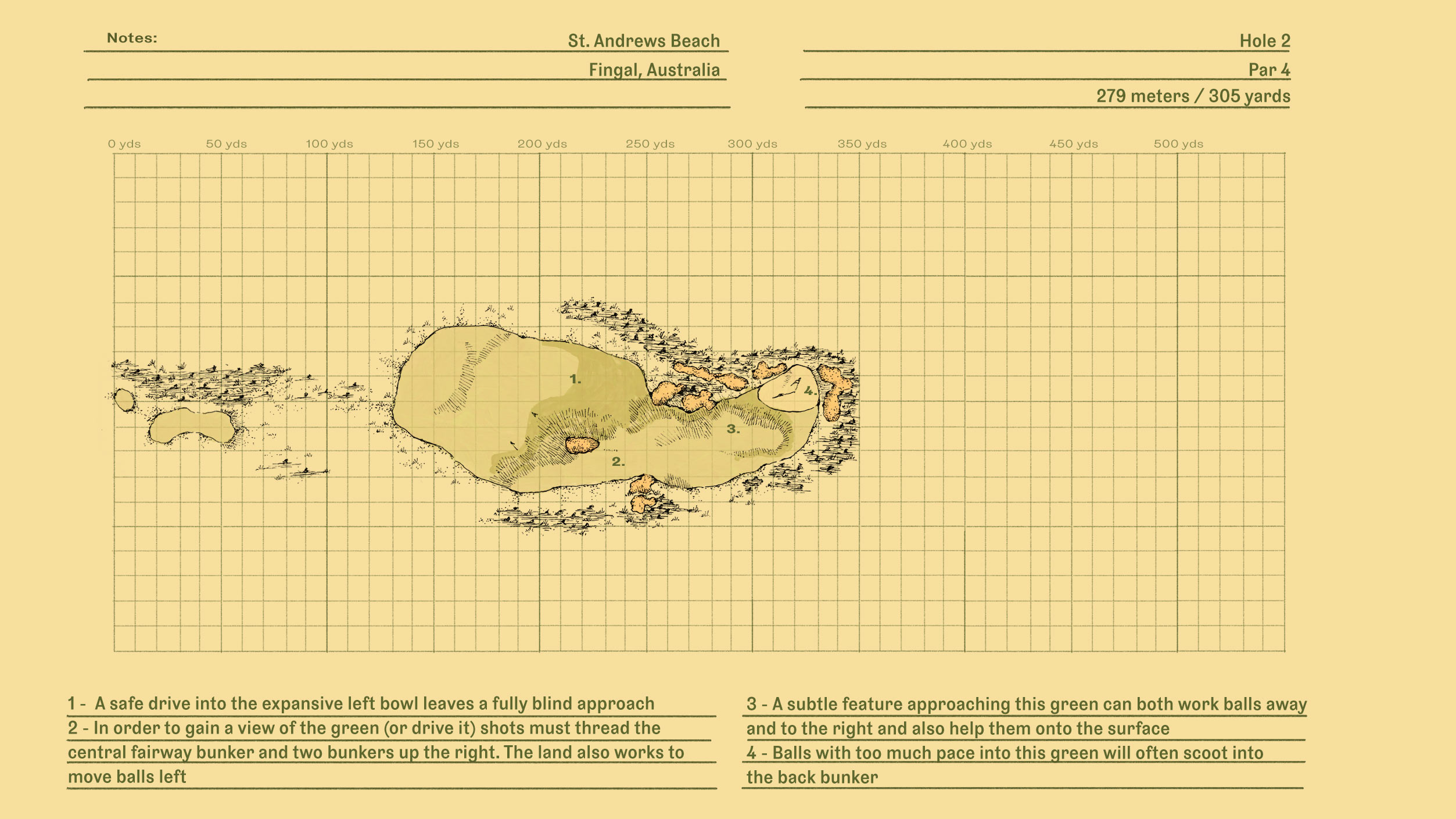 Illustration by Cameron Hurdus
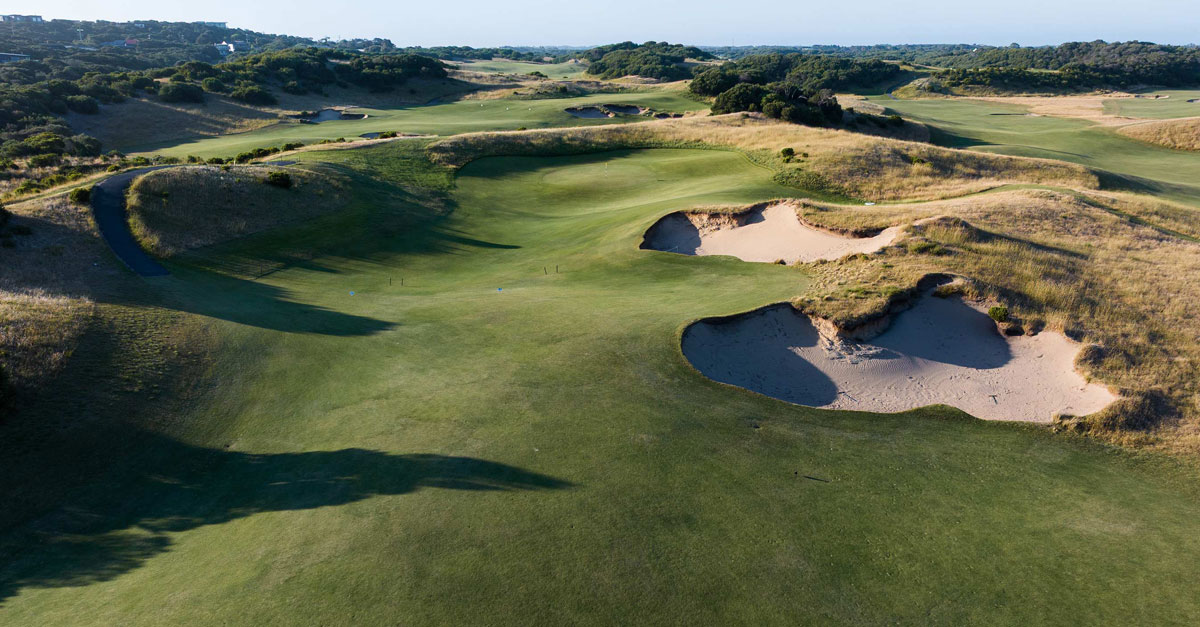
Tom Doak called the second at St. Andrews Beach “one of the best short par 4s I’ve built” — and it’s not hard to see why. It was also the first hole he routed on the property. Studying a topographical map overlaid with an aerial photograph, he zeroed in on a massive sandy blowout at the top of a ridge. He draped a short par 4 around this feature, sited the green in a natural saddle just beyond it, and built the rest of the routing outward from there.
The hole offers three distinct options from the tee. Players who bail left have plenty of room on the low side of the fairway, but their approach will be blind, played over a nest of bunkers spilling out from the blowout. Challenging the bunkers on the high right side opens up a better look. Longer hitters can attempt to drive the green, but even a slight miss can result in a long bunker shot. A large bump short of the green complicates matters further: one side funnels balls onto the putting surface, while the other deflects them into the scrub on the right.
There are many great short par 4s in the Melbourne area — particularly the third and 10th at Royal Melbourne West, the third at Kingston Heath, and the 15th at Victoria — but the second at St. Andrews Beach holds its own against all of them.
{{st-andrews-beach-favorite-hole-2-gallery}}
Overall Thoughts
During a recent interview with Fried Egg Golf, Tom Doak called St. Andrews Beach Golf Course “one of my favorite pieces of ground I’ve ever worked on.” That’s saying something for an architect whose résumé includes Pacific Dunes, Ballyneal, and Tara Iti.
The property consists of several valleys divided by a network of ridges, and its scale is ideal for golf. The ridges are plenty dramatic but not too large to be walkable, while the valleys contain medium-sized undulations that lend themselves naturally to fairway features, green sites, and bunkers.
Putting together a routing on this terrain, Doak wrote in his book “Getting to 18,” was “an exercise in getting the most out of each bowl, while locating the easiest transition points from one to the next.” His solution was elegant: deploy par 3s and short par 4s at the most difficult parts of the site and let the longer holes breathe in the valleys. The sixth and 11th, both one-shotters, traverse the choppiest section of a ridge dividing two bowls at the eastern end of the property. The 305-yard second handles a less severe stretch of the same spine. These shorter holes stitch the routing together, clearing the way for expansive holes like the par-5 first and 17th to unfurl over more gently rolling ground.
MORE: Check Out All 47 Episodes of our Yolk with Doak Podcast Series
Doak’s routing was so successful that he and his co-designer Mike Clayton barely needed to move any earth during construction. In his “Little Red Book of Golf Course Architecture,” Doak notes that 16 of the fairways are unaltered from their natural state; only the 15th and a small portion of the 13th were significantly reshaped.
Because of its naturalness, the course feels effortless. The holes simply respond to the terrain rather than straining to manufacture interest. The greens have shrunk over time, but even in the beginning, they were among the smallest and simplest Doak has ever built. Yet each has at least one trait that lingers in the memory: the broad swale occupied by the fifth, the severe shelf at the front of the ninth, the Redan-like slope funneling into the 16th. These contours are either natural or blended so seamlessly into the surrounding topography that the distinction doesn’t matter. The architect’s hand is effectively invisible.
As a result, what stays with you after a round at St. Andrews Beach is the land itself. Most holes are organized around one or two natural landforms, and whatever the architects added — bunkers, contouring — serves those features instead of competing with them.
Consider the 13th and 14th holes. The tremendously long par-4 13th plays over a basin to a hog’s-back fairway, then to a green nestled into the curve of a small ridge. After an accurate drive, you can lay up to a hollow short and left of the green with relative ease. To reach in two, however, you must challenge a pair of bunkers cut into a rise on the right, finding a ramp just beyond that feeds into the putting surface. The 14th, by contrast, presents a birdie opportunity — a 302-yard par 4 with a fairway 80 to 100 yards wide. Here, again, topography is the critical factor: the fairway is split between a left plateau and a right bowl. The high side is better, offering a view of the green, but to get there, you need to reckon with two fairway bunkers. Plus, if you play too aggressively on that line, you’ll end up with a delicate pitch over a hillock to a crowned green. Any misses long from that angle will trundle down a sharp runoff.
On both holes, it is the terrain, not the architecture, that draws the player’s attention.
{{st-andrews-beach-13-14-gallery}}
In this sense, St. Andrews Beach embodies Doak’s minimalist philosophy as fully as anything he has designed. “The whole point of golf architecture is to discover and then present to the player challenging shots inherent in the landscape,” he wrote in 1997. Most sites make that task harder than it sounds. At St. Andrews Beach, however, the ground was good enough for Doak to turn his ideals into reality.
3 Eggs
St. Andrews Beach’s land and design are world-class. Its presentation is a little slapdash, smudging some details of the original architecture, but this scruffiness actually suits the course’s rustic identity.
So why three Eggs? I mulled this over for a while. No, I don’t believe St. Andrews Beach rises to the level of Cypress Point, Sand Hills, Chicago Golf, or most of the other stone-cold classics we’ve given our top rating. But I do think it rivals Wild Horse Golf Club in Nebraska for the title of best course in the world that anyone can play for under $100 U.S. So if St. Andrews Beach increases its green fee substantially (which would be understandable) or goes private (which would be tragic), I may revoke an Egg. Either way, though, it is one of Tom Doak’s finest designs and a must-play for any golfer visiting the Melbourne area.
Course Tour 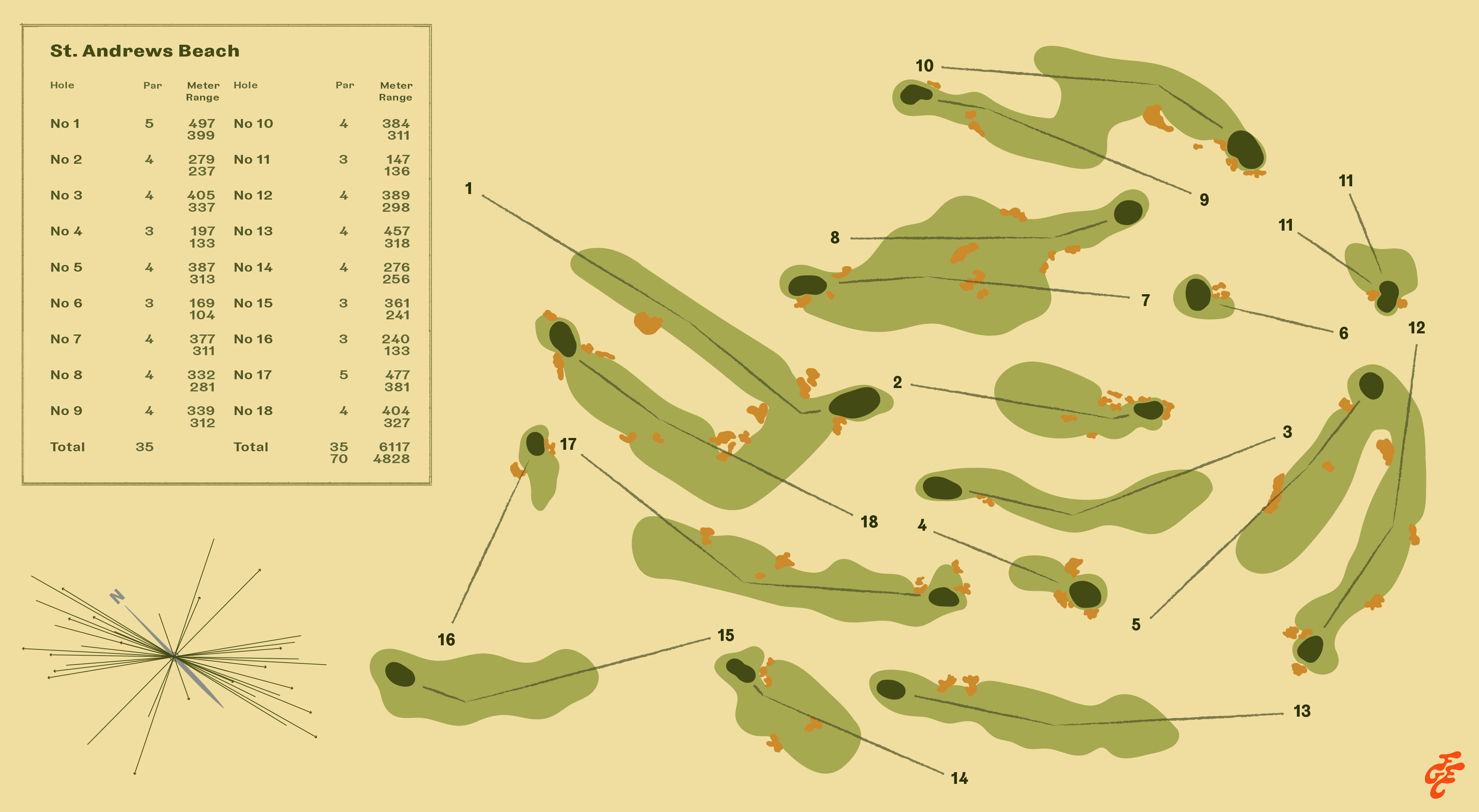 Illustration by Matt Rouches
{{st-andrews-beach-course-tour-01}}
Additional Content
Yolk with Doak 24: St. Andrews Beach, Covid-19, and East Potomac (Fried Egg Golf Podcast)