
Scientists at the University of Illinois Urbana-Champaign have confirmed the existence of a massless particle, long theorized by physicist David Pines’ theory. This particle, known as the “demon,” could hold the key to understanding an elusive concept that, if unlocked, could drastically change the way we use and transmit energy.
The “demon” is electrically neutral, and impossible to detect by conventional means. First proposed over six decades ago, this particle had been a theoretical curiosity for many years. But thanks to some unexpected results, this particle has now been observed in a twist of fate that could potentially redefine our understanding of superconductivity.
How Pine’s Demon Came to Be
The story of the demon particle begins with David Pines, a physicist who, in 1956, proposed the existence of a massless plasmon, essentially a ripple in a material’s electron cloud, that could explain certain phenomena in superconductivity. Pines suggests that this particle is essential for understanding materials that exhibit superconductivity at temperatures higher than those predicted by the conventional BCS theory.
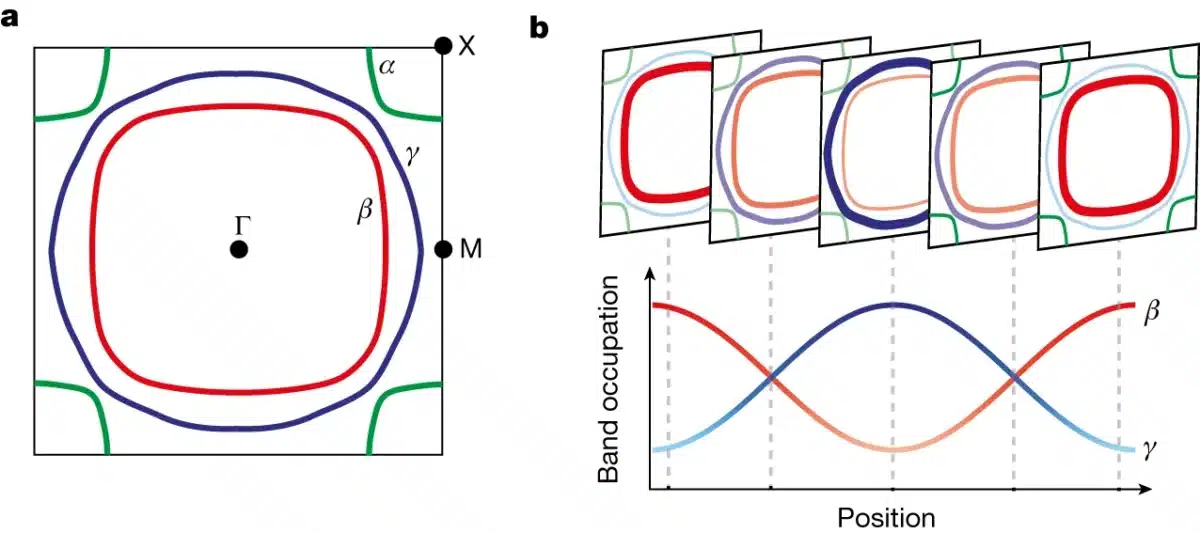 Conceptual illustration of the demon excitation. Credit: Nature
BCS theory, the standard model for superconductivity, works great for low-temperature superconductors. It suggests that superconductivity is the result of an interaction between electrons and phonons. But here’s the catch: the theory fails to explain why some materials, like high-temperature superconductors, maintain their superconducting properties at much warmer temperatures.
Enter the demon, a massless particle that could be responsible for the mysterious behavior of these materials. Yet, for decades, it remained just a theoretical idea.
A Surprising Discovery of the Massless Particle
Fast-forward to today, and scientists at the University of Illinois were exploring the properties of strontium ruthenate, a metal that behaves a lot like high-temperature superconductors, yet doesn’t quite fit the bill. As explained in the study, published in Nature, the team wasn’t specifically looking for this particle, they were simply trying to understand why strontium ruthenate exhibited some curious superconducting-like traits. And then, quite unexpectedly, they saw it: a quasiparticle that didn’t match anything they’d seen before. Ali Husain, one of the co-authors, recalled:
“As we started ruling things out, we started to suspect that we had really found the demon.”
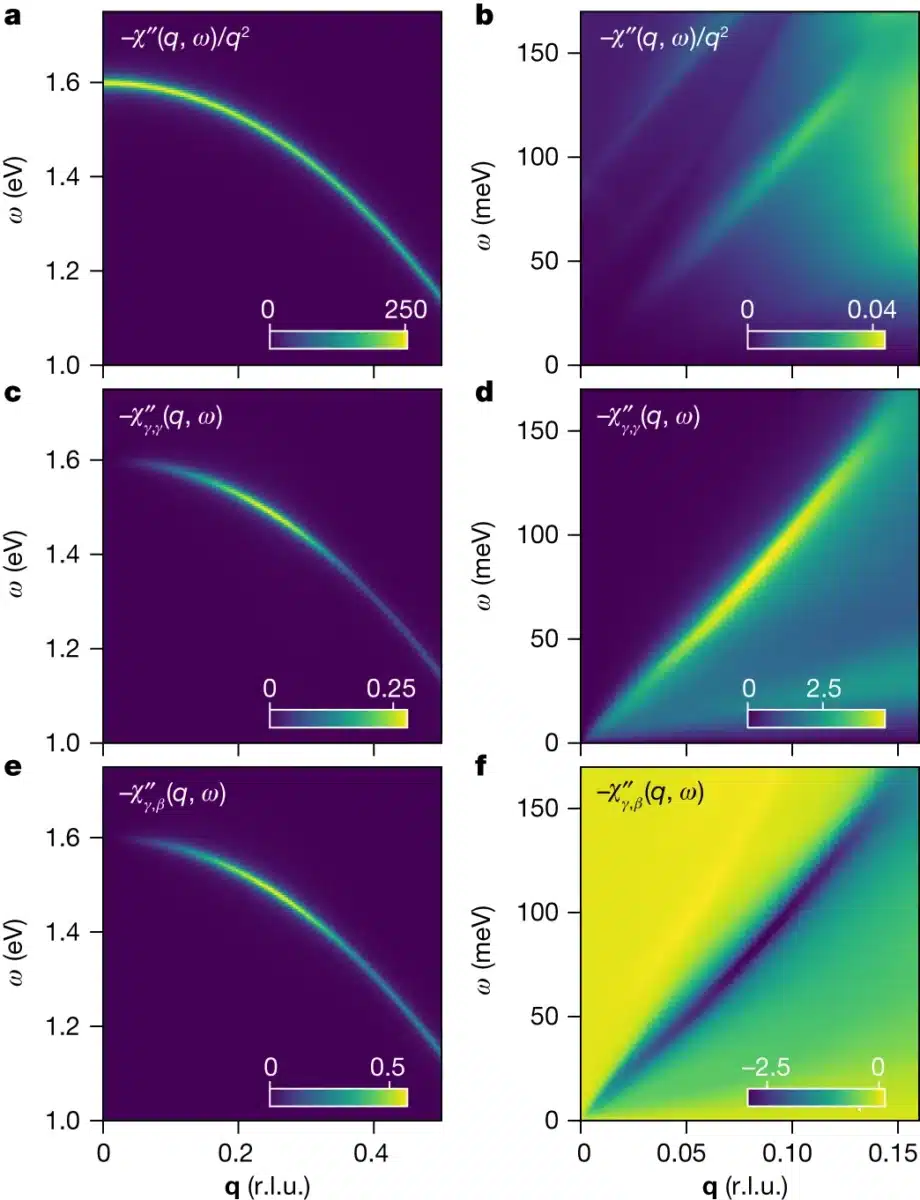 Color plots of the imaginary susceptibility for different channels and energy scales. Credit: Nature
The idea seemed almost too strange to be true. They began measuring the energy gained by firing electrons into the material with remarkable precision. After eliminating other possibilities, the data clearly pointed to something that resembled David Pine’s demon.
“We had to perform a microscopic calculation to clarify what was going on. When we did this, we found a particle consisting of two electron bands oscillating out-of-phase with nearly equal magnitude, just like Pines described,” stated Edwin Huang, Moore Postdoctoral Scholar at UIUC with a focus on condensed matter theory
A Step Forward for Superconductivity
So why does this matter? It could completely change how we think about superconductivity. Right now, the world of superconductors is limited to materials that only work at incredibly low temperatures, requiring costly and complex cooling systems. But the discovery of this massless particle suggests that superconductivity might be possible at much higher, even room, temperatures.
Peter Abbamonte, another co-author and a professor of physics, pointed out that many great scientific discoveries happen by accident, and this one is no different. He said:
“Most big discoveries are not planned. You go look somewhere new and see what’s there.” And that’s exactly what happened here.
The team didn’t set out to find the demon, but in their quest for answers about strontium ruthenate, they found it. The results of their research are sparking excitement in the scientific community. With a better understanding of how this massless quasiparticle behaves, researchers can now investigate how it might contribute to superconductivity at higher temperatures.