
Climate change remains a top issue for many New York State lawmakers as a new study finds global warming has accelerated significantly over the last decade.
The study has raised fresh urgency around the state’s legally binding climate targets and the cost of meeting them.
Researchers analyzed five large global temperature data sets and found the Earth warmed by about 0.2 degrees Celsius from 1970 to 2015. The study found a 75% jump after that, with the Earth warming by 0.35 degrees Celsius from 2015 to 2025. If that accelerated rate continues, the report says the world would reach critical warming limits before 2030.
New York has set up initiatives aimed at curbing the impact. The state’s Climate Leadership & Community Protection Act was signed into law in July 2019 by former Governor Andrew Cuomo and is described as one of the most ambitious climate laws in the nation.
It requires New York to reduce economy-wide greenhouse gas emissions 40% by 2030 and no less than 85% by 2050, along with targets to cut emissions and expand clean energy by 2040.
But, a recent memo from the New York State Energy Research & Development Authority, known as NYSERDA, addressed to Governor Kathy Hochul warns that implementing the law will be expensive and is almost certain to drive up energy bills.
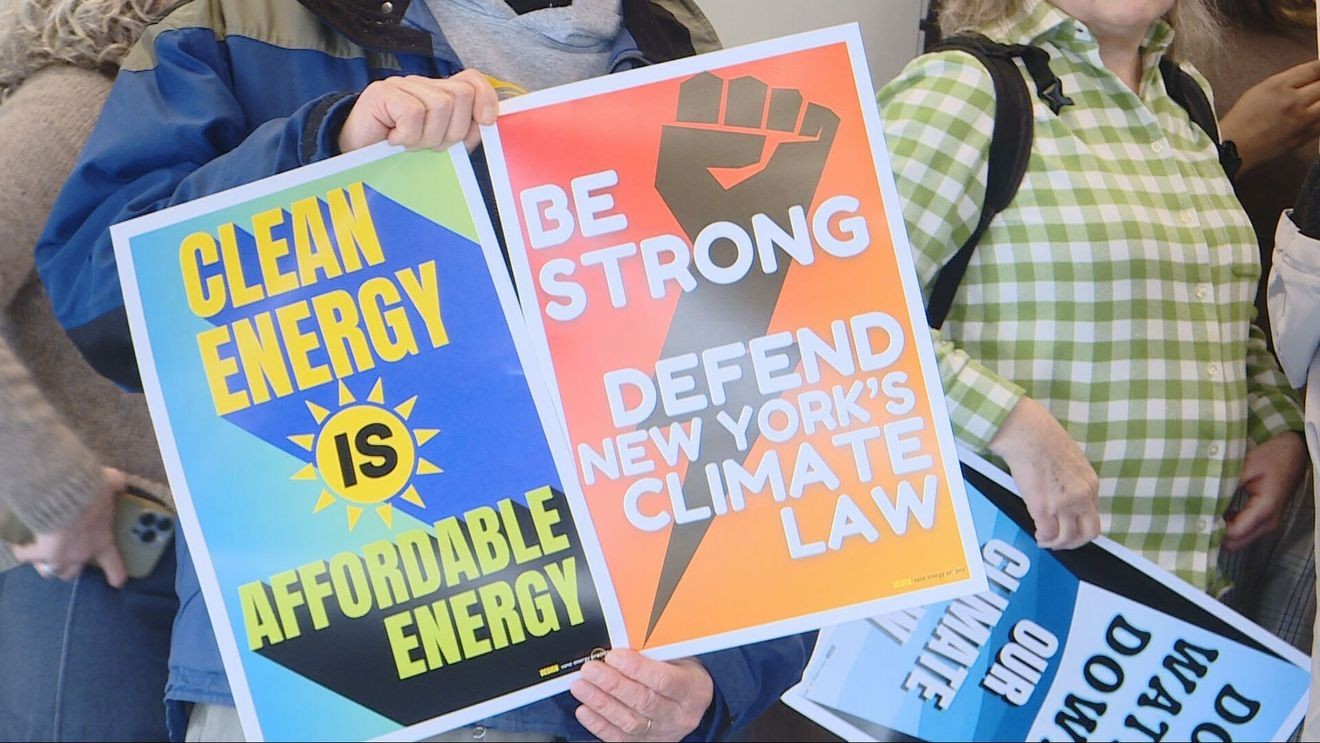
In Syracuse on Friday, supporters of the climate law defended it even as New Yorkers face rising energy costs.
Vanessa Fajans-Turner of Environmental Advocates NY said, “The climate law is not just about climate. It is an affordability law. It protects consumers and it protects the climate. And that is the definition of a win-win.”
State Senator Rachel May (D, 48) was among 29 of New York’s 41 Democratic senators who sent a letter urging Hochul to hold off on changes to the state’s climate law.
May said, “Anyone who thinks that leaning into fossil fuels is a smart energy policy, is a good long-term strategy, is good for people’s utility bills, is just flat wrong.”
The NYSERDA memo warns of steep cost increases, including that “Upstate oil and natural gas households would see costs in excess of 4-thousand dollars a year.” It also says businesses can “expect utility costs to increase by as much as 46-percent,” and that “Operating a delivery truck would increase by over 60%.”
Assemblyman Al Stirpe (D, 127) argued the law is even more relevant now than when it was enacted.
“Absolutely. It’s a better plan than any plan anybody has put up for energy affordability and the health of people in New York. Delaying it is just delaying the benefits,” Stirpe said.
May said, “The whole climate law was the idea that we’re going to put ourselves on a more sustainable path. If we divert from that path now, it’s going to be years and years before we catch up again.”
Stirpe also pointed to the state’s current reliance on natural gas, saying, “60% of our energy is produced by natural gas. And natural gas has increased by 50% over the last year. So, it doesn’t take a genius to understand that we’re never gonna get to where we wanna go if we’re leaning on natural gas.”
May acknowledged skepticism about renewable energy and attributed it to organized opposition.
“Definitely, there is an asserted campaign funded by the fossil fuel industry, by right-wing media and certainly our Republican colleagues to push back,” she said. “They are trying to make us believe that solar and wind, battery storage, or some kind of calamity in the making and they’re doing a really good job of that messaging right now and we have to be pushing back.”
The debate comes as energy bills continue to rise. Hochul has made tackling utility costs a priority in the next budget, while lawmakers supporting the climate law argue that changing the state’s climate targets is not the way to address higher bills.