
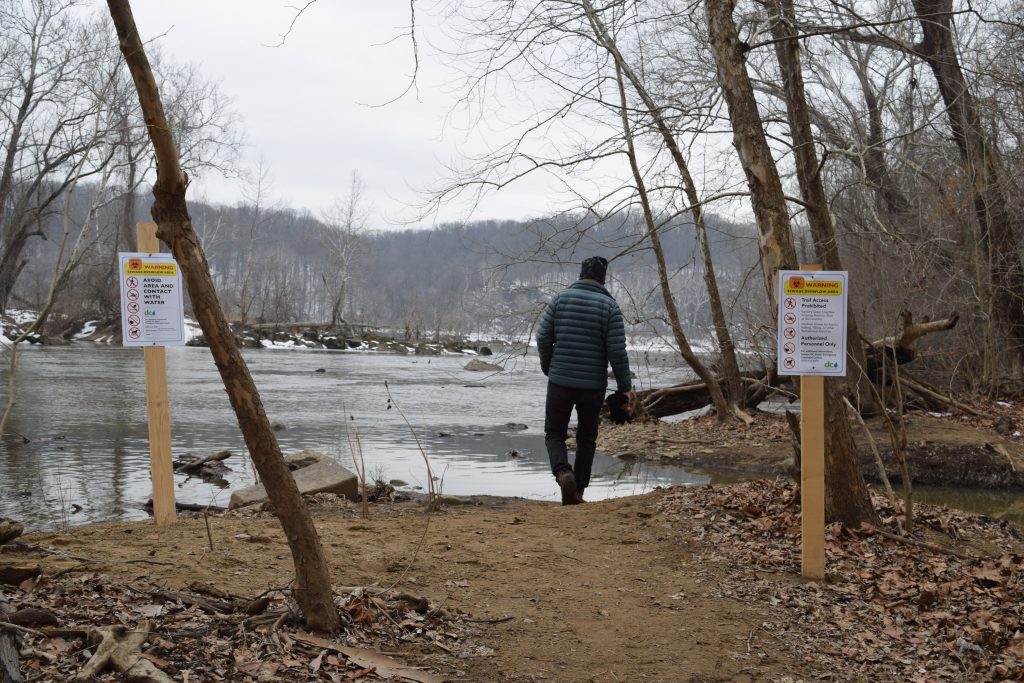
While other local jurisdictions have lifted recreational water advisories related to the January Potomac River sewage spill, Montgomery County health officials say the river is still not safe for recreation, according to a Thursday press release from the Maryland Department of Health.
Montgomery County’s Department of Health and Human Services (DHHS) issued a recreational advisory on Jan. 19, about 10 days after the collapse of the Potomac Interceptor sewer line near Cabin John, warning residents to avoid contact with the water.
The county’s continuing advisory leaves future outdoor recreation on the river uncertain as temperatures begin to warm.
Those impacted include local kayakers with the Potomac Whitewater Racing Center in Brookmont who have not been able to return to their normal training area in a feeder canal on the river near Lock 6 of the C&O Canal National Historical Park since the spill. The Potomac Whitewater Racing Center is known for producing world-class athletes who have competed and won medals for the U.S. during the Olympics and world championship competitions.
The Potomac Interceptor collapse occurred just outside of Cabin John and off of the Clara Barton Parkway near I-495. DC Water, the utility that manages the line, estimates a total of 243.5 million gallons of wastewater spilled onto the banks of the Potomac River in Montgomery County and into the waterway known as the “nation’s river.”
The interceptor normally carries about 60 million gallons of sewage per day to the Blue Plains Advanced Wastewater Treatment Plant in Southeast D.C., the largest treatment plant in the world.
Sean O’Donnell, the county’s deputy chief of Public Health Services at the health and human services department, said Wednesday in a statement to Bethesda Today that the county is monitoring the conditions in the river as well as bacterial testing data conducted by DC Water and the Maryland Department of the Environment along the county’s borders.
“Current testing levels, despite fluctuations, remain significantly higher than [Environmental Protection Agency] swimming limits,” O’Donnell said. “We will continue to evaluate water testing as well as progress on remediating the contaminated land and riverbank areas surrounding the spill, and update the local advisory once levels are consistently safe in our area.”
Upstream geopolymer lining in the Potomac Interceptor is nearly complete. Here’s what it looks like now.
Next up: the downstream section. Once both are lined, emergency repairs will be complete. pic.twitter.com/8MnJL796jJ
— DC Water (@dcwater) March 6, 2026
According to the state department of health release, elevated E. Coli levels in the Potomac River are “expected given that the spill site occurred on federal land in Montgomery County.” E. coli is a water quality parameter that indicates fecal material in the water.
County health officials continue to monitor the site, water quality sampling data to determine if additional advisories and action are needed, the release said.
DC Water crews are working on emergency repairs to the damaged section of the pipe. According to a Thursday blog post from the utility, crews have been reinforcing the upstream section of the pipe with geopolymer lining to “help restore the pipe’s structural integrity” and plan to then add the lining to the downstream portion of the pipe.
In addition, environmental remediation in the immediate area near the spill has begun, according to DC Water, and the first phase of the clean-up could take about one to two months. The first phase focuses on removing debris, brush and soil.
Recent water quality data from DC Water at Swainson Island, a Potomac River island near the sewage spill site, indicates that elevated and unsafe levels of E. Coli remain in the water.
Samples taken at Swainson Island from the first four days of March were reported to show E. coli levels more than five and a half times the EPA’s standard for safe swimming, according to DC Water data.
Environmental restoration work is underway near Clara Barton Parkway. Our crews have been on site clearing debris and stabilizing the drainage channel. Phase 1 of the environmental rehabilitation will take 1–2 months and focuses on removing soil, brush, and debris. pic.twitter.com/WX57ienzqi
— DC Water (@dcwater) March 5, 2026
DC Water data also shows the utility has added water quality testing locations at Sycamore Island and Lock 6, which is near the feeder canal where kayakers with the Potomac Whitewater Racing Center train.
Tyler Westfall, a coach and athlete at the racing center, told Bethesda Today on Friday that kayakers have not been able to train at their normal location in the feeder canal since the sewage spill in January. That has had an “immense” impact on the center’s top paddlers, some of whom will be vying for a spot on the U.S. national team during trials in mid-March, he said.
Westfall is hoping to compete in the 2028 Los Angeles Summer Olympics and was on his way to Montgomery, Alabama, on Friday for the 2026 USA Canoe Slalom National Team Trials that begin March 13.
The sewage spill “definitely had a pretty big impact for a number of weeks on our top paddlers and their ability to get quality training in,” Westfall said, noting they have been training upstream from the spill near Old Angler’s Inn in Potomac.
“We made it work the best we could … to stay fresh, stay physically fit and preparing the best way that they could,” he said.
Westfall said the center is keeping paddlers out of the water out of “an abundance of caution.” But recent water quality testing results from DC Water show promising results, he said.
Westfall said he was “happy” that DC Water was beginning to test at Lock 6. On Feb. 26, Westfall spoke at a DC Water community meeting in Bethesda asked officials to conduct additional testing in the area where kayakers train near Lock 6.
According to water quality testing data released by DC Water, E. Coli levels at Lock 6 remained below the EPA safety standard for swimming on March 4, but are improving.
“It’s looking positive and we’re happy that DC Water has started to do what they should be doing with regard to testing in the right area and listening to people that use the river and know where the recreation hot spots are,” Westfall said.
Still, Westfall said the center is pushing public health authorities for broader water quality testing that tests for other pathogens and chemicals.
“We just want them to continue doing the right thing and getting full broad-spectrum testing done, so that we know for sure,” Westfall said. “We don’t want to be guessing on public health.”