
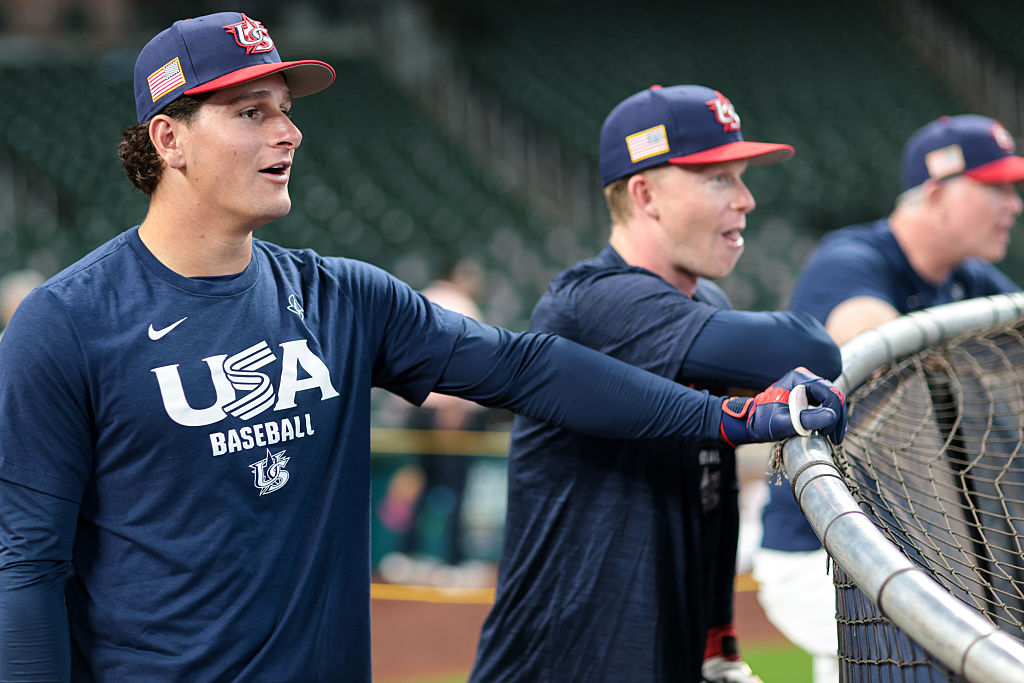
Dan Johnson shares his preview, prediction and pick for tonight’s WBC first round match between the United States and Brazil.
Daikin Park opens Pool B with a matchup that carries two very different kinds of WBC history. Team USA has been here every Classic and owns the sport’s cleanest American crown—champions in 2017, then back on the title stage in 2023 before Shohei Ohtani and Japan edged them in the final. Mark DeRosa has been living in that 2023 bitterness ever since, and this roster was built to turn the rematch impulse into a run through the bracket.
Brazil is a different and resurgent kind of WBC story. A program that’s only been in the tournament once, 0–3 in 2013, but not remotely a tourist. In its WBC debut, Brazil carried a four-run lead on Japan into the eighth before the dam finally broke, and that night is still the proof-of-life reference point for what this jersey can be when the game gets weird. After missing the next two Classics, Brazil punched its ticket back by going 3–1 in last March’s qualifiers, and it enters Houston still chasing its first Classic win.
This is the first USA–Brazil meeting in WBC play.
Here’s how I’ll play it. I’ll be pumping out these predictions for individual games all tournament, with plenty of coverage here on DraftKings Network. Follow my handle @dansby_edits for more betting plays.
Team USA went +24 in two exhibitions (29-5), starting with a 15-1 rout of the Giants that produced 19 hits and featured homers from Alex Bregman and Roman Anthony (a two-run shot that pushed the lead into runway territory). Then the finale vs the Rockies finished 14-4 with the U.S. launching five homers—Judge, Bregman, Goldschmidt, Buxton, Will Smith—and the game was shortened to eight innings, meaning the damage came fast, not late. In that Rockies exhibition, the U.S. didn’t just homer—it stacked multi-hit and extra-base pressure behind it, with Brice Turang ripping two doubles and driving in two as the bench layer kept innings alive.
And the Giants blowout had a true top-of-order tell: the U.S. scored immediately—Witt single, Harper double, then Judge’s two-run hit in the first—which is exactly the kind of early-separation script that matters when a big run line needs runway by the middle innings, not the ninth.
Let’s admire the Captains America roster, shall we?
Team USA starters
The reason the market can even post a number like this is the American lineup’s contact-quality floor. Aaron Judge walks in as the tournament’s loudest bat: in 2025 he hit .331/.457/.688 (1.144 OPS) with 53 homers, 124 walks, and a Statcast profile that basically dares pitchers to be perfect—95.4 mph average exit velocity, 58.2% hard-hit, 24.7% barrel rate, .463 wOBA with a .460 xwOBA backing it. Bryce Harper is the left-handed stabilizer: .261, 27 homers, .844 OPS, and 12 steals last season, which matters in WBC rules-ball where a single extra 90 feet can flip an inning. And Kyle Schwarber is the purest one-swing detonation on this roster: .240/.365/.563 (.928 OPS) with 56 homers in 2025, which is exactly why the HR prop is the sharpest place to express the mismatch.
Then the depth starts doing unfair things to opponents’ brains. The projected spine—Witt, Harper, Judge, Schwarber, Raleigh—has been the popular consensus look, and it’s built to force a pitcher into damage zones immediately. Bobby Witt Jr. brings real blowout fuel because he creates crooked innings without homers; Cal Raleigh is the unfair keystone at catcher: 60 homers, .359 OBP, .589 SLG, .948 OPS, 97 walks, and 14 steals in 2025. Even the supporting on-base layer matters: Alex Bregman’s the kind of leader and lineup piece that keeps innings alive until the big bats get a second crack.
On the mound, Logan Webb is the exact tournament opener archetype: low chaos, high control, and fast innings. His 2025 was ace-volume plus ace-shape—207 innings, 3.22 ERA, 1.24 WHIP, with the underlying traits that erase weak lineups: 26.2% K rate, 5.4% walk rate, and a 53.2% ground-ball rate that turns contact into double-play chances. Pitch limits mean Webb probably lives in the four-to-five inning window, but that’s enough runway to put Brazil in a deficit script early, especially if the sinker is living at the knees and the changeup is dragging swings off the barrel.
USA bullpen
The back-end is unfair. Mason Miller is a short-burst cheat code—61.2 IP, 2.63 ERA, 2.23 FIP, 104 Ks (15.18 K/9) with triple-digit heat—then David Bednar closes like a metronome at 2.30 ERA, 1.04 WHIP, 34.3% K rate (12.35 K/9). The bridge has the same teeth: Garrett Whitlock, Gabe Speier, and Garrett Cleavinger are all nasty enough to help the U.S. win matchup pockets without losing punch.
Even the secondary options are leverage arms: Griffin Jax ran a 35.0% K rate with a 2.51 FIP despite the 4.36 ERA, and Clay Holmes brings a 55.8% ground-ball rate with 0.76 HR/9 to keep the ball in the yard when the game turns into pitch-limit management.
Team USA reserves
And when the first wave doesn’t finish the job, the bench is still starting-caliber and comes with real 2025 receipts. Will Smith is the extra catcher and a full-on middle-order bat: .296/.404/.497 (.901 OPS) with 17 homers and 64 walks in 110 games, which is basically a second leadoff hitter stapled to power. Byron Buxton is a late-innings nightmare because the power-speed combo stays live even in a blowout script: .264/.327/.551 (.878 OPS) with 35 homers and 24 steals, and he went 24-for-24 on steals in 2025. Pete Crow-Armstrong is the defense-plus-chaos outfielder who can also put a crooked number on the board: .247/.287/.481 (.768 OPS) with 31 homers, 37 doubles, and 35 steals in 2025. Brice Turang is the glue-piece that keeps innings moving—contact, speed, and enough gap juice to keep rallies from dying when the stars rotate out.
The infield depth is the same story—no soft landings. Gunnar Henderson can show up as a reserve and still play like a headliner: .274/.349/.438 (.787 OPS) with 17 homers and 30 steals across 154 games in 2025. Ernie Clement is just the purest utility asset—.277/.313/.398 (.711 OPS) with 151 hits and 35 doubles while logging 15-plus appearances all over the dirt, which matters when the game turns into matchup chess early. Paul Goldschmidt‘s already showed WBC comfort in 2023 with a .280/.455/.440 (.895 OPS) line in that tournament sample. And, of course, Roman Anthony is the young bat off the bench with instant on-base: .292/.396/.463 (.859 OPS) in 2025 with 40 walks in 71 games, which is exactly how a blowout becomes a runway when the lineup turns over in the fifth. He hit a moonshot against the Giants.
Team Brazil
Team Brazil starters
Brazil’s plan is narrow, but it’s not empty, and it starts on the mound with Bo Takahashi trying to land the first two innings without damage. The cleanest stat snapshot is his 2024 NPB season: 72.2 innings, 3.22 ERA, 5.94 K/9, 3.34 BB/9, 0.50 HR/9—a contact-and-command profile where every missed spot gets magnified against a lineup that can slug its way out of 0-2 counts. Behind him, Brazil’s relief innings still have a couple real pro arms. Thyago Vieira brings the only true MLB-leverage history on the staff—53 big-league games, 66.2 MLB innings on his ledger—so if Brazil gets to the sixth with the score still breathable, he’s the name that can steal a pocket of outs. Gabriel Barbosa is another stabilizer-type arm with fresh minor-league form: 33 games, 87.0 innings, 3.62 ERA, 69 strikeouts, 1.32 WHIP in 2025. The wild card is youth—Joseph Contreras is only 17, already carries that 6-foot-4 frame, and he’s No. 47 in the 2026 Draft class after a 2025 Georgia 4A state title run, with Vanderbilt leverage sitting behind his signability.
Offensively, Brazil’s lineup is built around one heartbeat bat and one rising prospect. Leonardo Reginatto is the whole program’s pressure valve: in the 2025 Qualifier he went 5-for-13 with three doubles and four RBIs, and his career Qualifiers line across four cycles is absurd—26-for-51 with 11 RBIs in 14 games. It’s carried, too; Reginatto carried real pop in Mexico last year, hitting .289/.351/.528 (0.879 OPS) with 14 homers in 64 games for Quintana Roo, then .276/.364/.431 in a smaller Tabasco run. Lucas Ramirez is the upside swing: in his first pro season in 2025 he combined to hit .266 with a .773 OPS and three homers in 60 games, and he also went 5-for-13 in the Qualifier—so there’s at least one bat that can turn a mistake into an instant double-in-the-gap problem.
The veteran support is more patchwork, but there are usable bats on the bench card: Dante Bichette Jr. has historically hit for average in pro contexts, including indie stretches that totaled .330/.370/.455 (0.825 OPS) across two seasons, and that matters because Brazil’s only real scoring path tonight is sequencing—two singles, a gapper, a sac fly—before Webb’s ground-ball machine can erase the inning. And the broader momentum piece for the team here is that Brazil is back in the Classic because it went 3-1 in the Tucson Qualifier pool, and the program’s recent arc includes a silver medal at the 2023 Pan American Games, which is why the tone around this team is that of a potential sticky underdog.
In the First Round, starters are capped at 65 pitches, and the game can get called if a team is up 10-plus after seven or 15-plus after five, which can freeze the margin before the ninth-inning tack-ons arrive. That’s why USA -9.5 is thin even in a mismatch: a very plausible final like 10-2 or 11-2 still loses, and the cover lives in narrow bands like 12-2 or 11-1. The one structural nudge toward keeping the foot down is tie-break math—Pool standings can break on runs allowed divided by defensive outs (and earned runs allowed the same way), which quietly rewards clean, lopsided scripts.
The case for the double-digit USA win starts with how low-chaos Webb tends to be when the game is supposed to—and needs to—be low-chaos. In 2025 Statcast contact quality against him was tame for an ace workload: .303 wOBA allowed, .295 xwOBA allowed, 89.7 mph average exit velocity allowed, and just an 8.3% barrel rate allowed. Even his home log shows how hard it is to take him deep when he’s locating—nine homers allowed in 116 home innings with a 3.10 home ERA—and that’s the profile that tends to keep an underdog stuck at one or two runs unless the bullpen leaks. On the other side, Takahashi’s 2024 NPB line screams contact management more than bat-missing—5.94 K/9 with 3.34 BB/9—and against an order that can stack barrels, the punishment for one fastball that drifts is immediate.
That’s also why I feel like a prop is the cleaner edge than asking for a precise 10-plus margin. So I’m providing a few bets, here.
Schwarber’s 2025 splits versus right-handed pitching are exactly what this matchup wants: 33 homers in 448 plate appearances with 72 walks, meaning the floor is either damage or base traffic, inning after inning. The Statcast underpinning stays loud too—.403 xwOBA and a 20.8% barrel rate—so the home-run bet is a contact-quality play as much as it is a raw power wager. To wit, my best bet stays Schwarber to hit a home run (+125), playable to about +105.
If there’s a secondary prop worth pairing, Logan Webb 6+ strikeouts (+145) feels live—he ran a 9.74 K/9 and 26.2% K rate in 2025, so even on a 65-pitch WBC leash the four-to-five inning window can still get to six punchouts. And, possible and patriotic though it may be, betting the side feels risky. It’s a decidedly smaller lean for me: USA -9.5 (-125), because Webb’s contact suppression plus the U.S. lineup’s righty-split power points to enough separation to land in that 12-2 / 11-1 neighborhood more often than Brazil can keep it tidy. The way it dies is Brazil scratching to three—something like 12-3—because one extra run flips a cover into a loss, but the matchup still points to the U.S. big bats creating a margin fast, and then protecting it with low-traffic innings from the bullpen, and some pesky play and shutdown defense from our reserves.
As for a final score projection, I see it somewhere in the ballpark of USA 12, Brazil 2.
Kyle Schwarber to hit a home run (+125)