
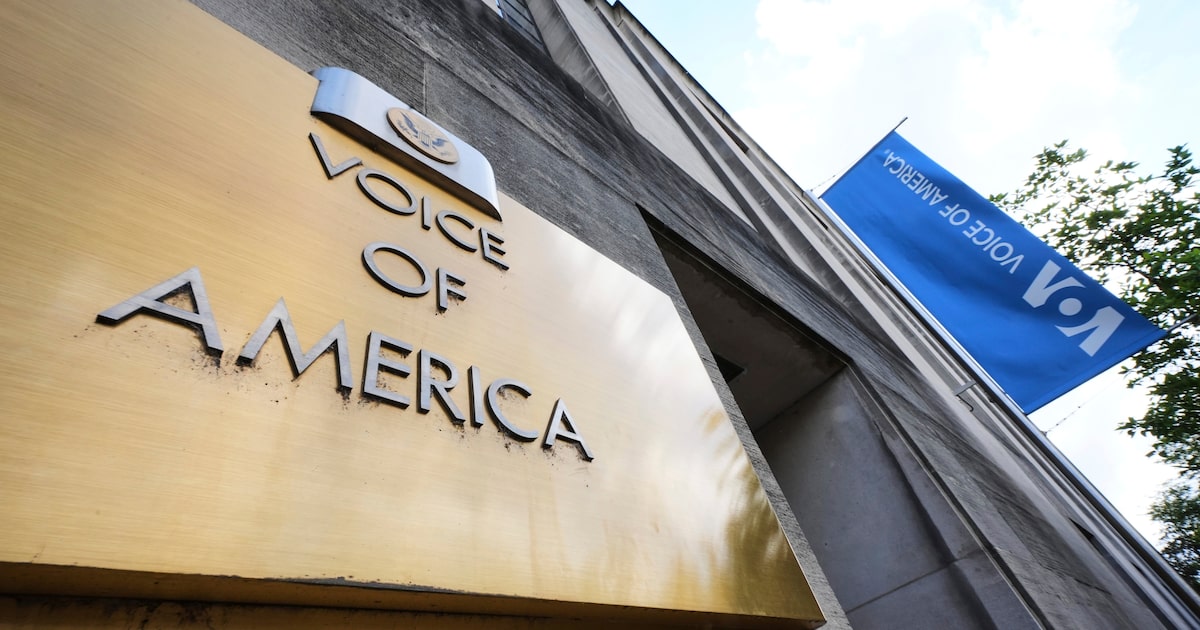

Republican strategist Doug Heye piped up on a talk show recently with what may seem like a non-sequitur about what comes next in Iran. “We also really could use a funded Voice of America right now. The Iranian people could use that as well,” he concluded on ABC’s “This Week with George Stephanopoulos.”
President Franklin D. Roosevelt created Voice of America (VOA) through an executive order in 1942. Until President Donald Trump’s March 2025 executive order to strip much of VOA’s financing, the publicly funded yet independent news organization was indispensable to providing reliable information around — and about — the world.
That included fighting Nazi propaganda efforts in World War II with factual reports. That included disseminating accurate information beyond the Iron Curtain during the Cold War. And now, that includes broadcasting truthful reporting into Africa, where China is doing its level best to dominate information flows around the continent.
American presidents from both parties have celebrated VOA’s role in using soft power — in the agency’s case, promoting fact-based reporting — to advance democratic ideals like a free press.
John F. Kennedy took VOA’s mission so seriously that he selected legendary CBS broadcaster Edward R. Murrow to lead the United States Information Agency, which then oversaw Voice of America.
Opinion
On its 40th anniversary, Ronald Reagan said: “The Voice of America is for many the only source of reliable information in a world where events move very quickly.” And on its 60th anniversary, George W. Bush emphasized that “To people who live under governments that sustain their power with lies, the Voice of America brings truth.”
Today, Iranians need independently verified facts. Many live in information deserts after authoritarian clerics shut down access to the internet for most Iranians. That has allowed the ruling elite to hide information from protesters.
The United States Agency for Global Media (USAGM), which today oversees VOA, has ramped up its coverage of Iran over the last couple of months. That’s important. But the coverage is a lot less than before the agency essentially was shut down last March.
Before then, VOA reportedly reached about 15% of Iran’s adult population through satellite TV broadcasting, the internet and social media. Not only does the shift impact Iranians today, it could be hard to rebuild an audience there in the future.
At the same time, The Hill and The Washington Post have reported that an adviser overseeing VOA’s Persian-language service is now censoring coverage about Iran’s exiled Crown Prince Reza Pahlavi, who is considered a leading opposition figure. Kari Lake, who has led USAGM, has denounced those reports, saying VOA is trying not to pick sides among opposition groups.
Adding to the confusion, on Saturday, a U.S. district judge voided all of Lake’s actions while she was acting CEO of USAGM, saying she was improperly installed in that role.
It is important to remember the organization has a history of independent reporting to maintain. Going back to President Gerald Ford’s administration, VOA’s charter has required editorial freedom. And in 1942, VOA’s first radio show broadcast in German with journalist William Harlan Hale saying:
“We bring you voices from America. Today, and daily from now on, we shall speak to you about America and the war. The news may be good for us. The news may be bad. But we shall tell you the truth.”
To be sure, programming tensions have existed between previous administrations and VOA. But independent reporting has been the guiding principle of VOA staffers, who numbered around 2,000 at one point. About 500 staff members are on paid administrative leave today awaiting a court decision regarding their fate. About 150 people reportedly still have been working there in recent weeks.
To their credit, bipartisan majorities in both houses of Congress agreed earlier this year to restore some funding for USAGM. Legislators approved $653 million for the next fiscal year instead of the $153 million Trump requested last year.
Still, Politico reported late last month, USAGM is offering a “deferred resignation program” to those VOA employees on administrative leave, although a federal judge has suspended all reductions in force.
The point in all this is that our interests are served, especially as the situation in Iran unfolds, in funding the Voice of America to do the work it has done since World War II. And to do it with an independent editorial voice.
Maintaining the flow of reliable information is its own battleground these days. Authoritarians clearly don’t want a free flow of accurate information. But factual reporting gives citizens, particularly in closed societies like Iran, the knowledge to make informed decisions about their future.
As Heye said, Iranians stand to benefit from a funded Voice of America. One that can do its work.
It’s hard to see the problem with that.
We welcome your thoughts in a letter to the editor. See the guidelines and submit your letter here.
If you have problems with the form, you can submit via email at letters@dallasnews.com