
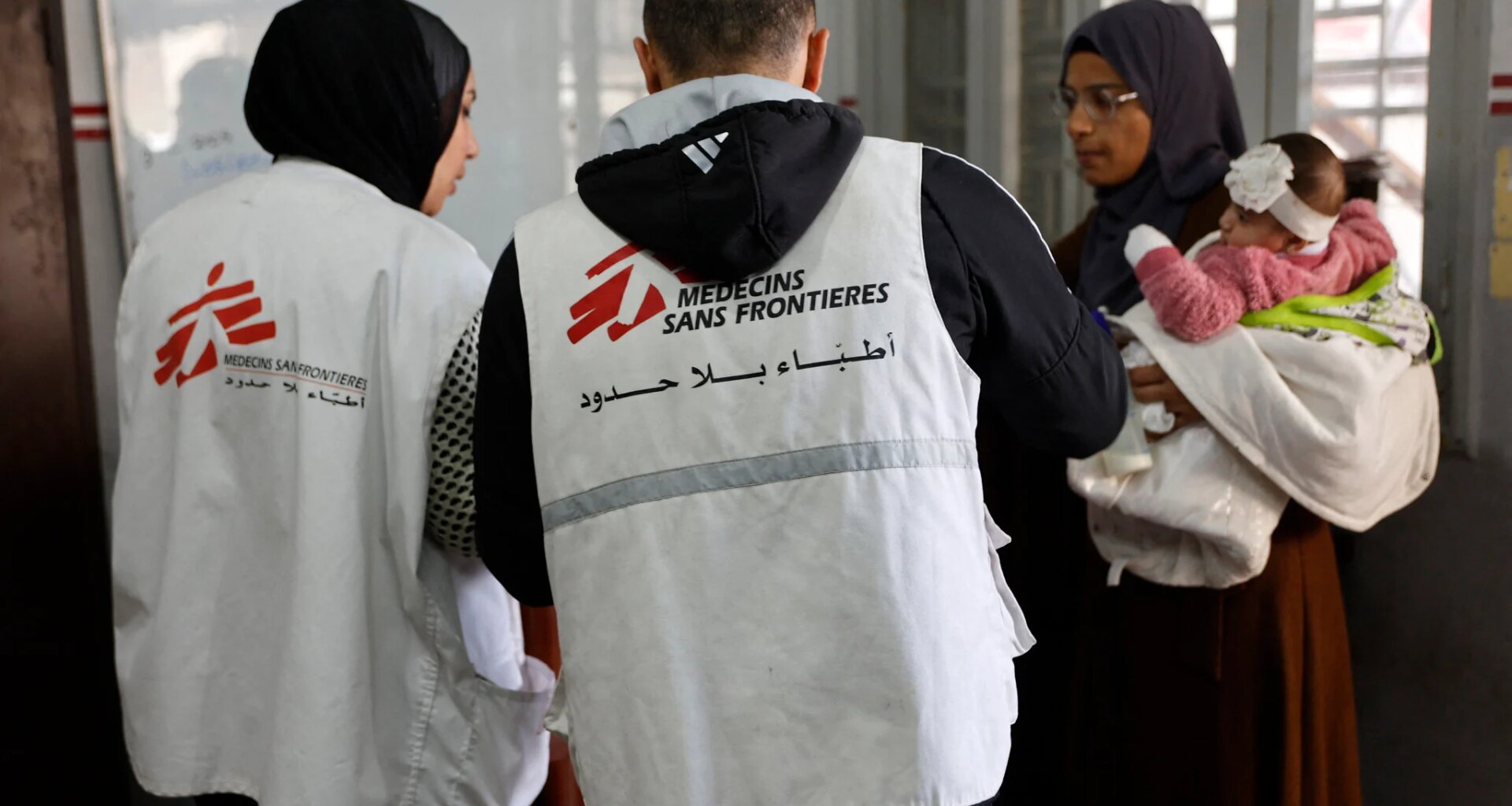
For over half a century, Doctors without Borders – Médecins Sans Frontières (MSF) stood as a model for principled humanitarian medicine. Since its founding in 1971, the organization emphasized the values of impartiality, independence, and medical neutrality, an approach so widely admired that it was awarded the Nobel Peace Prize in 1999. In recent years, MSF has undergone a profound ideological transformation. While continuing to invoke the language of medical neutrality, its rhetoric has become overtly politicized, most notably in its discourse on Israel.
Since October 7, 2023 extensive evidence has emerged of healthcare workers directly involved in Hamas’s terror apparatus; hostages paraded through Al-Shifa Hospital, captives held in physicians’ homes, a hostage killed by a lethal air injection administered by a doctor, and hostages sexually assaulted by medical personnel assigned to care for them. One released hostage, Emily Damari, recounted being taken to Al-Shifa on October 7 where she was told by the physician treating her gunshot wounds to call him “Dr. Hamas.”
Against the backdrop of escalating concern over the integrity of humanitarian operations, Israel’s Ministry of Diaspora Affairs announced new registration and vetting requirements in March 2025 for non-governmental organizations (NGOs) operating in the Palestinian territories, including disclosure of staff identities to screen for terrorist links. Organizations that complied were allowed to continue operating. After months of public denunciations portraying Israel’s requirements as an assault on humanitarian aid, MSF announced on January 30, 2026 that it would not comply, while simultaneously waging a media campaign condemning the policy. In a setting where healthcare had been profoundly weaponized, these safeguards should have been championed by an organization meant to defend medical neutrality and the sanctity of healthcare.
The weaponization of Gaza’s hospitals
There is longstanding documentation of Hamas’s use of hospitals for military purposes. For more than a decade, journalists, aid workers, and Hamas’s own records documented the dual use of Gaza’s medical facilities. Hamas military documents discovered in 2020 detail a deliberate strategy of embedding fighters and military infrastructure within hospitals in direct violation of international humanitarian law. The current war confirmed the scale of this integration.
Documents recovered by the IDF describe a centralized regime through which Hamas regulated international NGOs, including MSF. Hospitals had designated off-limits areas reserved for military use. Each organization was assigned a Hamas-approved “guarantor,” a senior official who liaised with Hamas security services and enabled Hamas to influence operational decisions. MSF’s guarantor was the deputy head of its Gaza leadership. Physical evidence corroborated these findings. Beneath Al-Shifa Hospital, the IDF uncovered a major tunnel complex, housing a command center and weapons storage sites. Hospitals were systematically used to shield operatives, and hold meetings for Hamas commanders.
Get The Times of Israel’s Daily Edition
by email and never miss our top stories
By signing up, you agree to the terms
The abuse of protected medical roles by armed operatives should have prompted institutional reckoning, transparency, and reform.
Apart from issuing an unprecedented statement on February 11, 2026, acknowledging the presence of “armed operatives” at Nasser Hospital, the organization denied Hamas’s use of medical facilities for military purposes. By acquiescing to and concealing the militarization of hospitals, MSF contributed to stripping those facilities of their protected status under international humanitarian law, thereby endangering the very healthcare workers and civilians it claims to defend.
From medical neutrality to political advocacy
The collapse of medical neutrality was compounded when MSF amplified false claims advanced by its own affiliates. British-Palestinian physician Ghassan Abu-Sittah held a press conference from the hospital grounds claiming that an Israeli air strike hit Al-Ahli Hospital’s operating room, causing a mass casualty “massacre.” Subsequent evidence showed the explosion was the result of a misfired PIJ rocket in the parking lot. The incident continues to be cited as evidence of Israeli “genocide”. Abu-Sittah has since submitted statements to the International Criminal Court Prosecutor and has continued to invoke his MSF affiliation to advocate sanctions and publish political advocacy.
Further evidence has emerged that some MSF-affiliated healthcare workers in Gaza were members of Hamas or other Palestinian terrorist groups. Documented cases include individuals involved in rocket production, sniper activity, and operatives photographed in Hamas uniforms alongside senior commanders.
Our review of MSF communications in Gaza documented that over 40 percent of statements by staff, including senior figures, praised Hamas and the October 7 massacre. Some boasted of participation in tunnel construction and weapons production. A former deputy MSF coordinator in Gaza publicly celebrated Hamas and circulated images of abducted hostages.
The abuse of protected medical roles by armed operatives should have prompted institutional reckoning, transparency, and reform. Instead, MSF has in recent years appointed senior figures across multiple national branches with overtly political positions aligned with narratives that excuse or erase Hamas violence while condemning Israel.
Jehan Bseiso, former executive director of MSF Belgium and currently deputy secretary general, positions herself as a Palestinian political activist. Long before October 7th, she published in outlets such as Al Jazeera and The Electronic Intifada, advancing narratives of settler colonialism, apartheid, and genocide in reference to Israel. Since October 7, 2023, Bseiso’s public commentary has focused exclusively on condemning Israel, including circulating unsubstantiated claims of “beheaded Palestinian babies” and the execution of aid workers.
A similar pattern is evident in MSF in the United States. Under the leadership of Tirana Hassan, MSF USA has repeatedly advanced accusations of genocide and apartheid while dismissing documented concerns about staff ties to terrorist organizations. Her predecessor, Avril Benoît, similarly denied evidence of Hamas’s use of hospitals despite extensive evidence.
The same pattern is evident in Canada. Under the leadership of Sana Bég, formerly of Bridges TV and Al Jazeera, MSF Canada has undergone a pronounced shift toward political campaigning, including full-page advertisements in major Canadian newspapers accusing Israel of genocide, coordinated social media campaigns, and public protests in front of Canada’s Parliament.
This ideological position has also been reinforced at the highest level of MSF’s international leadership. Dr. Javid Abdelmoneim, the organization’s international president, testified at the Gaza Tribunal, a forum convened to pressure governments, where he accused Israel of genocide and of deliberately destroying Gaza’s healthcare system without mentioning Hamas.
A credibility crisis for a Nobel Prize-winning organization
For much of its history, MSF distinguished itself by withdrawing from conflict zones when humanitarian principles could not be upheld. In 1995, MSF famously withdrew from Rwandan refugee camps in Eastern Zaire after determining that the camps were controlled by perpetrators of genocide who diverted aid, taxed refugees, and used humanitarian infrastructure for military purposes.
In Gaza, however, MSF has taken the opposite course. It insists that it has no alternative but to operate under the authority of the Hamas-run Gaza Ministry of Health, accepting subordination to that system while its physicians and leaders deny or justify Hamas’s presence in hospitals. MSF’s recent acknowledgment of that presence at Nasser Hospital came only after extensive documentation rendered continued denial untenable, placing the organization’s credibility at stake. The pattern of silence followed by selective disclosure marks a sharp departure from MSF’s historic insistence on independence and moral clarity, and from its willingness to withdraw when humanitarian principles could not be upheld. At this stage, credibility can only be salvaged through full transparency, independent audits, and leadership aligned with the principles that once earned MSF the Nobel Peace Prize.
An organization genuinely concerned with Palestinian civilian lives would denounce Hamas’s use of civilians as human shields, its conversion of hospitals into military installations, and its theft and diversion of humanitarian aid. MSF has failed to denounce Hamas, including for its systematic abuse of the Palestinian population it claims to defend. That silence leaves the international community to ask whether MSF is advocating for Palestinians or functioning as a humanitarian façade through which terror is laundered by the moral authority of humanitarian medicine.
Dr. Karine Toledano is an anesthesiologist in Montreal, and a board member of Doctors Against Racism and Antisemitism, in Canada.
Dr. Alain Destexhe is a physician and politician who served as a senator in Belgium from 1995-2019. From 1991 until 1995, he was the Secretary General of Médecins Sans Frontières.
You appreciate our wartime journalism

You clearly find our careful reporting of the Iran war valuable, at a time when facts are often distorted and news coverage often lacks context.
Your support is essential to continue our work. We want to continue delivering the professional journalism you value, even as the demands on our newsroom have grown dramatically during this ongoing conflict.
So today, please consider joining our reader support group, The Times of Israel Community. For as little as $6 a month you’ll become our partners while enjoying The Times of Israel AD-FREE, as well as accessing exclusive content available only to Times of Israel Community members.
Thank you,
David Horovitz, Founding Editor of The Times of Israel