
By nature, projection systems tend to converge around a consensus on how a player will perform in the coming season.
Occasionally, though, one or two projections make the case for a player being better or worse than we might think. For each of the six players featured below, at least one projection system deviates from conventional wisdom. With competing expectations comes the need for more draft prep and a deeper dive into a player’s history, which is exactly what I’ll do in each of these six analyses.
For players featured, I’ll list the projected 12-team, 5×5 Roto value and where each system ranks them at their position. Five projection systems — Steamer, ZIPS, ATC, THE BAT X and OOPSY — are included, and the projected stats, values and rankings were taken from the auction calculator tool on FanGraphs.
Now let’s make some sense of the conflicting signals we’re getting from these projection systems.
Note: All references to ADPs are from FantasyPros’ consensus ADP rankings.
Matt Olson, 1B, ATL2026 projections
Proj. Sys.
Auc$
Rank
AVG
HR
R
RBI
SB
Steamer
$21.6
6
.256
31
89
94
1
ZIPS
$15.0
7
.250
30
86
91
1
ATC
$16.4
9
.248
29
87
93
1
THE BAT X
$9.8
13
.238
27
81
86
1
OOPSY
$20.6
5
.255
33
93
102
1
For the most part, the projection systems agree with Olson’s current 37.0 ADP. While that places him fourth among first basemen, less than three picks separate him from the fifth- and sixth-place occupants, Bryce Harper and Rafael Devers, and seventh-place Freddie Freeman (51.0 ADP) is not too far behind. On the other hand, THE BAT X puts him just behind Vinnie Pasquantino (80.4 ADP) and Alec Burleson (177.0 ADP) — pinning Olson with the lowest home run, run and RBI totals, and forecasting the lowest batting average by a good margin.
The other four systems give Olson a near-normal BABIP of .289 or higher, but THE BAT X saddles him with .278. Over the past three seasons, Olson has neither the history nor the profile of a low-BABIP hitter, so it seems fair to expect him to hit in the vicinity of a .250 batting average. OOPSY and Steamer appear a little too optimistic, so ZIPS and ATC look to provide the safest assessments of Olson’s value. While it’s not a big difference, drafters should probably tier Olson with Freeman rather than Harper and Devers.
Royce Lewis, 3B, MIN2026 projections
Proj. Sys.
Auc$
Rank
AVG
HR
R
RBI
SB
Steamer
$5.4
11
.252
20
56
62
9
ZIPS
-$8.2
54
.251
14
45
54
9
ATC
$1.0
19
.243
19
56
62
10
THE BAT X
-$0.1
22
.235
17
56
87
10
OOPSY
$6.7
8
.255
21
65
73
14
What’s hardest to project for Lewis is playing time, as injuries have kept him off the field for parts of each of his first four major-league seasons. Not surprisingly, the systems vary greatly in this regard, from ZIPS’ projection of 404 plate appearances to OOPSY’s forecast of 567 plate appearances. The split among the systems in terms of fantasy value is also about their assessments of Lewis’ skills and per-plate-appearance production. Steamer and OOPSY assert that this will be Lewis’ first 20-homer season, and they also see a substantial rebound from back-to-back seasons with a sub-.240 batting average. THE BAT X essentially sees 2026 as a repeat of 2025, though with more plate appearances and much more run-scoring.
Steamer and OOPSY are probably too optimistic about Lewis’ home runs and batting average. He saw a drop in average exit velocity on fly balls and line drives in 2024 (from 95.1 mph in 2023 to 92.4 mph), but it was masked by a high fly-ball pull rate (42.2%) that helped him to produce 16 home runs in just 325 plate appearances. When that pull rate regressed last season, and his EV FB/LD stalled at 92.8 mph, power production dropped. The projections from THE BAT X and ATC appear to be the safest guides for valuing Lewis, even if they may be optimistic about playing time. Given that Lewis is typically being drafted 17th among third basemen, he is probably going a little too early.
Brenton Doyle, OF, COL
Proj. Sys.
Auc$
Rank
AVG
HR
R
RBI
SB
Steamer
$6.1
41
.245
16
54
56
17
ZIPS
$2.8
54
.250
17
64
63
18
ATC
$10.3
35
.249
18
70
65
21
THE BAT X
$14.9
21
.259
20
75
67
21
OOPSY
$6.7
46
.242
20
67
68
22
Doyle’s production fell off so sharply in 2025 that it might be hard to remember that he was the 11th-ranked Roto outfielder in his breakout 2024 season. Projection systems see Doyle landing somewhere between those two benchmarks, and only THE BAT X projects him to come close to his 2024 value. If you look at the indicators behind Doyle’s power numbers, such as exit velocity, barrel rate and batted-ball profile, there is little reason to think he can’t reach or exceed 20 home runs again.
THE BAT X also makes the bold move of projecting a career-high .325 BABIP for Doyle, which is not as wild as it sounds. Rockies hitters generally enjoy high BABIP rates at Coors Field and low BABIPs in away games, but Doyle’s puny .199 road BABIP from 2025 was beyond comprehension. Doyle’s batted-ball profile is similar to that of teammate Jordan Beck in 2025 and ex-Rockie Jacob Stallings in 2024, and they posted overall BABIPs of .351 and .324, respectively. Despite the reasons for optimism, drafters are taking the pessimistic view (ADP rank of 56th among outfielders) reflected in the ZIPS projection. If you reach just a little bit when targeting Doyle — let’s say in the pick No. 175-200 range — you just might wind up with a top-30 outfielder.
Shane McClanahan, SP, TBR2026 projections
Proj. Sys.
Auc$
Rank
IP
W
ERA
WHIP
K
Steamer
$15.2
19
142
9
3.35
1.16
158
ZIPS
$12.7
29
111
8
3.32
1.12
117
ATC
$8.0
44
118
8
3.61
1.17
126
THE BAT X
$3.2
54
118
7
4.02
1.22
122
OOPSY
$3.9
59
141
8
3.92
1.21
133
It’s easy to understand why projection systems can’t agree on how McClanahan will perform this year. He missed the past two seasons due to a pair of elbow surgeries, and it’s anyone’s guess whether the 28-year-old will return to his All-Star form. Steamer sees McClanahan as an SP2, projecting him to notch over half a strikeout per nine innings more than he did in 2023. Its projection of 142 innings is also the most optimistic in the group. Steamer and ZIPS are counting on McClanahan continuing his tendency to strand runners at an above-average rate, though it’s not clear if that trend is based on skill or luck.
THE BAT X and OOPSY take the conservative route, expecting McClanahan’s strikeout rate to dip while yielding home runs at rates above his career average. Yet even these pessimistic appraisals leave McClanahan among the top-60 starting pitchers, slightly above his current ADP rank of 68th. Given McClanahan’s long hiatus and the general reluctance of drafters to gamble on him, there is no reason to reach for him, even if you buy into Steamer’s and ZIPS’ sunny projections.
Tyler Glasnow, SP, LAD2026 projections
Proj. Sys.
Auc$
Rank
IP
W
ERA
WHIP
K
Steamer
$11.8
28
139
10
3.61
1.22
162
ZIPS
$3.5
66
105
5
3.76
1.18
123
ATC
$9.7
39
129
8
3.68
1.17
151
THE BAT X
$2.8
57
129
9
4.20
1.28
139
OOPSY
$13.5
22
135
11
3.39
1.17
156
Glasnow has never logged more than 134 innings in a season, so none of the projection systems are looking for anything close to a typical starter’s full-year workload from him. Despite totaling just 90.1 innings, Glasnow was a top-50 starter in Roto value in 2025, so it shouldn’t be surprising that three of the five projection systems see him reaching that threshold in 2026. There’s not much middle ground, though. OOPSY, Streamer and ATC see him as an SP2 or SP3, while ZIPS and THE BAT X view Glasnow as marginally relevant in 12-team leagues.
The chasm between ZIPS and the three more optimistic projections can be explained almost entirely by their innings estimates. THE BAT X is the only one of these systems that seizes on a negative trend. Glasnow’s strikeout rate has fallen steadily over each of the past three seasons, and THE BAT X has that rate taking another substantial dip, from last year’s 29.0% to 25.5%. Targeting Glasnow at his current ADP (108.6, 31st among starters) likely means he needs to stem the erosion in his strikeout rate and finish with approximately 130 innings. Banking on that happening is a gamble, but it’s fair to expect that Glasnow can repeat as a top-50 starter, even if he doesn’t live up to the more optimistic projections.
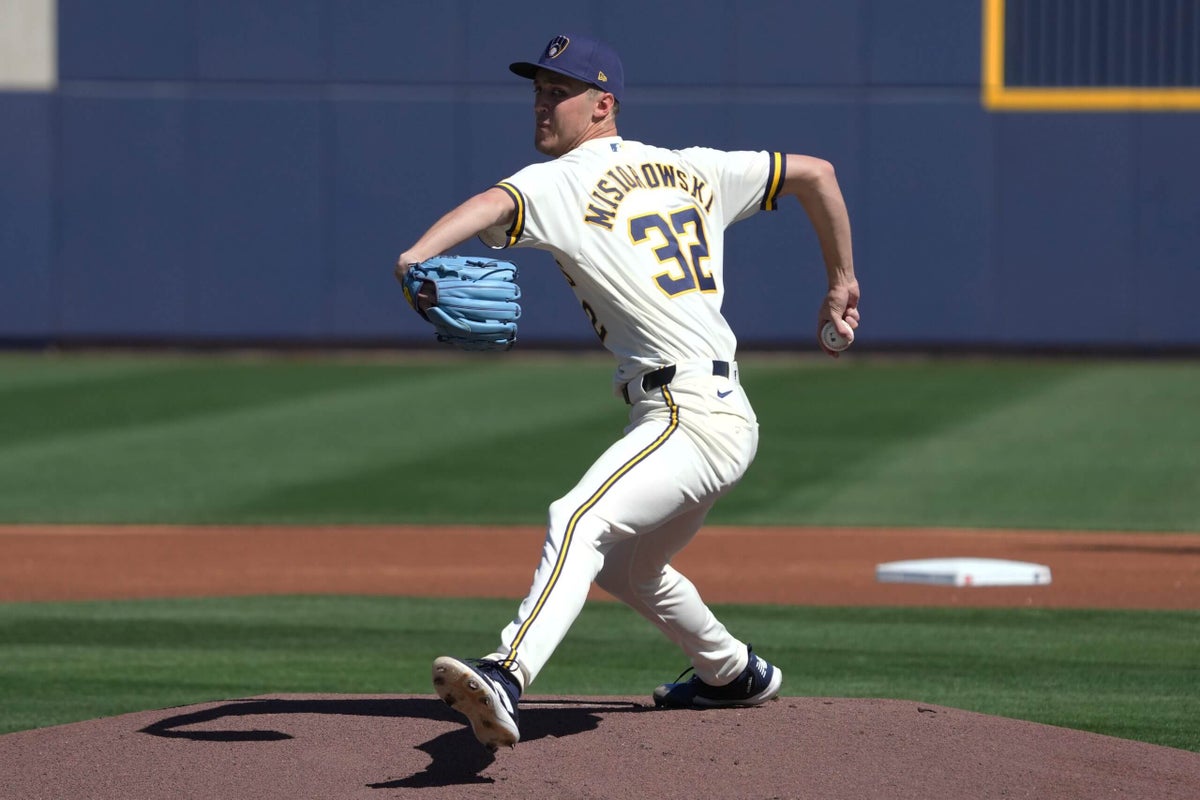
Jacob Misiorowski, SP, MIL2026 projections
Proj. Sys.
Auc$
Rank
IP
W
ERA
WHIP
K
Steamer
$0.6
87
139
8
4.10
1.34
152
ZIPS
$6.8
47
117
8
3.86
1.22
142
ATC
$4.4
59
138
9
4.06
1.26
156
THE BAT X
$7.3
38
138
9
3.87
1.25
165
OOPSY
$9.2
37
136
9
3.41
1.26
168
Drafters have a far more optimistic view of the Brewers’ righty than any of the projection systems. None ranks Misiorowski as high as his current ADP rank of 32nd among starting pitchers, though OOPSY and THE BAT X come close. They are the most optimistic in terms of Misiorowski’s strikeout total. OOPSY is the only system that sees him with a mid-3.00s ERA, thanks to a projected 77.0% strand rate that is roughly 5 percentage points above recent major-league norms.
While the best-case scenario of a high strand rate might be unlikely, so perhaps is the 6.6-point percentage drop in strikeout rate (from 31.9% to 25.3%) that Steamer forecasts. Even if Misiorowski avoids Steamer’s worst-case scenario, he could have trouble living up to the expectations set by his current No. 112 ADP. He may not be an SP3, but contrary to Steamer’s projection, Misiorowski is far more than a fringe option for 12-team leagues.
Statistical sources: FanGraphs; Baseball Savant