
SUNRISE, Florida — The Detroit Red Wings don’t have much room to exhale. Not in the middle of a white-knuckle Eastern Conference playoff race that will leave little room for lapses or letdowns.
But after the fireworks of the trade deadline, the frustration of a pair of losses last week, an injury to their captain, and then a resilient road win to kick off a four-game road trip on Sunday … well, they’ve at least earned a reset to get their bearings.
The Red Wings didn’t skate Monday in Fort Lauderdale, ahead of a Tuesday contest with the Florida Panthers. And given the whirlwind of action over the last five days — trades, call-ups, injuries and action elsewhere in the league — we could all probably use a little reset on where the Red Wings stand and what their path back to the playoffs might look like at this point.
So, with 18 games remaining to determine Detroit’s postseason fate, here’s how it all sets up.
Injury timelines
Dylan Larkin’s absence looms large over all aspects of the stretch run, especially without a clear timeline on when he could return. Coach Todd McLellan has projected relative positivity so far, but details have been sparse, and there’s no doubt how much the Red Wings will miss him.
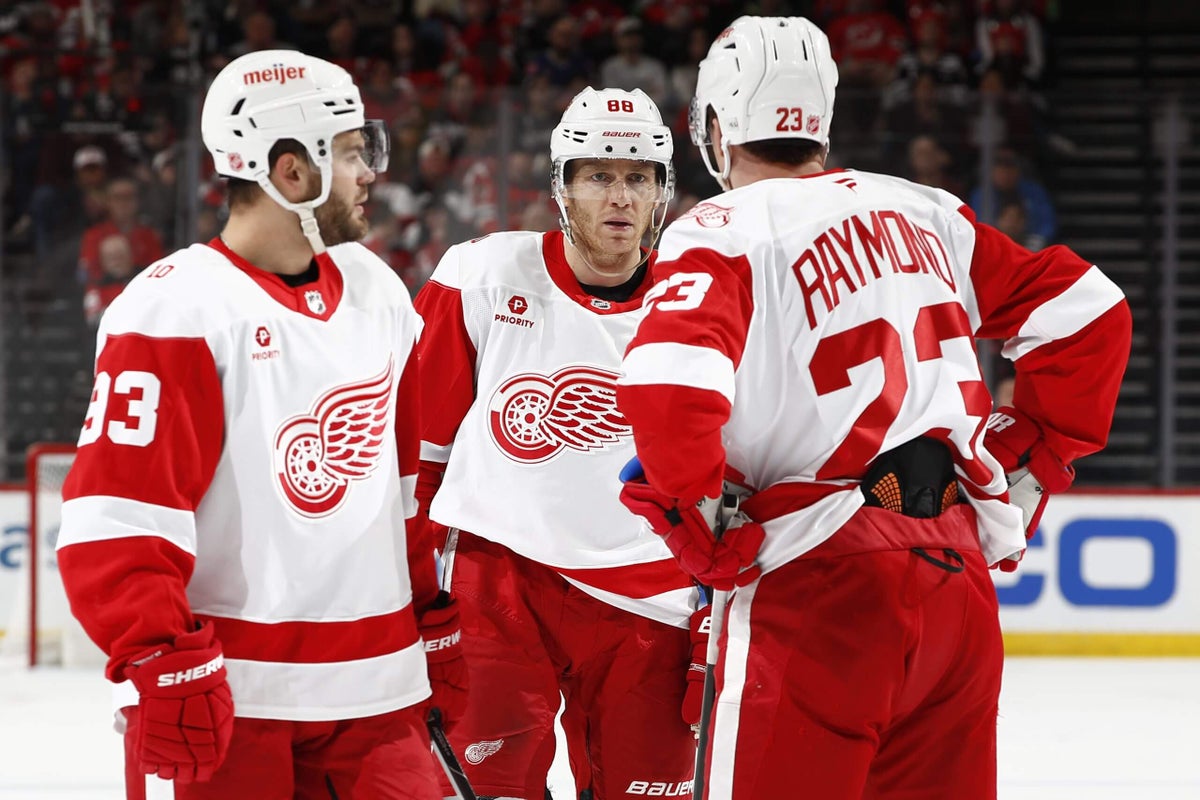
Detroit handled its first full game without Larkin quite well, playing a simple, smart game that led to a 3-0 shutout win over the New Jersey Devils. But you still noticed the Red Wings’ captain’s absence, in ways big and small. He’s a true play-driver and a dangerous offensive piece next to leading scorer Lucas Raymond, and his absence puts some pressure on Marco Kasper and Emmitt Finnie to fit into Raymond’s style. Larkin not being there also left the Red Wings without a true center on their top power-play unit, which will require some solving if he ends up missing meaningful time.
The latest update from McLellan was simply that Larkin was “feeling a little bit better” Sunday, but with no skate on Monday, there was no further update. Given how the injury first looked, ambiguity is arguably one of the better possible outcomes.
Trade deadline acquisition David Perron, conversely, seems to have a much more specific timeline. Yzerman said on March 6 that Perron was roughly 14 days out, which would seem to indicate a return either March 19 or 21, for two big games against the Montreal Canadiens and Boston Bruins — two of Detroit’s fiercest competitors in the playoff race.
It’s unclear how long he’ll take to get up to game speed, but Perron has shown plenty of big-game aptitude throughout his career, and his presence should bring a boost at an optimal point on the calendar.
One more injury popped up during Sunday’s game, when goalie John Gibson left after two periods after McLellan said Gibson “got hit in a bad spot” and didn’t feel well afterward. McLellan said Gibson “should be fine, I would think,” and that’s encouraging. But it’s also worth pointing out that Gibson has now left two different games early in a week’s time, and with the workload piling up for him, that’s something to keep in mind.
Gibson has been a horse for the Red Wings and has now started 41 of their 64 games. They’ve gone to him over and over, and he’s delivered with some of the best numbers in the league since Dec. 1. But when an older goalie comes out of two games in seven days, it’s something to keep an eye on, even though the two injuries seem to be unrelated.
How the new players fit
The big arrival is defenseman Justin Faulk, who debuted in New Jersey without even practicing in Detroit and turned in an impressive first outing. He was physical, won some defensive battles, and created a couple of offensive chances as well. He played just under 20 minutes, and here’s betting that number will go up in the coming weeks as he gets more acclimated.
Both McLellan and defenseman Moritz Seider raved about Faulk’s first outing, and the fit next to Ben Chiarot looked viable, with Faulk bringing some needed puck-moving to the pairing without sacrificing the kind of hard-nosed defense these March games will demand. He’s played in 45 career playoff games, and is now the only Red Wing defenseman besides Chiarot and Travis Hamonic to have played any. On a young blue line, his poise was immediately visible.
“Just try and play steady, both ends of the ice,” Faulk said. “I like to play strong, try and win my battles and move pucks north. It’s a grind in this time of year to get in the playoffs, and then when you’re in the playoffs. And that’s the hockey I like to play. I like to play physical, be hard to play against first and foremost that way, and like I said, if I get the puck, try and go north. Give it to the forwards, let them do their thing.”
Faulk is also perhaps selling his individual offense a bit short there. He’s been a double-digit goal scorer from the back end seven times in his career, including this season. For context, since Nick Lidstrom retired in 2012, the Red Wings have had only three defensemen hit double digits in the goal column: Mike Green (14) in 2016-17, and both Jake Walman (12) and Shayne Gostisbehere (10) in 2023-24.
Faulk’s goals in St. Louis this year probably can’t count in that camp, but both Moritz Seider and Simon Edvinsson have a chance of getting there (each sitting at eight), and adding Faulk into the mix gives the Red Wings some valuable extra firepower from the blue line.
Perron’s fit is even easier to size up, since we’ve seen it before. He was with the team from 2022-24, and while he’s now two years older at 37, the core of his game is as it ever was: he has strong heavy elements down low, protecting the puck and pulling rimmed pucks off the wall, and can finish chances with a strong right-handed shot as well. He’s not fleet of foot, but he never has been, so age shouldn’t affect him much in that way. Detroit will be looking for him to retrieve pucks, extend possessions and finish some chances every so often, and all of that is entirely within his ability.
As for where he’ll fit, it’s an interesting question. Plenty can change in two weeks’ time (especially with Larkin’s outlook already up in the air), but let’s assume the Red Wings get their top center back by the time Perron returns. Detroit could throw Perron next to Larkin and Raymond, counting on him as a trailer off the rush and a possession-extender for two of their best offensive pieces. Or they could use him next to Kasper and Finnie, two high-pace players who can bring the energy, while Perron adds veteran savvy and toughness to complement them.
Perron on a third line feels like a great pitch for a playoff hopeful, but considering the Red Wings have been looking for an answer next to Larkin and Raymond, he could turn out to be the best option up top.
Then there’s the newcomer who wasn’t a trade acquisition. By playing Michael Brandsegg-Nygård in New Jersey for his 10th game this season, the Red Wings officially burned the first year of his entry-level contract. So now, any decisions relating to him will be purely based on what’s best for this year’s team, and for him — nothing to do with contractual factors.
And while Brandsegg-Nygård made one ill-conceived blind pass to the slot early in the game, he settled in pretty nicely after that, especially in the physical department. He was tied with Faulk for a game-high four hits, and if you watched the game, that number might feel low. He initiated contact often and knocked Luke Hughes down on a reverse hit when the Devils defenseman came after him.
“He is a bull,” McLellan said. “Heavy on his feet, hard to knock off — not only delivering (hits) but taking. He surprises some people with his stiffness. Played a good game for us.”
Pace was one hole in Brandsegg-Nygård’s game in his earlier NHL stint, and while he’s still not particularly fleet of foot, he played at the game’s pace better on Sunday. He also had a pair of takeaways, a nice chance in on net on the rush, and showed some good footwork in kicking pucks to himself to keep the play moving north.
It remains to be seen if he’ll stay in the lineup when the Red Wings are fully healthy, but until they are, he’ll have the opportunity to make his case. Certainly, Detroit has few (if any) forwards with his level of physicality, and his ability to score from distance or in tight in Grand Rapids feels like it could be an asset in late-season hockey. Right now, it’s about showing he’s ready to do that in the NHL.
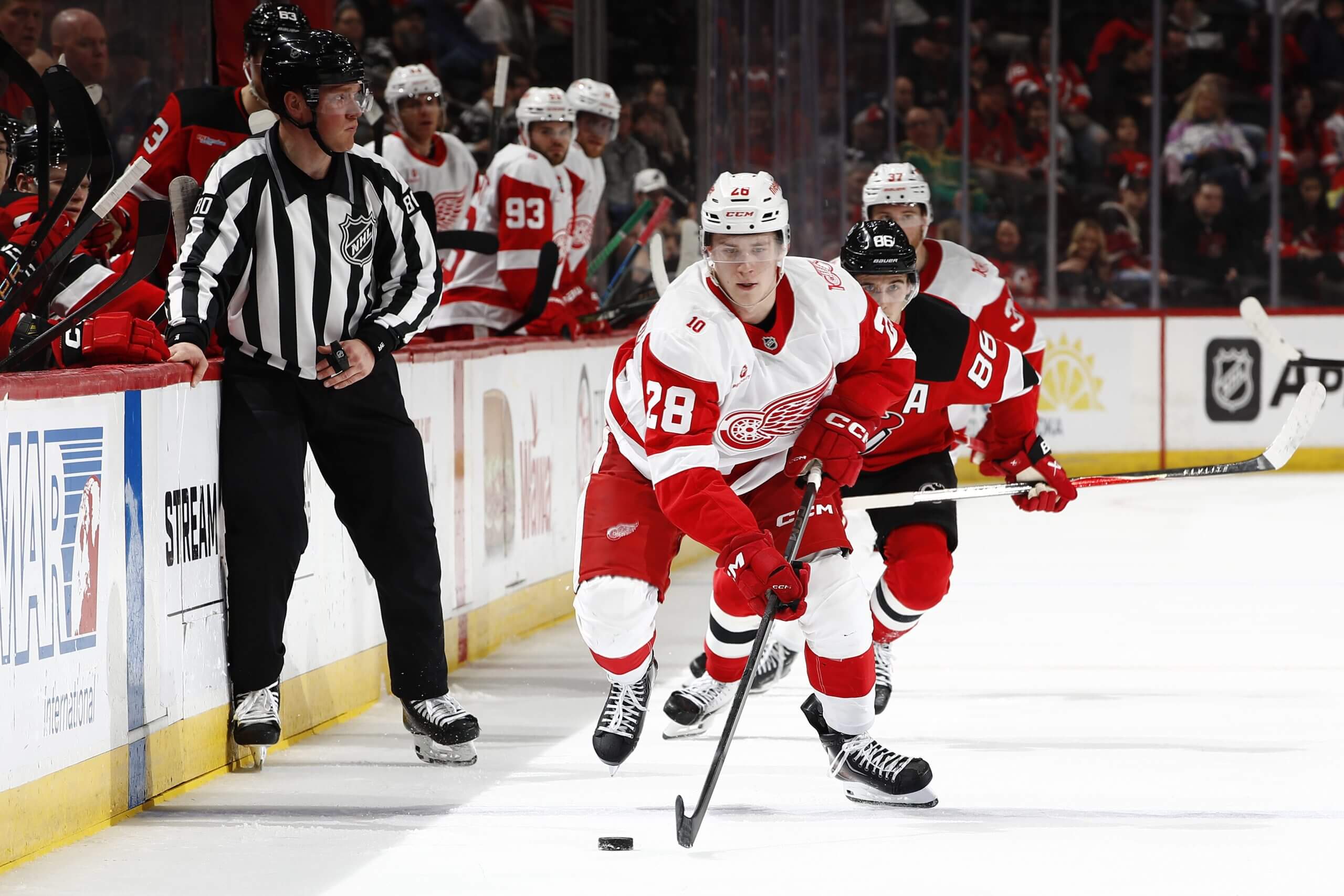
Michael Brandsegg-Nygård officially burned the first year of his entry-level contract with an appearance against the Devils. (Sarah Stier/Getty Images)
How many points will they need down the stretch?
I have a feeling how McLellan would respond if asked about the minimum Detroit needs to get into the playoffs: Obviously, the minimum isn’t the goal.
It’s still a relevant question for many Red Wings fans, though. Right now, Detroit sits at 79 points in 64 games, on pace for 101. But there’s no guarantee Detroit finishes at that pace, with the pressure and intensity of the games ramping up and plenty of games remaining against similarly desperate teams.
If the Red Wings went .500 the rest of the way, averaging one point for the rest of their 18 games, they would finish with 97 — which could be enough, but would still leave some things to chance. The Eastern Conference’s current eight seed, Boston, is tracking toward 99, and the current ninth-place team, Columbus, is on pace for 96.
Having that said, the Blue Jackets have gotten quite hot since mid-January, going 14-2-3 in their last 19. If they keep up that kind of success, Columbus can certainly threaten 100 points, too.
And despite teams making the playoffs with 91, 91 and 92 points in the last three seasons in the East, there’s a fairly recent precedent for this kind of high cut line. In 2021-22, all eight playoff teams had at least 100 points. This season could be similar — although that 2021-22 season had a 16-point gap between eighth and ninth place, which feels unlikely this time around.
In other words, it’s going to be a tense finish. But the Red Wings still control their own fate, particularly with one crucial stretch in the second half of March. From March 19-31, Detroit will play Montreal (March 19), Boston (March 21), Ottawa (March 24), Buffalo (March 27), Philadelphia (March 28) and Pittsburgh (March 31).
As of today, all of those teams still have at least a puncher’s chance of getting into the playoffs and will be battling for seeding regardless. How Detroit fares in that six-game stretch could very well decide its playoff fate, its seed, and ultimately a big part of the narrative around this season.
Of course, the Red Wings can’t start looking ahead to that. Every point counts, and the more points they can stack before that stretch, the more cushion they’ll give themselves when it arrives.
But if you’re looking for Detroit’s path back to the playoffs, the simplest one centers on a strong two weeks going head-to-head against their most direct competition.