
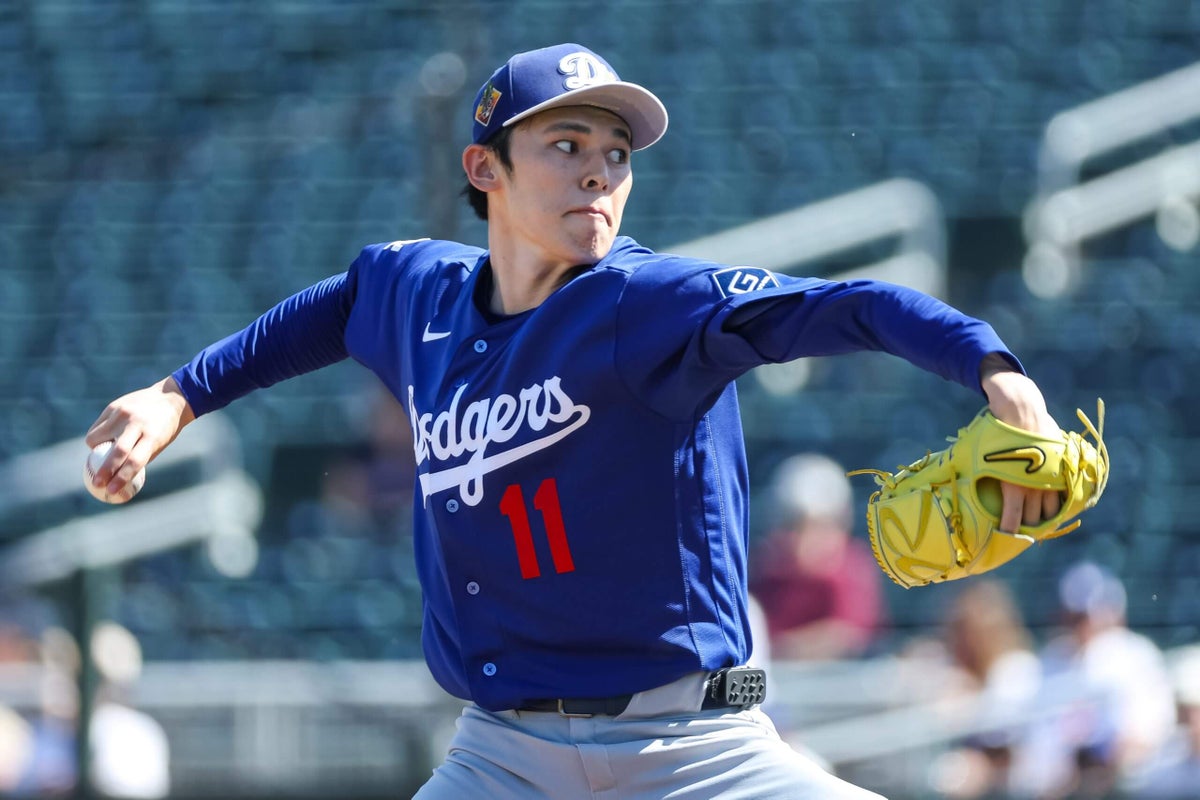
PHOENIX – The most interesting thing happening at the self-described most boring spring training in baseball took place on a back field. The Los Angeles Dodgers claimed they did not schedule Roki Sasaki’s outing Tuesday to be against minor leaguers to shield him, instead saying that Sasaki and Tyler Glasnow’s pitching schedules had a conflict.
The assignment still provided a convenient place for Sasaki to work on things. Facing a lineup of Chicago White Sox minor leaguers who spent most of their time at Double A a year ago provided a respite of sorts in a confounding spring. Not pitching in a Cactus League game meant fewer wandering eyeballs. A disastrous first inning, like he had in his last appearance, doesn’t feel like a litmus test for whether he will actually tap into the seemingly limitless potential in his right arm.
Still, Sasaki’s relevance was reflected in who was there. While pitching coach Mark Prior handled the staff for the Dodgers’ game against the Arizona Diamondbacks, assistant pitching coach Connor McGuiness went with Sasaki to a back field on the White Sox side of the complex to observe.
President of baseball operations Andrew Friedman sat behind home plate, watching as Sasaki’s pitch metrics flashed on a laptop in front of him. Alongside him was director of pitching Rob Hill, one of the men who helped Sasaki rediscover his delivery during his resurgence last fall. Vice president of player development Will Rhymes was in attendance. Rick Honeycutt, a special assistant and the team’s former pitching coach, took in the outing, as did fellow special assistants Tyson Ross and Raúl Ibañez.
Even Chris Getz, the White Sox general manager, was there cruising around on a golf cart.
That crew made up a sizable portion of the scattered audience to watch Sasaki try to sort himself out. The right-hander has cited inconsistent mechanics for his struggles in the couple of seasons since he appeared to be one of the best pitchers on the planet. After he briefly shined in a relief role last postseason, Sasaki still has tangible strides to make to prove he can be a quality big-league starter.
Regardless of how he looks this spring, he’ll get the opportunity to showcase himself in big-league games to start the year.
“I just don’t see a world where he doesn’t break with us as a starter,” manager Dave Roberts reiterated Tuesday morning. Injuries have knocked out Blake Snell and Gavin Stone for Opening Day, and the Dodgers have plenty of wiggle room (and incentive) to let him work through his struggles as they come.
The most anticipated back-field game of the spring left those minor-league hitters looking overmatched. A positive, if expected, step.
“They said it was electric,” Roberts said. “Couldn’t have asked for a better day.”
Sasaki surrendered a chopped single through the right side on his fourth pitch of the afternoon before kicking into gear. He struck out the next seven batters, making the teens look as if they’d never seen a pitch like Sasaki’s signature forkball. Only one more batter reached base over Sasaki’s four innings — Sasaki hit him with a forkball that got away from him. Only two more batters so much as put a ball in play.
His 59 pitches included 40 strikes and 17 swings-and-misses. His fastball command, shaky through two starts, looked improved. After missing the zone with his first two fastballs, he appeared to dial back in. The last two of his nine total strikeouts came on fastballs, with Sasaki working more aggressively in the zone as the outing went along. Refining that will be as important as anything to making sure Sasaki can stick as a starter. Keeping the velocity in the upper 90s matters too — Roberts said reports showed Sasaki’s fastball between 98 and 100 mph.
No matter the competition, Sasaki flashed some encouraging signs.
“The fastball, if it’s commanded, still plays,” Roberts said. “There’s still value to getting hitters out and seeing guys swing and miss.”
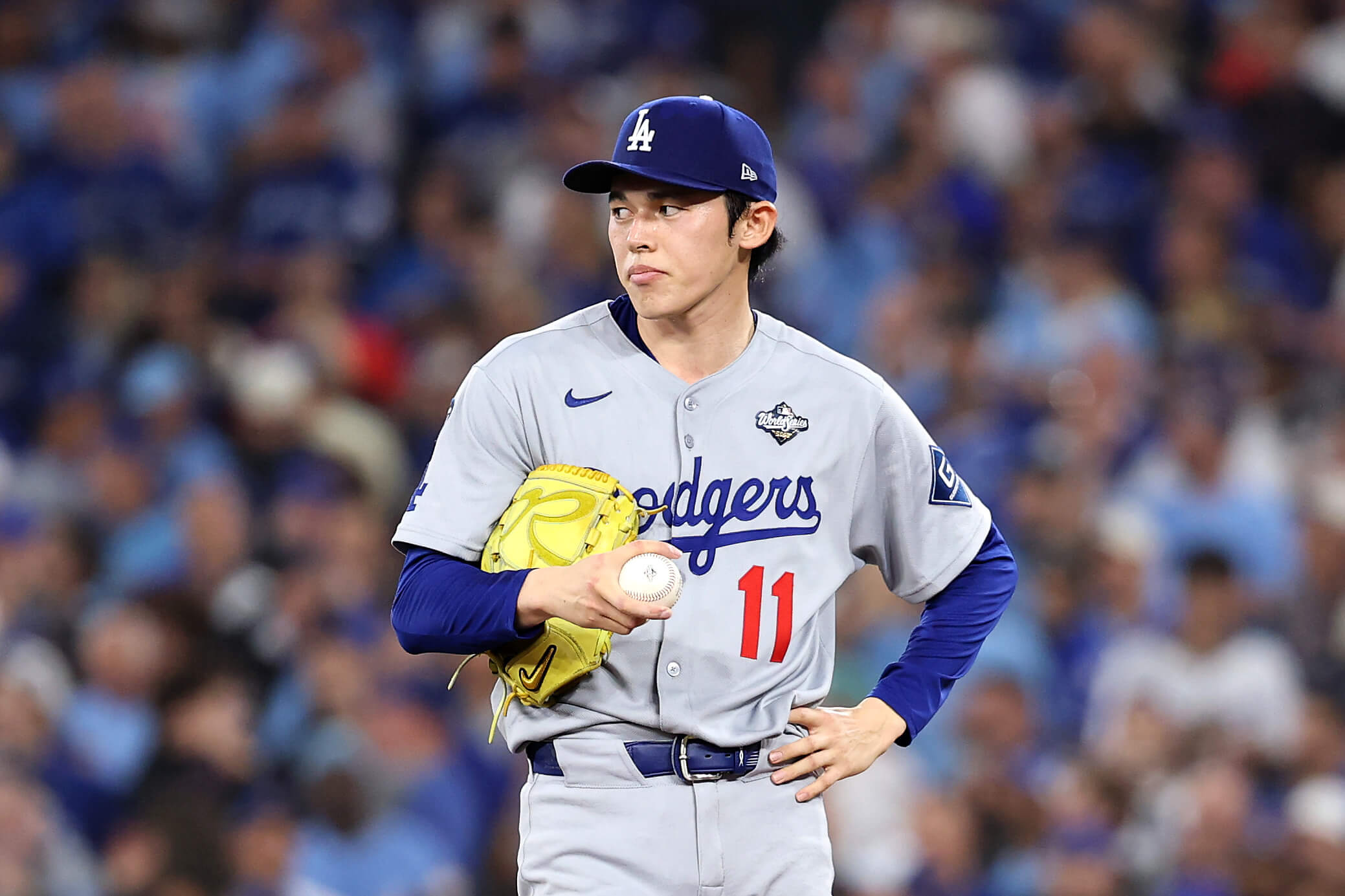
After Roki Sasaki appeared in relief and posted an 0.84 ERA in nine postseason games last season, he is expected to be back in the starting rotation as 2026 begins. (Emilee Chinn / Getty Images)
Sasaki said he employed the same cue he tapped into to finish his last outing on a high note. Along with correcting his upper half, he worked through different mental cues to use his core and torso better in his delivery and generate a consistent release point.
“I think that’s what I really need for right now,” Sasaki said through an interpreter. “So I think I can keep moving forward.
“I think it’s all about mechanics. If my mechanics are really good, I think my command is good, too.”
Finding something repeatable has been difficult. The Dodgers have talked up Sasaki’s added comfort in his second season stateside, hopeful that will make communication and trust easier between the sides. They’ve been communicating “really well,” Sasaki said, after a regular season that was nowhere near what he’d anticipated (a 4.46 ERA in 10 outings).
“When you’re thrust into a new environment, you’re going to use your survival skills to survive, and that’s going to using what you know,” Roberts said. “I think last year he was trying to lean a lot on what he knew, what he was comfortable with, whereas this year there’s more trust in knowing one another.”
That has fueled the Dodgers’ optimism in Sasaki this spring, even when the results have been shaky. The Dodgers can let Sasaki figure this out on the fly because they can take on short-term risk if it means maximizing Sasaki’s long-term potential. They are banking on him because they think, after enough hands with him, they can hit big.
“I guess I’m betting on the performance to continue to trend up, to be good enough and to only get better with the talent that he has and the work that he’s put in,” Roberts said.