
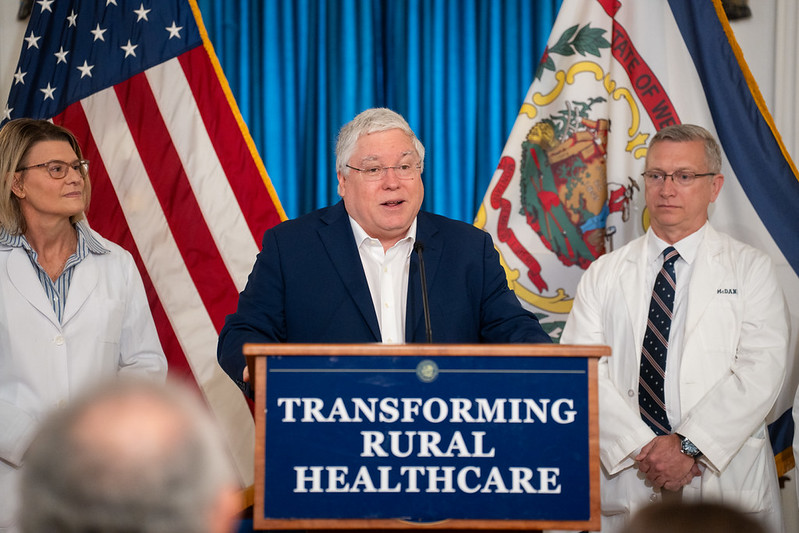
The House has started moving legislation to authorize spending of the $199 million West Virginia stands to bring down from the federal government to bolster rural healthcare.
The House Finance Committee on Wednesday morning considered and advanced SB570, providing a supplemental appropriation to the Department of Health via fund 8802.
Moving that bill has been a priority of Gov. Patrick Morrisey, who wants to prepare to unlock the federal dollars.
The conclusion of the regular legislative session is Saturday.
The House Finance Committee, on Tuesday morning, publicly placed the bill on its Tuesday agenda.
Governor Morrisey, shortly after that on Tuesday, hosted a media appearance where he expressed frustration that the House had not acted sooner.
 Gov. Patrick Morrisey
“Now, I think it’s outrageous that here we are at the end of session and that something that should have happened in the first week hasn’t occurred yet—terrible on every level,” Morrisey said Tuesday.
The governor added, “We may very well pay a price for the delay, let me clear, we may pay a price financially for what’s already happened, that’s outrageous and every way and I want everyone in the public to know that.”
Today, as it had planned to, the House Finance took up the bill and moved it to the full House of Delegates. It already passed the state Senate on Feb. 13.
 Vernon Criss
Speaking to reporters in the hallway, House Finance Chairman Vernon Criss said the bill moved on a regular schedule and needed time for lawmakers to fulfill their oversight responsibilities.
“It’s the legislative process. He didn’t bring the bill up on the first day. How does he expect us to be able to react until we have all the information in front of us?” said Criss, R-Wood.
In late December, officials announced that West Virginia has secured $199 million this year from the federal Rural Health Transformation Fund. The award almost doubled the guaranteed minimum for the first year.
Of the full amount, $25 billion is being evenly divided among the 50 states, and discretionary dollars are being allocated to states based on each state’s application, the state’s rural nature and other policies. Allocation to each state is based on a competitive application process and guided by the quality of state-proposed strategies.
Nationally, disbursements for states are between $145 million and $281 million for the year.
This is through The Rural Health Transformation Program, created under the “One Big Beautiful Bill Act” to distribute $50 billion over five years across all 50 states to strengthen rural health care.
The program to support rural health grew out of concerns that changes to Medicaid under the “One Big Beautiful Bill Act” would undercut already fragile rural health systems.
Criss said lawmakers have gained information about the fund and how dollars would flow all through the bill’s legislative journey. Without that time, he said, lawmakers would know far less about the state’s plans to responsibly use the $199 million.
“Once the bill started coming this way to the House, then we were getting more information about how the money was to be spent,” Criss said.