
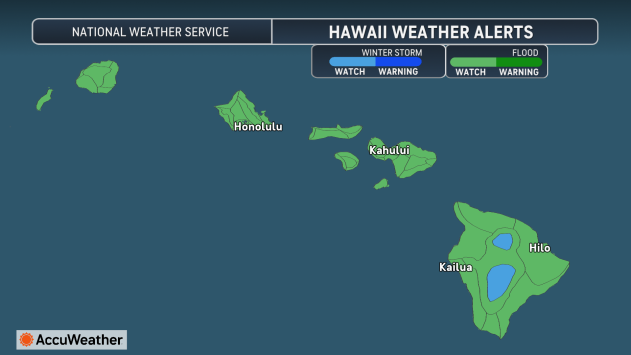
Hawaii is under a state of emergency as a powerful kona storm is forecast to bring heavy rain, wind gusts up to 80 mph and winter storm conditions to the highest summits.
As the wide-reaching storm approaches the islands from the northwest, periods of rain and thunderstorms will spread across the region Wednesday, according to AccuWeather Meteorologist Alyssa Glenny.
Some storms may produce intense downpours capable of triggering localized flooding, especially in upslope areas. As the week progresses, the storm will draw closer, bringing persistent showers Thursday to most of the islands. Heavier rainfall is expected to develop over Kauai and Oahu from Thursday evening into Friday.
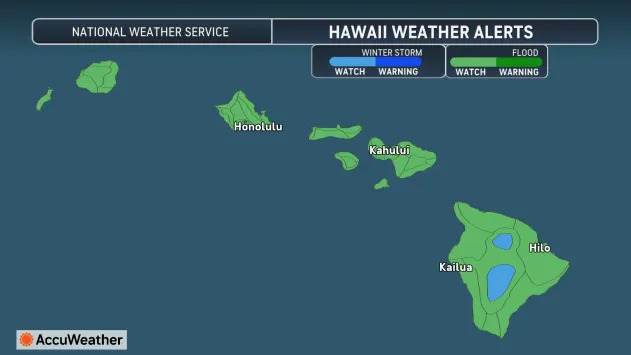
Active weather alerts in Hawaii, including flooding and winter conditions, on March 11, 2026.
“This deluge of heavy rain will persist for most of the Hawaiian Islands on Saturday, exacerbating any ongoing localized flooding,” Glenny said.
Rainfall rates of 1 to 2 inches per hour were already reported on Oahu early Wednesday, leading to minor flooding on roads and in streams. The entire island of Oahu remains under a flood watch through Saturday.
Gusty winds are expected to develop late Thursday night across the westernmost islands before expanding to the Big Island by Friday evening. Blustery conditions will persist Saturday, with gusts of 50 to 80 mph at times. The strongest winds are likely across the higher peaks, where gusts could exceed 100 mph.
Colder air wrapping into the storm will bring winterlike conditions to the highest elevations. The National Weather Service (NWS) office in Honolulu has issued a winter weather advisory for the Big Island summits through Thursday and a winter storm watch through Saturday afternoon. Up to 8 inches of snow is possible, along with blowing snow and periods of whiteout conditions.
Hawaii Gov. Josh Green issued an emergency declaration for the islands to take proactive steps ahead of the prolonged weather event.
“Our priority is keeping the people of HawaiÊ»i safe,” Green said. “By issuing this emergency proclamation now, we are ensuring that state and county agencies have the resources and flexibility needed to respond quickly to flooding, severe weather and any impacts this storm may bring.”
In addition to flooding rain and damaging winds, severe thunderstorms could produce waterspouts capable of overturning small boats and creating hazardous marine conditions. NWS forecasters warn of dangerous seas in the Alenuihaha Channel, Kaiwi Channel, Maalaea Bay, Maui County Leeward Waters, Maui County Windward Waters and the Pailolo Channel.
“Travel is likely to be difficult as winds increase over the islands and heavy rain bears down across the region,” Glenny said. “While showers are expected to stick around into early next week after the worst conditions pass Friday into Saturday, another round of rain can arrive by the middle of next week as a separate storm approaches from the west.”
KÄ«lauea eruption adds ash and road impacts on Big Island
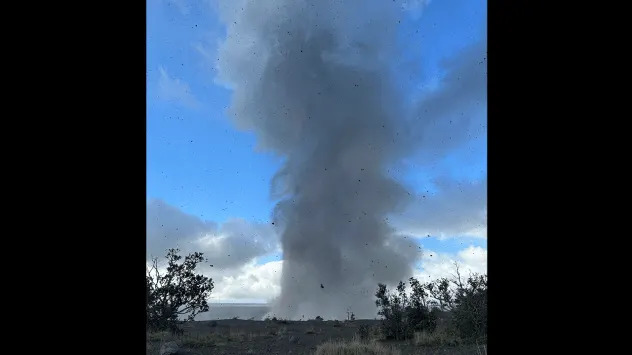
A photo showing volcanic rock and ash (tephra) raining down from a lava fountain and a gas plume at the summit of Kilauea in Hawaii during eruption 43. (Image: NPS)
In addition to the snow, wind and flooding potential, an eruptive episode from Hawaii’s KÄ«lauea volcano sent tephra outside HawaiÊ»i Volcanoes National Park into adjacent communities, according to the U.S. Geological Survey.
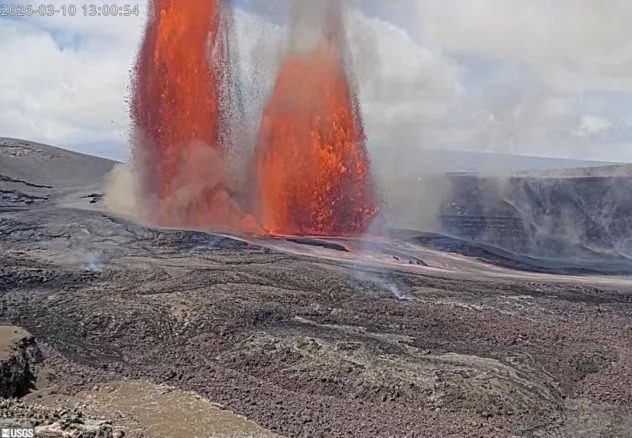
This image from video by the United States Geological Survey shows lava erupting from Kilauea volcano on Tuesday, March 10, 2026, in Hawaii Volcanoes National Park, Hawaii. (USGS via AP)
Tephra as large as 6 inches was reported along the Volcano Golf Course, and Pele’s hair was observed as far as Hilo. The NWS issued ashfall warnings Tuesday as volcanic particles spread downwind.
Due to significant tephra fallout, Highway 11 was closed to allow workers to use heavy equipment to clear roadways, according to the National Park Service.
While the lava activity remains confined to the summit area, ash and falling volcanic debris can create hazardous travel conditions and air quality concerns across parts of the Big Island.