
During a trip to South Carolina, Agassiz befriended Robert Gibbes, a physician to elite planters in Columbia who arranged access to enslaved people on plantations, including the dwindling few who had been born in Africa.
But such scrutiny is, by definition, limited; it depends on encounter and interaction, on being physically present. With commitments elsewhere, Agassiz surely could benefit from something more permanent.
So he and Gibbes came up with a plan. Agassiz would return to his duties up north. Gibbes would reach out to Columbia portrait photographer Joseph Zealy, master of the new technology that produced daguerreotypes.

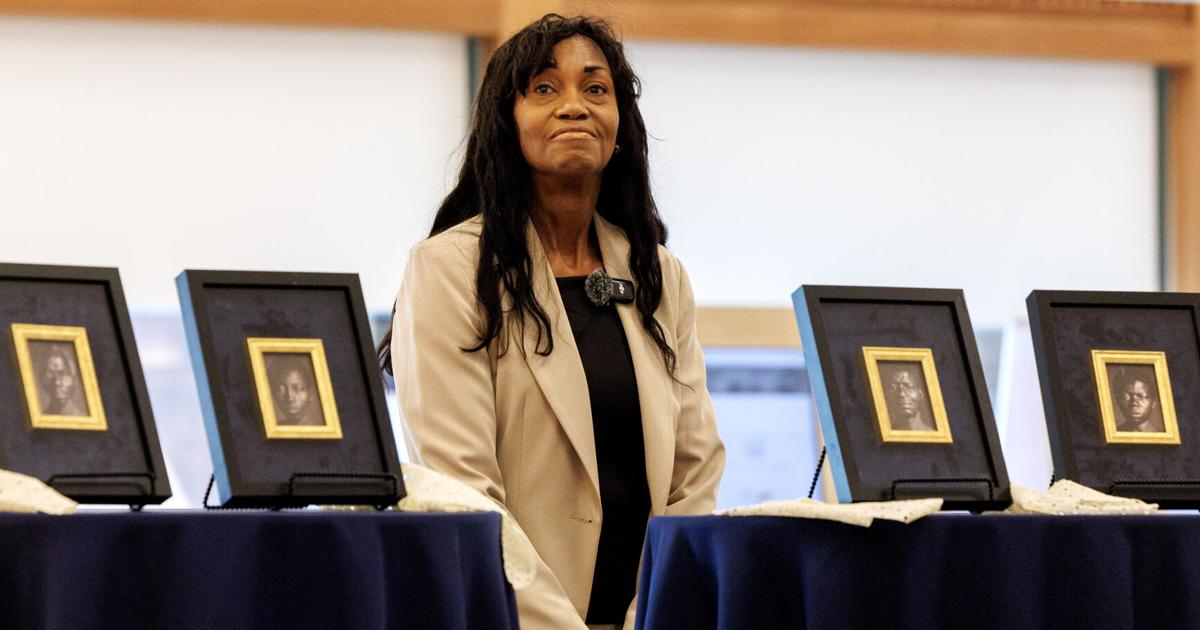
Visitors take photos of the prints made from the 1850 daguerreotypes of enslaved Americans during a ceremony welcoming the historic images to the International African American Museum, Wednesday, March 11, 2026, in Charleston.
Grace Beahm Alford/Staff
The doctor arrived at the studio one day with at least seven enslaved people — Alfred, Drana, Fassena, Jack, Jem, Delia and Renty — who were ordered to remove their clothes and stand this way or that for Zealy and his large camera.
Now Agassiz, and Harvard, would have something to examine freely.
At IAAM
Attorney Joshua Koskoff portrayed the legal case as a fable of good and evil, featuring characters too good to be true: A dignified hero (Renty), a twisted villain (Agassiz), and a corrupt institution that empowered and legitimized a quack scientist.
His colleague, Benjamin Crump, credited Lanier for her persistence. This was a challenging case that dated to 1850, and the legal arguments were original. He didn’t want to take on the challenge at first, he said.
In fact, a lower court threw out the case, but the Massachusetts Supreme Court agreed to hear it, and issued a unanimous decision in favor of Lanier, the plaintiff.
Reproductions of portions of the 1850 daguerreotype portraits of Renty, a South Carolina slave, and his daughter Delia, on display during a moment of prayer Wednesday, March 11, 2026, outside the International African American Museum in Charleston. The ceremony took place at the Tide Tribute pool, on the site of the historic Gadsden’s Wharf.
Grace Beahm Alford/Staff
That decision was groundbreaking, the lawyers said, because it acknowledged the rights of a distant descendant, cracking open a door that might get further pushes by reparations cases in the future.
And now the daguerreotypes are here where they belong, Crump said.
“The descendants of the African slaves will tell the story of Papa Renty, and will tell the narrative for our children’s children yet unborn,” he said.