
The received wisdom was that the Premier League would have three, possibly four, of its six representatives in the quarter-finals of the Champions League. It might now be lucky to have one. Expectations have flipped in 48 hours. It is one of the reasons we love this sport and, in particular, this competition.
Fatigue has been the lens through which people have viewed the shortcomings of the Premier League teams halfway through the round of 16.
Using the Premier League calendar and its competitiveness as an excuse is legitimate. But only up to a point. Sure, our continental counterparts do not have a Carabao Cup. The much-derided Ligue 1 did away with the Coupe de la Ligue in 2020 and downsized to 18 teams in 2023, matching the Bundesliga. Theoretically, they have fewer games and the Deloitte Money League tells us a handful of European elites have the revenue to compete with the Premier League.
Paris Saint-Germain’s state wealth and Bayern Munich’s corporate might allow them to attract a calibre of player who can stay fresher for longer. But both clubs were involved in the Club World Cup in the summer, playing in stifling heat. In fact, PSG knocked out Bayern, who have only recently seen Jamal Musiala return from the injury he sustained in that quarter-final in Atlanta in July.
Even in the context of Ligue 1, the toll of PSG’s run to the final has been cited as a reason they have not maintained the impeccable level shown in the second half of last season. Lens are only a point behind them in France. Monaco, despite being reduced to 10 men in both legs, also came unexpectedly close to knocking them out of the play-offs. Cumulatively, PSG had a man advantage for more than an hour and still only progressed 5-4 on aggregate.
They have not looked unbeatable.
Their decision to sell goalkeeper Gianluigi Donnarumma to Manchester City has ultimately backfired. His replacement, Lucas Chevalier, has lost his place to Matvey Safonov, who did not exactly inspire confidence against Chelsea on Wednesday. He could have saved Malo Gusto’s equaliser, only for his wrist to give way.
Real Madrid, lest we forget, were also in the play-off round for a second year running, paired with Benfica, who memorably beat them 4-2 on the final matchday of the league phase to qualify for the last 16 thanks to a stoppage-time goal from goalkeeper Anatoliy Trubin.
That defeat made people doubt Madrid and their decision to replace head coach Xabi Alonso with an interim, Alvaro Arbeloa. The red cards shown to Raul Asencio and Rodrygo, who has since suffered a season-ending anterior cruciate ligament tear, left Madrid shorthanded for the ‘punishment’ round, which was avoided by all but one of the Premier League clubs after five of them finished in the top eight.
The first leg of that Benfica tie was hardly a walk in the park for Madrid. Vinicius Junior scored the only goal and was then allegedly racially abused by Benfica’s Gianluca Prestianni, who received a provisional one-match ban for the second leg pending the outcome of an investigation by UEFA ethics and disciplinary inspector.
Anyone who thinks the scrutiny of that week made for a less intense game and took no mental toll on those involved isn’t human.
Madrid, second in La Liga, have also been playing without Jude Bellingham and top scorer Kylian Mbappe. Manchester City’s 3-0 defeat was, with hindsight, framed as a game taking place at the mythical Bernabeu against the most dominant club of the last decade.
Regardless of all the lore around Madrid, the result was genuinely surprising, as it featured a hat-trick from Federico Valverde and a bigger win than when supposedly ‘better’ Madrid teams coached by Zinedine Zidane or Carlo Ancelotti, featuring Toni Kroos and Luka Modric, took on City.

Federico Valverde helped cover for notable Real Madrid absences (Pierre-Philippe Marcou/AFP via Getty Images)
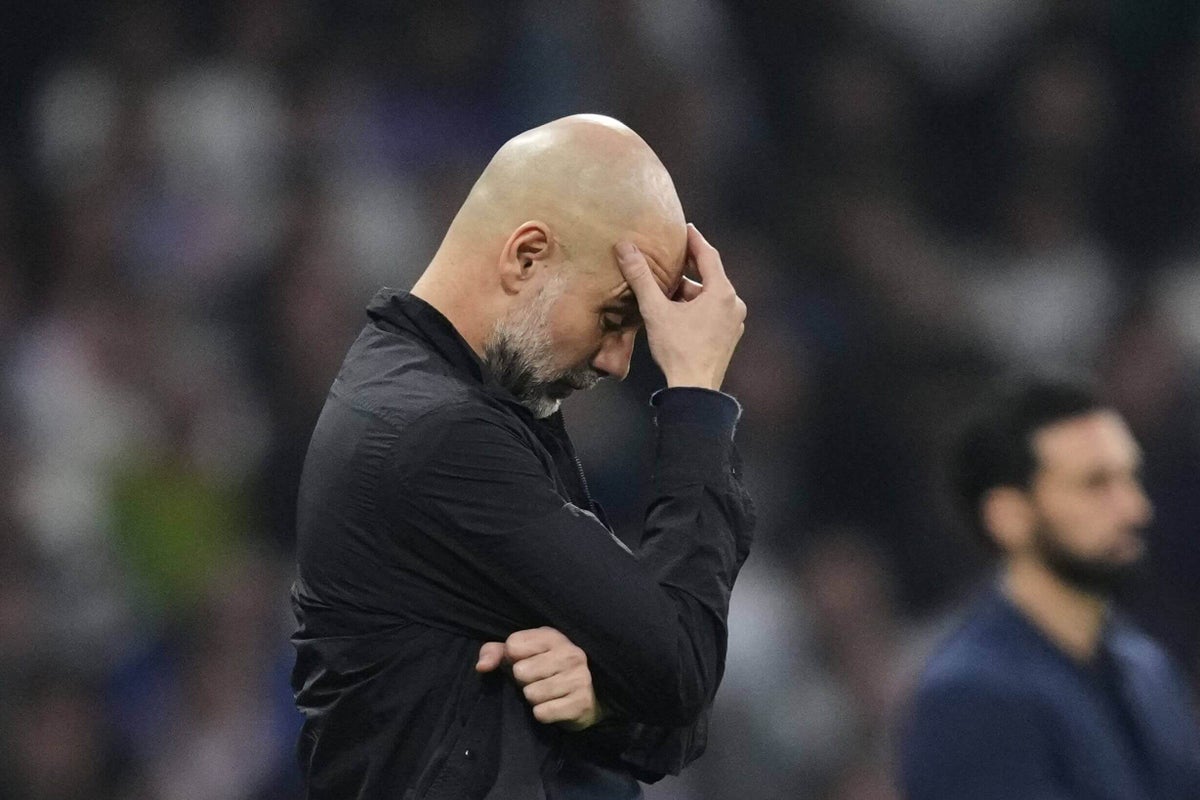
Everyone acknowledges City are past their Pep Guardiola peak. But their problem, as with the other Premier League teams, is not only a relentless fixture list in an ultra-competitive domestic environment, but also the strange paradox fans are asked to hold in their heads — the idea that English football has become so ugly and hard to watch, at times, precisely because the teams are so good.
But is the debilitating competitiveness of the Premier League enough to explain the results in midweek?
Ligue 1 and La Liga aren’t, by common consensus, at the same standard but their teams are still competitive enough that PSG can get knocked out of the Coupe de France by promoted Paris FC, lose twice against Monaco in the league and drop points to Lorient and Strasbourg.
Madrid recently lost back-to-back in La Liga against Osasuna and Getafe.
A more inconvenient truth for the Premier League clubs is the mismanagement of their tremendous financial advantage.
The vast revenues English clubs earn from television rights were presented as a problem for European football just last week, since even relegation-threatened Tottenham Hotspur were good enough to reach the round of 16.
The Premier League spent more than Serie A, the Bundesliga, La Liga and Ligue 1 combined last summer. They have far and away the most resources to mitigate for the calendar.
When Manchester City got the timing of their transition from one team to another badly wrong 18 months ago, they responded by spending €218million (£188m; $251m) last January and another €95m this January, beating significant competition for two of the Premier League’s most coveted players: Antoine Semenyo and Marc Guehi.
To sign Guehi when he was set to become a free agent in the summer felt particularly indulgent after the acquisitions of Abdukodir Khusanov (€40m) and Vitor Reis (€37m) a year ago, not to mention the presence of England Under-21 centre-back Max Alleyne.
Likewise, the goalkeeper situation in the summer — when James Trafford joined under the assumption he would replace Ederson for City, only to watch them sign Donnarumma — illustrated a win-now mentality, as City doubled up in the position.
And this depth leads us back to the Bernabeu.
City made seven changes in Madrid from the team that beat Newcastle in the FA Cup at the weekend. Restricted by injuries, Arbeloa only made one change.
Let’s review Madrid’s starting XI. Thiago Pitarch started for the first time in the Champions League. Brahim Diaz, who felt compelled to leave City to find a first-team pathway, was up front.
The bench featured Fran Gonzalez, Fran Garcia, Cesar Palacios, Jorge Cestero, Diego Aguado, and Manuel Angel.
Heard of them?
As for Chelsea, this is a club who have spent more than a billion on players under the Todd Boehly-Clearlake consortium. Some of the signings included in that figure (Geovany Quenda, Denner and Dastan Satpayev) have not even joined yet, which only adds to the sense that Chelsea have too many players — certainly more than enough to cope with playing in multiple competitions.
When you incur the biggest pre-tax loss in English football history — double the next-worst deficit in Europe for last season — you really shouldn’t have so many doubts about your goalkeeper, centre-backs and centre-forward.
As Antonio Conte said when his decimated Napoli team prepared to play Chelsea in January: “If you have the opportunity to spend more than £100million on 22-year-old players… the problem is that only a few can do it. In Italy, no one can, while in England, there are those who can go out and buy, just like Real Madrid in Spain.
“These are big investments, then they say, ‘We invest in youth’. I get it, but who in Italy can pay €70million for a 16-year-old? There are different realities, and England is totally different from us. This is how they become dominant, as is happening.”
After improbably going 2-1 up at the Maradona, Conte then watched his injury-depleted team fade as Liam Rosenior threw on Jamie Gittens, Cole Palmer and a player he wanted but couldn’t afford, Alejandro Garnacho.
And yet, overall, the Premier League is squandering this tremendous edge with bad recruitment choices, building unbalanced squads or teams short of experience at huge cost.
This is a view you can hold while still remembering that Chelsea were facing the reigning European champions in Paris on Wednesday, after being taken to extra time in the FA Cup at the weekend.
And yet, as a banner in the away end at the Parc des Princes proudly declared, Chelsea are world champions, having beaten PSG in the Club World Cup final.

Stopping Ousmane Dembele isn’t easy, but Chelsea should have the financial power to be more competitive (Julien de Rosa/aAFP via Getty Images)
Rosenior has a squad with the depth to make 10(!) changes from the weekend when they were somewhat fortunate that a soft red card wrecked Wrexham’s chances after the 90th minute.
Dario Essugo, the substitute who set up Joao Pedro’s goal in a 4-2 win, cost €22.7m. For context, the value of the team Wrexham fielded, even with Ryan Reynolds and Rob Mac bringing in Apollo Sports Capital as an investor, was roughly the same (€28m).
When Luis Enrique was asked if the difference on Wednesday in Paris was physical, he scoffed. “This is just a massive cliche that gets repeated whenever a team wins. If a team wins, it’s flying physically. And when they lose, it’s because people don’t know exactly why. To the media, when you lose or draw, it’s because you’re bad physically.”
“There are always many factors behind a performance. There’s a lot of complexity behind an elite football game.”
It isn’t as simple as who ran more or who ran hardest. It’s about the strategy you run on the day, how well you run your recruitment and the way you’re run in general.
The defeated Premier League clubs this midweek are like Leo Tolstoy’s families — unhappy in their own way, dysfunction undermining economic might. Rosenior was an in-season hire, and though he has done well, he is still new to this level (although, as a former Strasbourg coach, he is not new to preparing for games against PSG).
Tottenham also began the knockout phase with a different coach than the one who started the league phase. They have a problem in common with Chelsea: uncertainty in the goalkeeper position, a problem of their own making.
Igor Tudor has made things worse since he replaced Thomas Frank, losing all four of his games in charge.
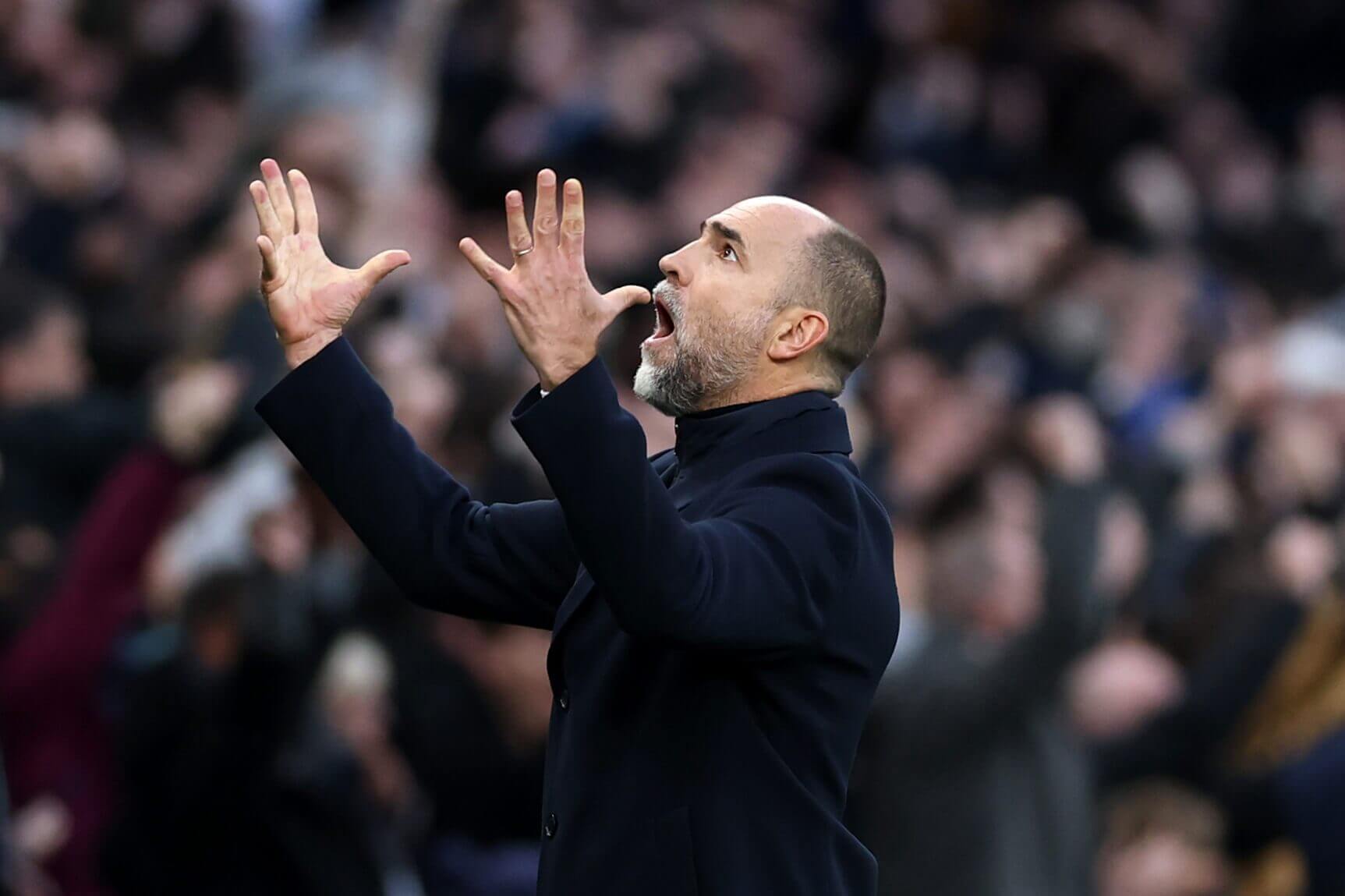
Tottenham have fallen even further since Igor Tudor took charge (Justin Setterfield/Getty Images)
No one is disputing that the attritional nature of Premier League football has made an impact on Tottenham but if you build a core around injury-prone and ill-disciplined players and then hand them over to someone with no experience of the Premier League at the recommendation of a sporting director who has since left, well, what do you expect?
Tottenham’s fate is not indicative of too much hard running in the Premier League; it is indicative of the disastrous running of Tottenham as a football club.
As for Liverpool, their 1-0 defeat at Galatasaray is the most recoverable of the losses English teams sustained this week.
Twenty-two points worse off in the league than at this stage last season and at risk of missing out on Champions League qualification, it is still remarkable that Liverpool lost by the same scoreline against the same opponents in September when they were, theoretically, fresher and only one game removed from (an admittedly unconvincing) seven-game winning streak.
Perhaps it is a bad match-up in a uniquely hostile environment, but you would have thought that September’s experience would have prepared Liverpool.
This is still a Galatasaray team with Davinson Sanchez at the back and Mario Lemina and Lucas Torreira in midfield.
Victor Osimhen was available in the summer for almost half the price Liverpool ultimately paid for Alexander Isak, after already signing Hugo Ekitike as part of a record transfer spend approaching half a billion euros.
Some of that was lavished on talent from Bayer Leverkusen, who cashed checks worth €165m for Florian Wirtz and Jeremie Frimpong from Liverpool. Weaker because of it, Liverpool, in some respects, did Leverkusen’s opponents, Arsenal, a favour.
This is not the Leverkusen that went undefeated in the league the season before last.
Alonso left in the summer and Leverkusen quickly recognised their mistake in replacing him with Erik ten Hag.
It is a team in transition and, as such, few people gave them a chance against an Arsenal team that made 10(!) changes from the weekend’s 2-1 win at Mansfield when their B team featured the world’s most expensive goalkeeper ever and Kai Havertz, another player Leverkusen sold to the Premier League for €100m (both those headline fees for Kepa Arrizabalaga and Havertz were paid by Chelsea)
Hoisted by their own petard, Arsenal fell behind to a set piece but Havertz levelled with a softly awarded penalty late on.
Inevitably, calls for a winter break have been voiced again, as if a league with more than double the resources of its rivals needs more help.
The wealth gap has never been greater, to the extent Liverpool can bookmark a talent such as Jeremy Jacquet for next season in a £60m deal, but the past week has been as much about inefficiencies in squad building as legginess. Premier League teams can stockpile players like never before. They have not made it count. Money has been misspent. Record transfer windows have inexplicably led to imbalances, making expensively assembled squads look embarrassingly thin.
The people who should be as jaded as the players are the owners, who must tire of excuses from sporting directors and managers about the limited results all this capital expenditure is delivering. Fatigue is a factor. But the money is there to mitigate it like never before and it has been frittered away.
All in all, we should be tired of fatigue being the one all-encompassing excuse for bad nights in Europe.