
Yes, it required a double-take.
After Nick Schmaltz removed himself from the already thin July 1 free-agent market with his contract extension with the Utah Mammoth on Wednesday, I glanced at the remaining pending UFA class.
As of Thursday morning, your leading point-getter among pending UFA players was … drumroll … Darren Raddysh!
Good for Raddysh, an undrafted defenseman who has shown great determination in sticking with it and who, at age 30, is putting up a career-best NHL season, making the most of the best opportunity he’s had. It’s another example of how the Tampa Bay Lightning keep pushing their championship window open by finding gems in places other teams aren’t looking.
And given his current $975,000 salary-cap hit, his next contract is going to look a lot different, whether it’s in Tampa or elsewhere. I’m told there have been general discussions to date between the parties but nothing serious yet. We’ll see whether Lightning GM Julien BriseBois decides to try right before the playoffs — when extensions sometimes happen — or waits until after the postseason is over. He told media in Tampa during his midseason availability in January that he wanted a bigger sample size before diving into extension talks.
“I think we’re going to wait,” BriseBois said on Jan. 8, “not because it’s going to be a life-changing contract but because you look at his play the first year with us, his play last year, his play at the start of season, his play now — I’m going to need a bigger sample size to know exactly how to value that going forward. I think ultimately that’s what it comes down to. I don’t know what that dollar sign looks like. I know I want the player to stay here. We love the guy. He bleeds blue, and he’s helping us win.’’
Either way, Raddysh will finally get paid, there or elsewhere, and it’s a nice story.
But, and I say this with total respect to Raddysh, the fact that on Thursday morning, he was the leading scoring of the 2026 pending UFA July 1 class pretty much sums up the situation.
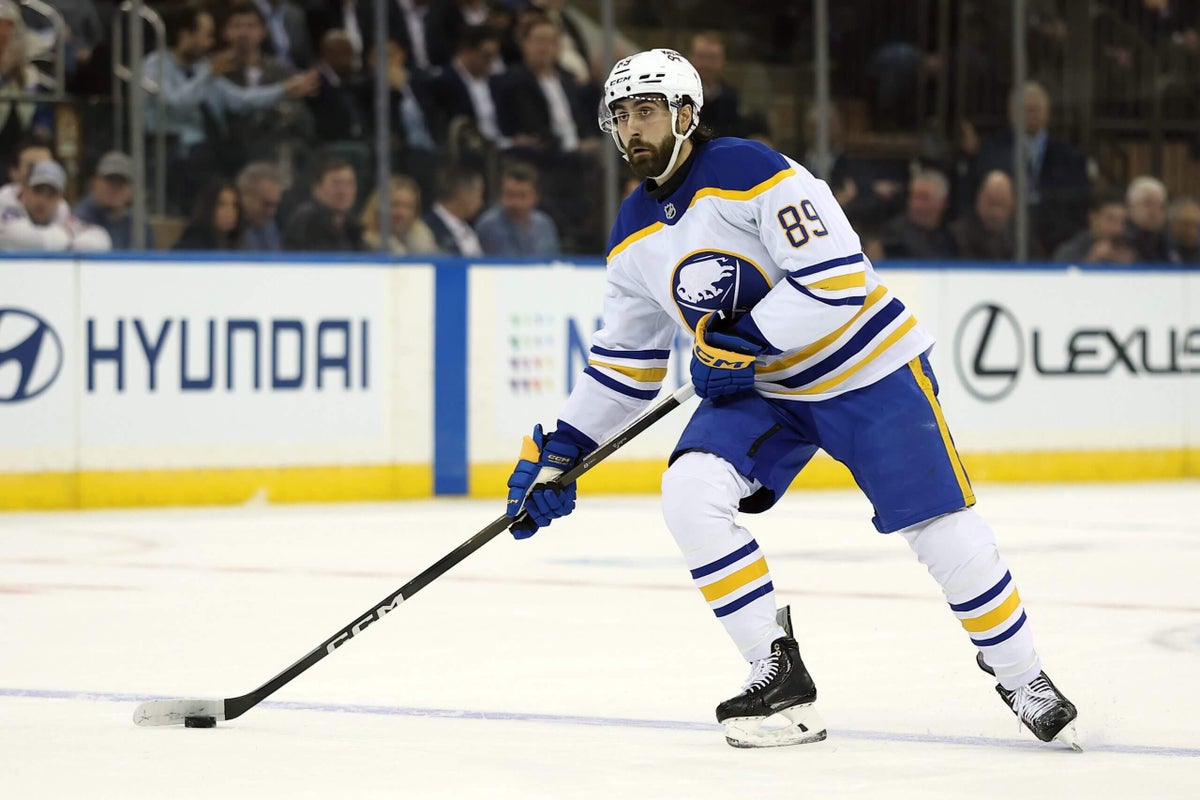
Just one point behind was Alex Tuch of the Buffalo Sabres, and he’s the biggest pending UFA remaining in the class. The escalating salary cap and recent contract comparables (Adrian Kempe, eight years, $10.63 million AAV) allow him, with justification, to ask for a double-digit salary in his next deal. And league sources confirm that Tuch’s camp has done just that. On the other hand, Schmaltz’s eight-year, $64 million deal actually helps the Sabres on the Tuch front. The players have similar numbers this season and it’s clear Schmaltz took a bit less on the AAV to stay in Utah (although he could only get seven years on the open market, not eight. So the total dollars matter, too.
But I would imagine the Sabres are going back to Tuch’s camp, led by the Bartlett family, saying, “Sure, Kempe is a comparable, but so is Schmaltz.”
So a Tuch extension in Buffalo, perhaps, could land somewhere between $8 million and $10.63 million AAV.
The difference in the Kempe and Schmaltz extensions is that the Kings were over a barrel with Kempe, given the pending retirement of Anze Kopitar. There’s no way they could afford to lose Kempe as well. And it was clear Schmaltz wanted to stay put in what is becoming an amazing market to play in, in Utah.
And as much as the Sabres want to keep Tuch, and they really do, they’re pretty loaded up front and could pivot if they lose him. They’re not over a barrel like the Kings were.
As for an actual update on the Tuch negotiations, I checked into it on Thursday, and talks have not been shelved yet. There’s still time before the playoffs next month, and the Sabres are still determined to make it work on an extension. We shall see. But at the very least, it’s noteworthy that both sides are still communicating on it and that talks haven’t been shelved yet.
It’s a tough call for Tuch. The Sabres are finally happening; they’re a legit contender after 14 years of hibernation. It’s an amazing market to play in when things are like this. On the flip side, I could definitely see some teams being willing to pay $11 million a year on the open market because the cap is escalating, teams have money to spend and there’s very little offense available on July 1 via UFAs this year.
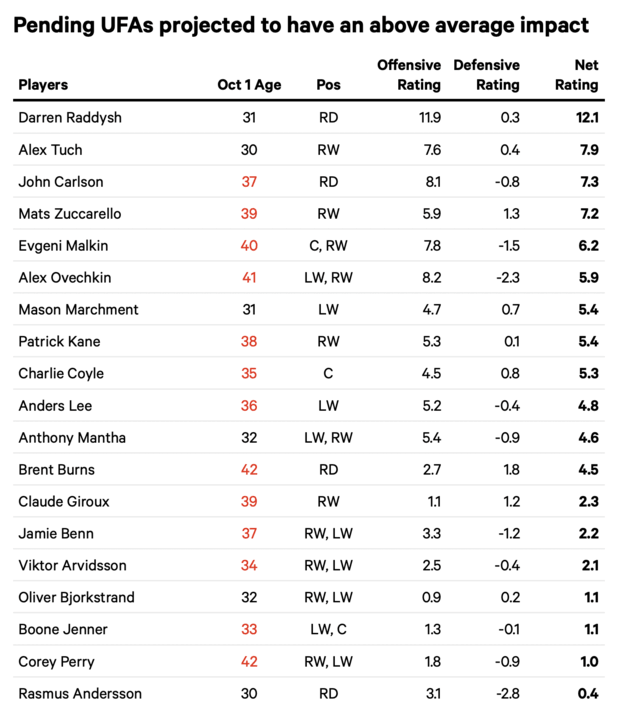
If you look at the list that our stats expert Dom Luszczyszyn put together on the pending UFA class, there certainly aren’t a lot of high-impact guys, and especially not many under age 33.
The pending UFA defense market
As thin as the high-end forward group is, there are still some notable defensemen among pending UFAs (beyond Raddysh), led by John Carlson, Rasmus Andersson and Jacob Trouba. But it’s not a long list, either. And there’s a decent chance neither Carlson nor Andersson will get to market.
When Vegas traded for Andersson on Jan. 18, the assumption was that it wouldn’t be that long before he was signed to an extension, like when Vegas traded for Noah Hanifin two years ago.
But nearly two months after the Andersson trade, he still hasn’t signed an extension.
Here’s what I believe is probably happening: the Golden Knights can’t actually extend him at the moment, per CBA rules. My understanding of the situation is that they currently only have $3.2 million in projected cap space for next season, which includes Alex Pietrangelo’s $8.8 million cap hit. Vegas has the lowest 2026-27 projected cap space available currently among all 32 teams. And clearly an Andersson extension will cost more than $3.2 million per year.
But it’s not a big deal. Eventually, Vegas will obviously be able to put Pietrangelo back on LTIR for next season and, on July 1, the salary cap officially jumps in a big way. Even before then, the Golden Knights could move money out after the season, in May or June, depending on how long they play this spring.
The point is, they will eventually be able to extend Andersson, but they can’t do it right now. That is my understanding of the CBA rules.
Given that Vegas pursued Andersson, all the way back to last June in a failed trade attempt at the time with the Flames, there’s too much history with the player not to have him extended at some point — when they can. Although it must be pointed out, Andersson has so far struggled to find his game in Vegas.
Meanwhile, let’s see where it goes with Carlson. Anaheim did not give up the return that it did for a 36-year-old blueliner with the idea of him being only a rental. My understanding is that the Ducks will eventually approach Carlson’s camp, led by veteran agent Rick Curran, about what an extension looks like. But I also think everyone involved wants to wait until Carlson adjusts to his new surroundings and his family comes out and gets a sense of Anaheim, etc. There’s still a month to go in the regular season, so there’s lots of time still for a contract conversation before the playoffs start. But even if it waits until after the playoffs, there’s also lots of time before July 1.
If I had to guess, a two-year extension would make sense, and I think it would be $8 million to $9 million per year based on the impact Carlson still has. But again, the Ducks will wait for a while before diving in on that potential negotiation.
League decision on Ottawa
The NHL withheld further comment on its decision Thursday to give Ottawa the No. 32 pick in this June’s draft, rescinding its previous decision to force the Senators to forfeit a first-round pick for their mishandling of the Evgenii Dadonov no-trade list — and the eventual nixed trade between Vegas and Anaheim four years ago (Ottawa didn’t provide Vegas with Dadonov’s no-trade list when trading him to Vegas in 2021).
In its statement Thursday, the league pointed to the Senators having changed ownership and management since the Dadonov situation occurred. My understanding is that the league also sees some similarities here to how it changed its mind with the New Jersey Devils and their penalties for signing Ilya Kovalchuk in July 2010 to a 17-year contract — which the league felt at the time circumvented the CBA. In 2014, the Devils got a first-round pick back as the league reduced the original penalties, which also included a $3 million fine that was cut in half. The similarity here is that the Devils also had an ownership change after the Kovalchuk contract controversy.
The Arizona Coyotes, in 2020, got nailed by the NHL for testing draft prospects outside of the combine event. The Coyotes forfeited a 2020 second-round pick and a 2021 first-round pick and the league never altered its decision. The Coyotes would have drafted at No. 49 in the second round in 2020 but that pick was voided, as was the No. 11 pick in 2021. The league stood firm. Of note, Alex Meruelo was the Coyotes’ owner from 2019-24, so there was no ownership change between the time of the infraction and the draft pick forfeiture. I suppose had Ryan Smith bought the team and relocated it before the 2021 draft, Utah could have applied for leniency. But Smith didn’t enter the picture until 2024.
What’s telling is that Senators owner Michael Andlauer toned down his comments regarding this issue over the past year, as compared to his angry remarks when the original ruling came down. And the reason for that is obvious. Behind the scenes, Andlauer was hoping he was making headway with commissioner Gary Bettman and deputy commissioner Bill Daly, and no longer wanted to rock the boat publicly in case there was a chance the league would soften the blow. Good call by Andlauer. The softer approach won out.
Draft combine
Funny little story about the draft combine, which again will be held in Buffalo, from May 31 to June 6.
People at the NHL office have realized that logistics could be more difficult at the combine if the Sabres are still in the playoffs, which is very much a possibility. The Eastern Conference final would still be going on in late May, and the Stanley Cup Final is tentatively scheduled for to start on June 4, although that is subject to change depending on how the long the previous rounds go. Point being, there’s very much a world in which the Sabres are still playing while much of the hockey world and prospects descend on Buffalo for the draft combine at the same time.
The NHL is trying to make sure it has all those logistics figured out, because the hotels and events are held next door to the Sabres’ arena, so it’s all about sharing the same footprint, more or less. The league has determined that moving the combine is not an option. Because teams have booked for Buffalo, it’s set in stone.