
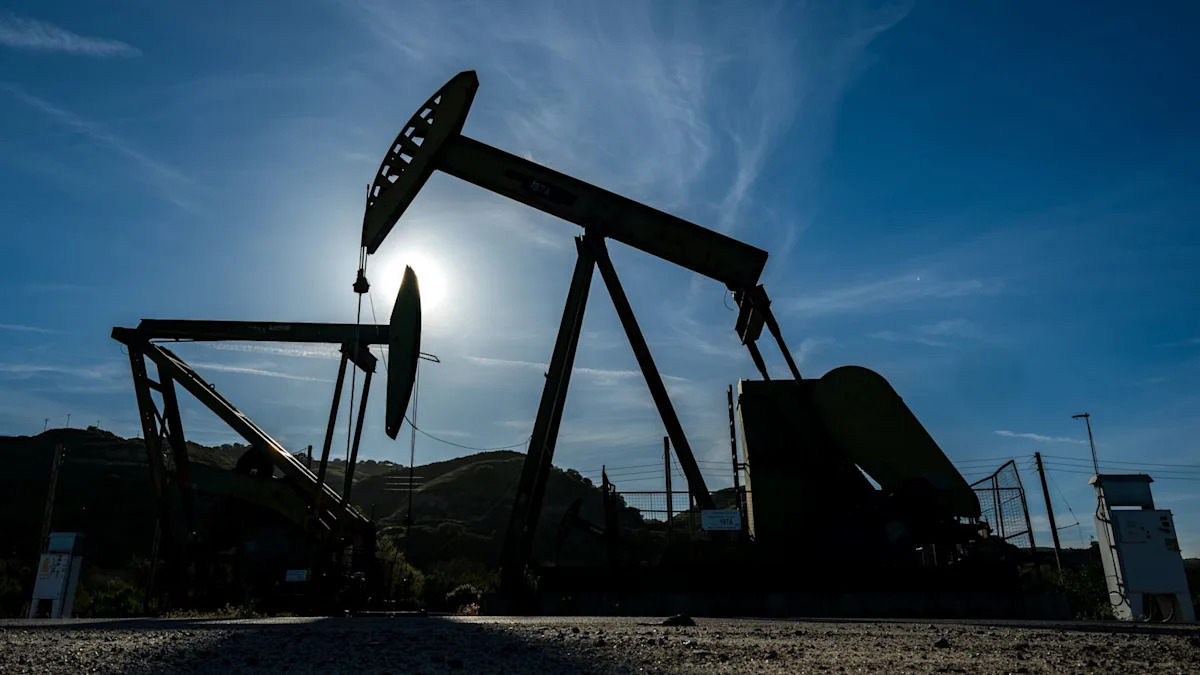
A prominent Wall Street bank has warned the continued closure of the Strait of Hormuz will have a significant economic impact across multiple sectors, as ITV News Economics Editor Joel Hills reports
US President Donald Trump has publicly dismissed concerns about rising fuel prices since the conflict began.
Higher oil prices, he said, are “a very small price” to pay for the increased security that Operation Epic Fury will deliver for ordinary Americans.
But tonight a prominent Wall Street bank has warned that the economic impact of the closure of the Strait of Hormuz – a vital shipping lane for oil and gas – could intensify dramatically in the coming days as shortages emerge.
In a research note published on Friday evening, Natasha Kaneva, head of commodities research at JPMorgan Chase, wrote: “By the end of next week, we expect crude supply cuts to approach 12 million barrels per day, making the deficit highly visible across physical markets.”
Subscribe free to our weekly newsletter for exclusive and original coverage from ITV News. Direct to your inbox every Friday morning.
That is an enormous amount of oil to disappear. For context, the world normally consumes around 100 million barrels a day.
The JPMorgan note adds: “The market is facing an acute shortage of products – diesel, jet fuel, LPG and naphtha – that cannot be consumed simply because they are not available.”
In plain English: the problem isn’t just oil prices. The world is running short of the fuels that power cars, lorries, aircraft, factories and farms.
The first visible effects of the shock are already appearing in Asian countries that depend heavily on energy exports from the Gulf.
Four-day weeks and driving limits: How the world reacts to Iran oil crisis
India, Bangladesh, Sri Lanka and Vietnam are already rationing fuel or preparing emergency measures.
Airlines in Australia have raised airfares, while Air New Zealand has begun cancelling flights.
“We have never been in this situation before,” Neil Atkinson, the former head of oil markets at the International Energy Agency, told ITV News
Neil Atkinson, the former head of oil markets at the International Energy Agency (IEA), describes the Strait of Hormuz as the “single most important choke point in global shipping” – even more critical than the Suez Canal.
In an interview with ITV News, he explained that the IEA used to run war-game scenarios simulating major disruptions to oil supply.
But they never seriously considered the Strait of Hormuz closing.
It was considered unthinkable because of the shortages it would create.
The war in the Gulf Britain can’t escape
The release of 400 million barrels of oil is not enough to end the energy crisis
“We have never been in this situation before. We’ve had interruptions to oil and gas supply in the past – the Iranian revolution in 1979, the first Gulf War in 1990, the invasion of Iraq in 2003, Russia’s invasion of Ukraine four years ago,” Atkinson said.
“Not one of them comes close to what is actually happening today in the Strait of Hormuz.”
President Trump is right when he argues that the United States is less exposed to the energy shock because it is the world’s largest producer of oil.
But America consumes a lot of oil too, and petrol prices and airfares are rising there too.
If JPMorgan is right, the economic damage the war is causing is about to move up a gear.
From Westminster to Washington DC – our political experts are across all the latest key talking points. Listen to the latest episode below…