
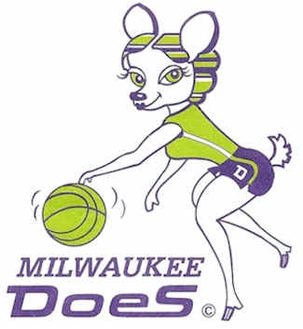
Milwaukee served as the starting point for the first professional basketball league for women. On December 9, 1978, the Milwaukee Does of the Women’s Professional Basketball League (typically abbreviated WBL) hosted the Chicago Hustle on opening night at MECCA. A crowd of 7,824 watched the Does erase a 13- point fourth quarter deficit before falling to Chicago, 92-87. NBC, CBS and ABC were all on hand to cover the game as well as a number of major print media outlets.
The Does played two seasons in the WBL [1978-1980]. They disbanded before the 1980-1981 season, which proved to be the league’s finale. Just three franchises survived all three seasons of the WPBL—Chicago, New Jersey, and Minnesota. While the Does and the WBL proved short lived, they helped open the door for the vibrant women’s professional game of today.
In 2026, women’s basketball draws large crowds at the collegiate level and in the WNBA. Fans fill arenas across the country to see Caitlin Clark play for the Indiana Fever. The NCAA Women’s Basketball Final Four now draws televised audiences that compete with the men’s games. This was far from the case during the 1970s when the mere idea of women’s team sports was just starting to emerge. Title IX kickstarted the process. The 1972 federal civil rights law banned sex-based discrimination in public educational institutions. It served as a springboard for women’s college athletics and basketball became the most prominent women’s intercollegiate sport. In subsequent years, the National women’s college basketball championship was televised, introducing viewers to previously little-known colleges like Immaculata (Pennsylvania) and Delta State (Mississippi). Women’s basketball gained further exposure at the 1976 Summer Olympics in Montreal, where the United States won a silver medal in the inaugural women’s Olympic basketball tournament.
Bucks and Does
The WBL and the Milwaukee Does emerged in the aftermath of the Montreal Olympics. A Milwaukee contractor and basketball enthusiast named Robert Peters paid $50,000 for a WBL franchise, which he named the Milwaukee Does, a play on the moniker of the NBA’s Milwaukee Bucks. Peters adopted a sexualized Doe logo for the team, which wore lipstick, a tight-fitting outfit, and had an hourglass figure. Little else in the team’s marketing adopted this suggestive approach. Peters rented out the Mecca for the team’s home games and hired a business associate named Gene DeLisle as general manager.
 Stay on top of the news of the day
Subscribe to our free, daily e-newsletter to get Milwaukee’s latest local news, restaurants, music, arts and entertainment and events delivered right to your inbox every weekday, plus a bonus Week in Review email on Saturdays.
Delisle built a roster that proved decidedly uncompetitive in the WBL. In both of the Does’ seasons, the team featured one of the league’s best players. In 1978-1979, the Does featured former Michigan State star Kathy DeBoer, who was one of the league’s leading scorers. In 1979-1980, the Does boasted former Western Kentucky great Brenda Chapman, who was also one of the league’s elite performers. Nevertheless, the Does could never quite put it together as a team.
The Does finished the 1978-1979 season with an 11-23 record, the second worst in the league. Instability in management made things worse. DeLisle went through five coaches in the first season, including himself.
Financial Troubles
By midway through the team’s first season, its financial troubles were being reported widely in Wisconsin newspapers. Apparently, Peters sought out a loan from the Small Business Administration to keep his team afloat. After a great opening night, attendance decreased considerably. For the season, the Does drew an average of 1,872 fans, which was above the league average of 1,500. Beyond the sparse attendance, the players caught wind of Peters’ financial struggles as well.
Initially, the team flew to games and stayed in nice hotels. Such niceties disappeared as the ownership’s financial fortunes waned. After the first season, Peters and DeLisle were gone in favor of a new ownership group.
For the 1979-1980 season, the Does made a splash by hiring former Milwaukee Bucks coach Larry Costello. As a player, Costello made six all-star games, serving as the point guard for some excellent Philadelphia Warriors and Philadelphia 76ers teams. In 1968, Costello became the first coach of the expansion Bucks, whom he led to four divisional titles and an NBA championship in 1971. Costello’s tenure with the Does was less successful. The team performed no better in 1979-1980 than they had the previous winter. Costello quit in February after going two months without a paycheck. The players, too, went unpaid but forged on in pursuit of their professional basketball dreams.
Last Place
Assistant coach Julia Yeater took over for the remainder of the season. The Does finished the season at 10-24 for their second consecutive last place finish in their division.
After the 1979-1980 season, a new ownership group rechristened the team as the “Milwaukee Express” but never played a game under the new moniker. New owner Arthur Howell told the Associated Press that “we had asked for a market analysis to see in what direction the franchise was headed, and most of the reports were negative.”
The management troubles experienced by the Does were not uncommon in the fledgling pro league. The combination of inexperienced team ownership and a public that seemed not ready for women’s pro basketball led to the WBL’s demise.
Unfortunately, Milwaukee has yet to return to the major leagues of women’s professional basketball. Nevertheless, the Does and their colleagues in the WBL helped form the foundation of what has become a vibrant landscape for women’s basketball.